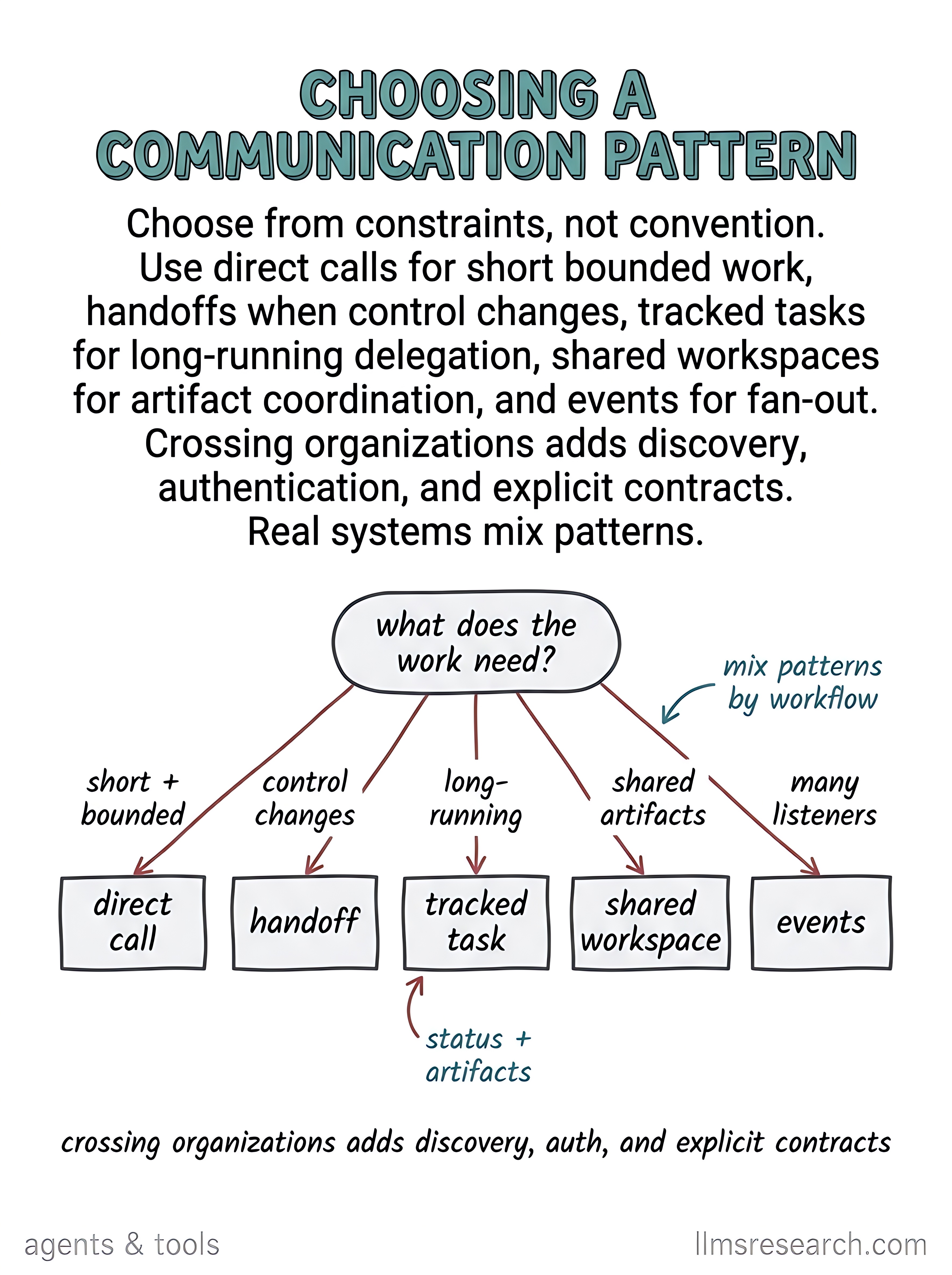
The card shows a hand-sketched decision tree starting at a pill labeled what does the work need? Five branches lead to outcome boxes: direct call, handoff, tracked task, shared workspace, and events. Beside each branch is a criterion: short plus bounded, control changes, long-running, shared artifacts, and many listeners. Callouts mark tracked task with status plus artifacts and the whole tree with mix patterns by workflow. The bottom line reads crossing organizations adds discovery, auth, and explicit contracts.
The tree is a selection guide, not a maturity ladder. Direct calls suit quick questions or tool-like helpers with stable inputs and outputs. Handoffs fit when the user should speak next to a different specialist and you can pass a scoped packet. Tracked tasks fit remote work that spans minutes or hours, may pause for input or auth, and returns artifacts with a visible lifecycle. Shared workspaces fit parallel editors working on the same draft or task board with explicit concurrency rules. Events fit when one fact should notify many downstream agents or services without naming each recipient upfront.
Choosing A2A or any protocol does not remove coordination decisions. It adds discovery through Agent Cards, authentication requirements, and explicit message and task types at the boundaries. Architecture layers for coordination, state, protocol, and transport remain useful vocabulary even after you pick a pattern. Team topology surveys describe who exists; this card asks what the work needs.
Start from duration, who owns the next user turn, whether artifacts are shared, and how many listeners react. Choose a contract for each boundary, then combine those contracts into the workflow. When agents cross organizations, budget extra work for capability discovery, credential exchange, and contract tests rather than assuming one pattern fits every hop.