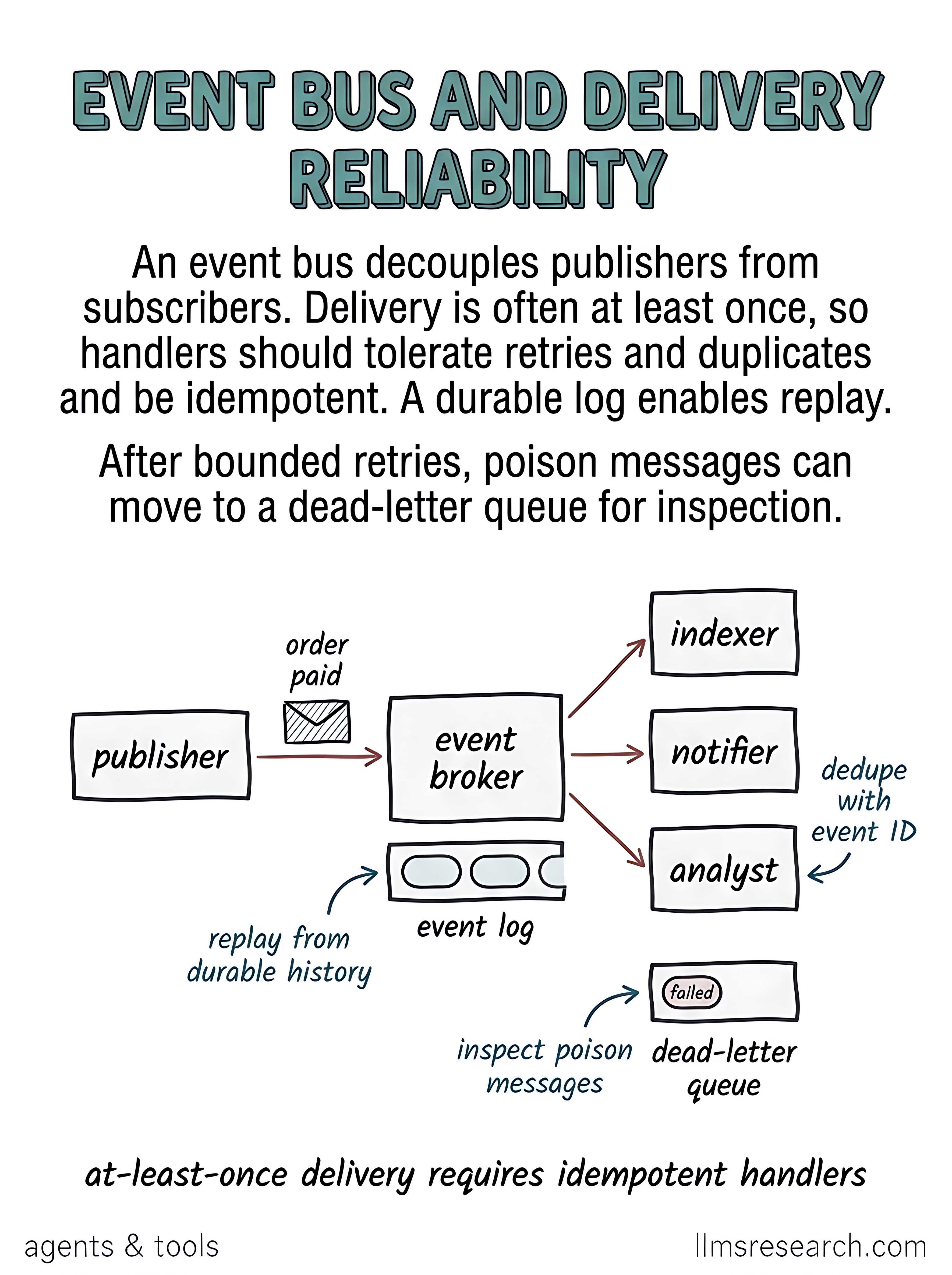
The card sketches publish-subscribe flow without large panels. A publisher sends a hatched envelope labeled order paid along a red arrow to a central event broker. Three red arrows fan out to indexer, notifier, and analyst. Under the broker is a strip labeled event log with two event pills. To the lower right, a dead-letter queue box holds one failed event pill. Callouts point to the log for replay from durable history, to a subscriber for dedupe with event ID, and to the dead-letter queue for inspect poison messages. The bottom line reads at-least-once delivery requires idempotent handlers.
An event bus lets producers emit facts without enumerating consumers. That loose coupling scales to many listeners, but broker semantics matter. Many systems guarantee at-least-once delivery: a message may arrive more than once if a worker crashes after handling but before acknowledgment. Handlers should deduplicate on a stable event identifier and be idempotent so repeated processing does not double charge or double index. A durable log retains history for replay after outages or when adding a new consumer that needs a backlog. When a message fails processing after bounded retries, often because of a bad payload or code bug, moving it to a dead-letter queue isolates poison traffic so operators can inspect without blocking the whole topic.
This card covers broker delivery semantics, not the introductory contrast of events versus direct calls. It does not claim universal exactly-once delivery, global ordering across all subscribers, or automatic repair simply because a message reached a dead-letter queue. Those properties depend on the product and must be designed explicitly if needed.
Apply these patterns when agent workflows fan out side effects to search indexes, notifications, analytics, or other agents. Assign unique event IDs, record processing checkpoints, make side effects safe to repeat, and alert on dead-letter growth. Treat event consumption like tool execution at a trust boundary: validate payloads before acting.