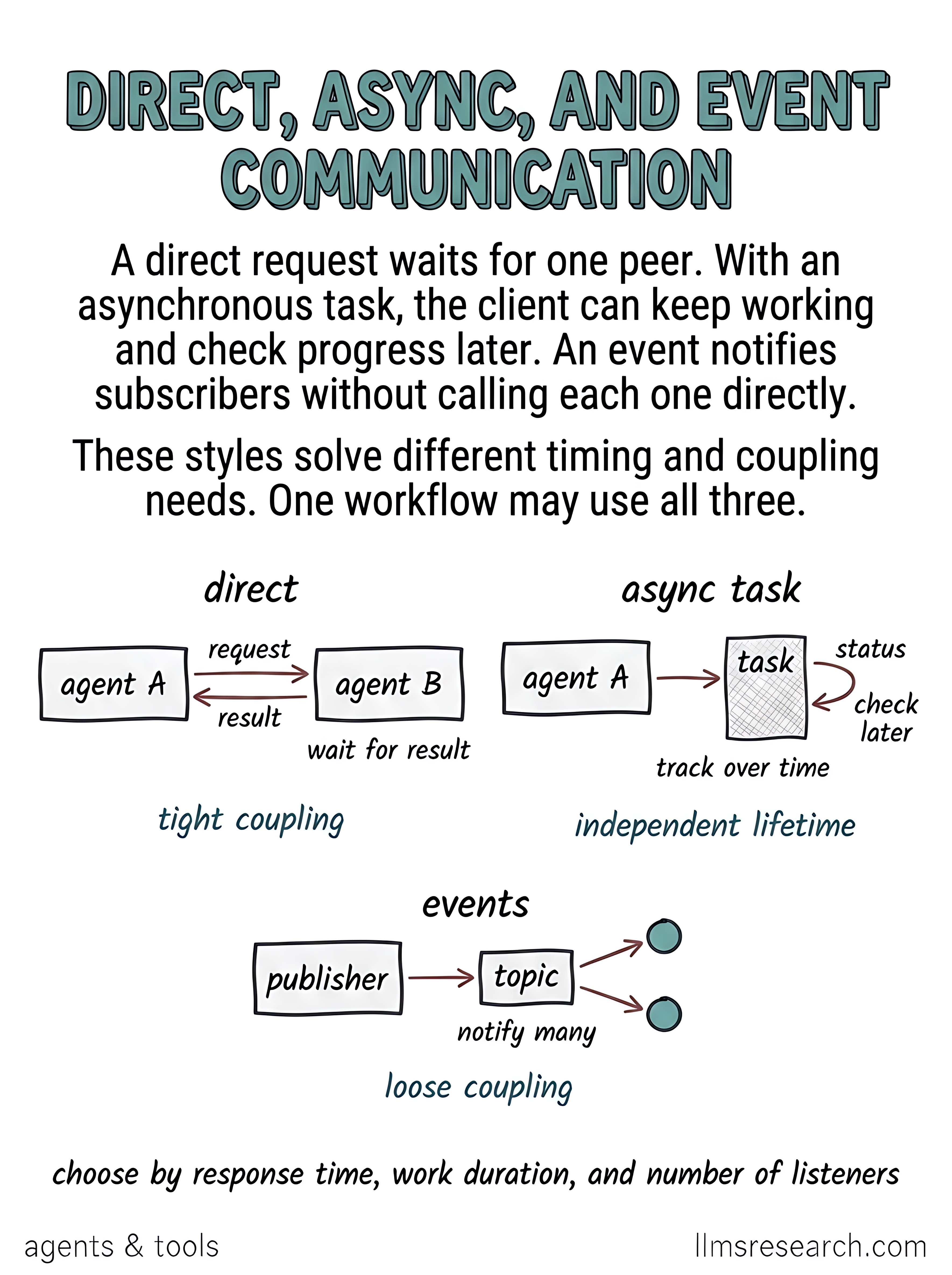
The card places three small sketches side by side. On the left, direct communication shows agent A sending a request to agent B and waiting for a result, labeled wait for result, with a callout for tight coupling. In the middle, async task shows agent A sending a hatched task card while a separate arrow returns status later, labeled track over time, with independent lifetime. On the right, events show a publisher sending to a topic while two subscribers receive fan-out, labeled notify many, with loose coupling. A line below reads choose by response time, work duration, and number of listeners.
Direct calls fit when the caller needs an answer before it can continue and when the work fits one round trip. The caller blocks on the peer, which keeps the contract simple but binds lifetimes together. Asynchronous tasks fit when work outlasts a single HTTP request or when the client should keep doing other things while a remote agent progresses. The client holds a task identifier and checks status or receives callbacks rather than holding a connection open. Events fit when one state change should wake many consumers without the publisher knowing their names, such as notifying an indexer, a notifier, and an analyst that an order was paid.
These are interaction styles at a high level, not a catalog of A2A RPC method names or broker internals. Delivery retries, deduplication, and poison-message handling belong on a separate card. Architecture layers for coordination, state, protocol, and transport are also separate. The comparison here is timing and coupling: how long the caller waits, how independent the work lifetime is, and how many listeners must react.
Choose direct calls for short bounded questions. Choose async tasks when work is long-running or may need input mid-flight. Choose events when many agents or services should react to the same fact. One workflow may open with a direct planning call, delegate an async task to a specialist, and publish an event when the artifact lands so downstream jobs can start without tight coupling.