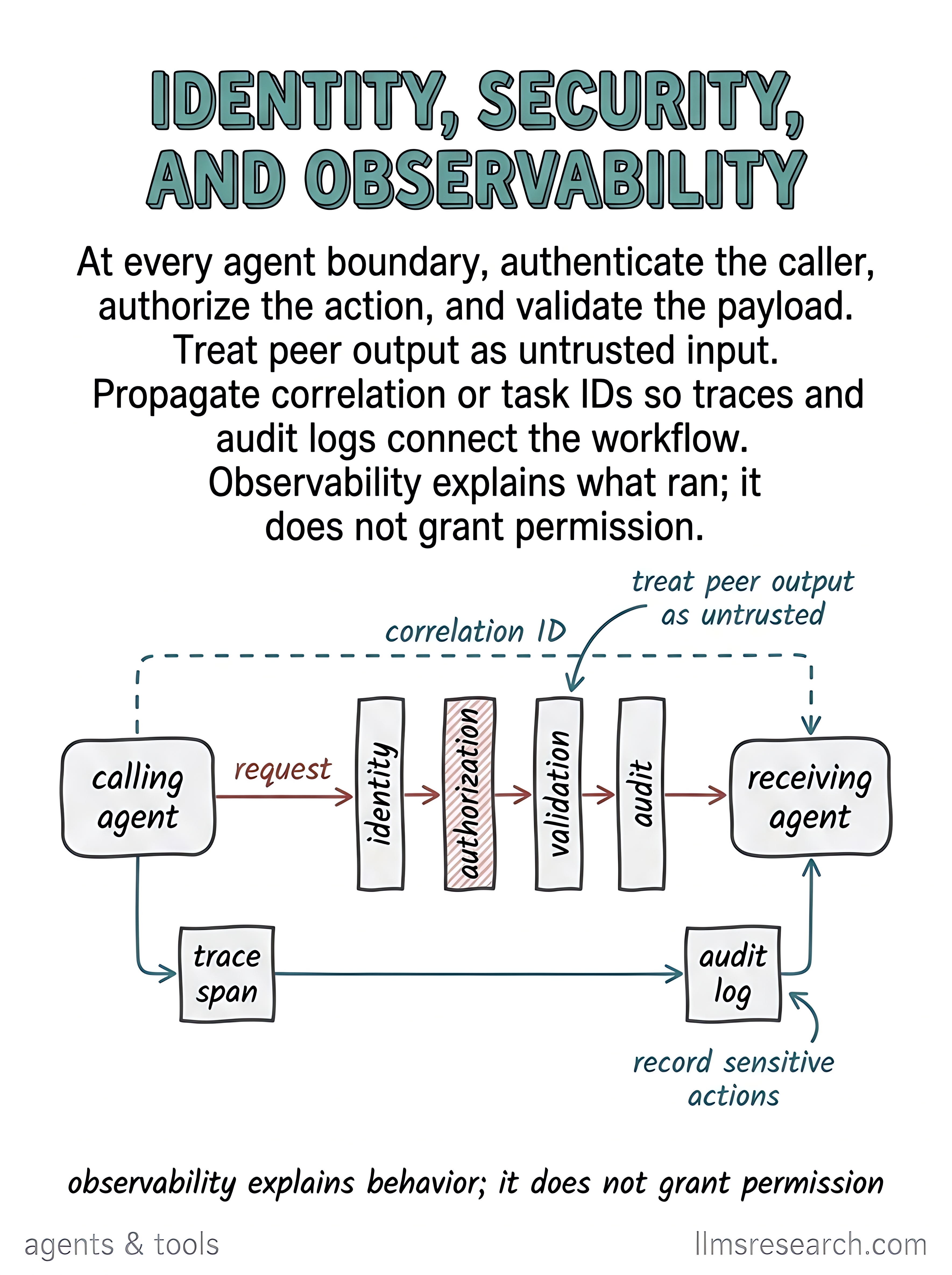
The card draws a horizontal request path from calling agent to receiving agent. A red arrow labeled request passes through four gate markers: identity, authorization, validation, and audit. Authorization alone is hatched. Above the path, a dashed teal correlation ID line links caller and receiver. Below sit trace span and audit log boxes connected to that line. Callouts mark validation as treat peer output as untrusted and audit log as record sensitive actions. The bottom line reads observability explains behavior; it does not grant permission.
Cross-agent traffic needs the same discipline as external API calls. Identity establishes which agent or service principal is speaking. Authorization checks whether that principal may invoke the operation on the target resource. Validation inspects schema, size limits, and content policy on incoming Messages, Parts, Artifacts, and tool results. Peer output is untrusted input: another agent can be compromised, misconfigured, or hallucinating structured fields. Parsing alone is not safety. Propagate correlation or task identifiers so distributed traces and audit logs line up across hops. Traces help debug latency and failure; audit logs record sensitive actions for later review.
This complements human approval gates and sandboxing cards rather than replacing them. TLS protects a connection. A task ID links records for the same work. A verified Agent Card signature can show that the card was not altered. None of these proves that an agent’s claims are truthful or safe to execute blindly. Observability makes incidents diagnosable; it does not substitute for deny-by-default permissions on tools and data.
Implement gates in infrastructure the model cannot bypass. Authenticate at connect using schemes advertised on the Agent Card, authorize per operation, validate before side effects, and log decisions with correlation IDs shared across services. Monitor anomalous cross-agent traffic the same way you monitor prompt injection in retrieved content, because delegated work can carry hostile text inside apparently valid envelopes.