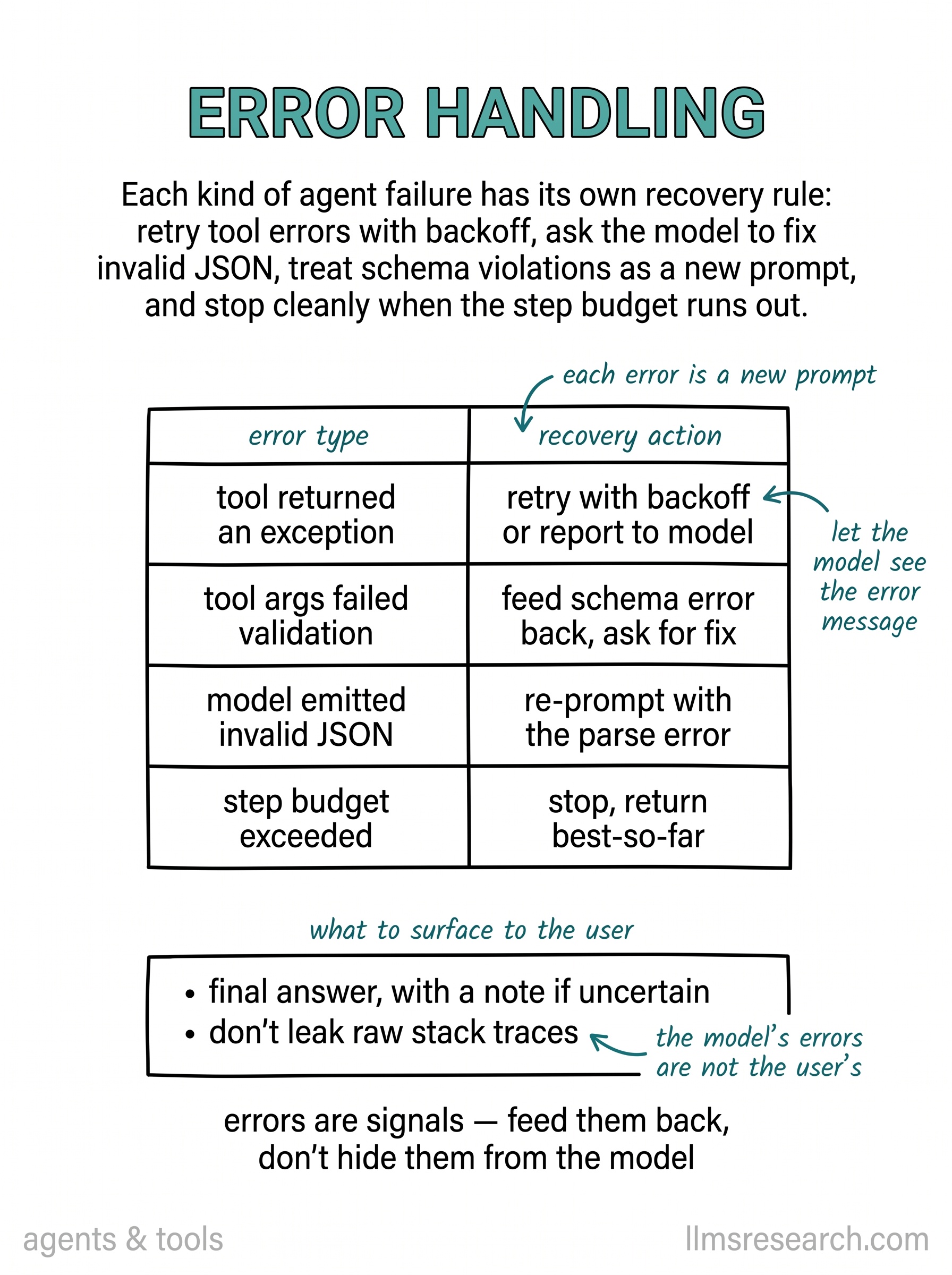
The card is a dispatch chart. Four failure categories each map to a recovery action. Transient errors, timeouts, rate limits, get a retry with backoff. Malformed tool calls or schema violations trigger a re-prompt so the model can correct its output. Logical mistakes, wrong tool choice, misread observation, route to plan revision or a reflection step. Hard stops, budget exhausted, permission denied, unrecoverable tool failure, exit the loop and surface a clear status to the user. A one-line note at the bottom says what to show the user: what failed, what was tried, and what they can do next.
Agents fail often and in boring ways. Treating every exception as a generic “error occurred” gives the model nothing to recover from and gives the user no trust in the system. Feeding structured error messages back into the loop (“tool X returned 404, available IDs are …”) turns failures into observations the agent can act on, the same way ReAct intends.
The category matters because recovery strategies differ. Retrying a 503 from an API is reasonable; retrying the same wrong SQL ten times is not. Detecting repeated identical tool calls is a loop-detection problem, not a transient error. Permission failures should not be retried silently; they need escalation or a user prompt. Mapping errors to actions in code keeps the model from improvising unsafe fixes.
What to surface to the user is a product decision as much as an engineering one. Internal loops can retry quietly when the stakes are low. High-impact actions should report partial progress before aborting. Logs for operators should contain full traces; messages for end users should be short and actionable. Error handling sits between the agent loop and stopping conditions: it decides whether to continue, branch, or halt, and it sets the quality bar for how failures feel when autonomy meets the real world.