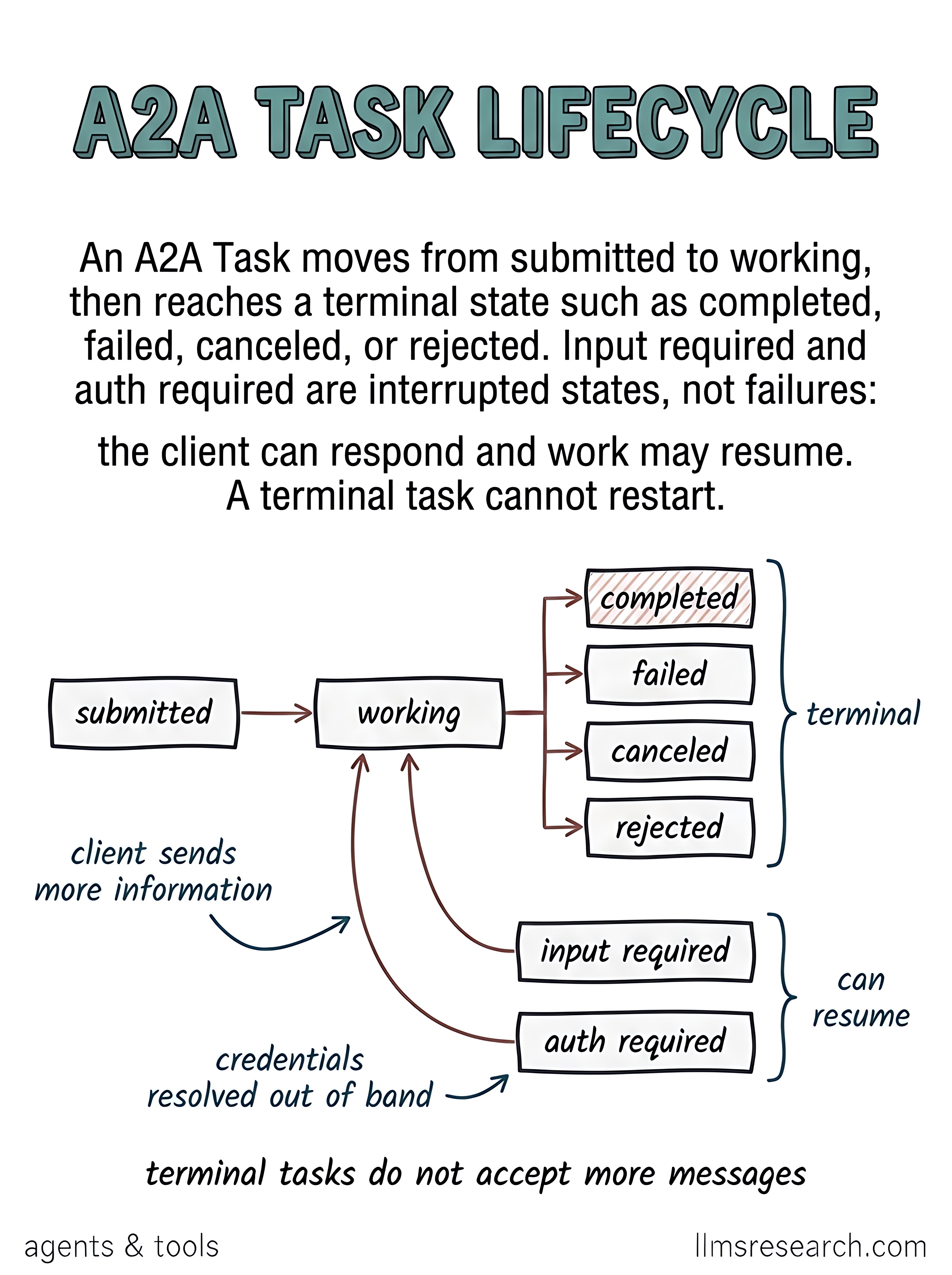
The card shows a state flow in small pills connected by red arrows. Work begins at submitted and moves to working. From working, a branch right reaches a terminal cluster: completed, failed, canceled, and rejected, grouped under a teal bracket labeled terminal. Completed is hatched. From working, a downward branch reaches input required and auth required, grouped under can resume, with return arrows back to working. Callouts note that input required means the client sends more information and that auth required means credentials resolve out of band. The bottom line states that terminal tasks do not accept more messages.
These display labels correspond to reader-friendly forms of the current A2A TASK_STATE enum. Submitted means the task exists but execution has not started. Working means the remote agent is actively processing. Terminal states close the task: completed with a result, failed with an error, canceled by client action, or rejected because the server refused the work. Input required and auth required are interrupted states, not failures. The client can supply missing fields or complete authentication, after which work may resume at working. Once terminal, the task cannot restart; new work needs a new task.
This external state machine differs from stopping conditions inside one agent loop. A local loop may halt on step budget or repeated actions while an A2A Task may still be working on the server. Conversely, a client loop may keep running while waiting on input required from a remote peer. Clients must respect terminal semantics and stop sending messages to closed tasks.
Design clients to poll, stream, or receive push updates that reflect these states, and to branch UI on interrupted states separately from failures. Treat auth required as a signal to run an out-of-band credential flow, not as a generic error. Log terminal reasons for operators and map them to user-visible outcomes without implying a dead task can be revived.