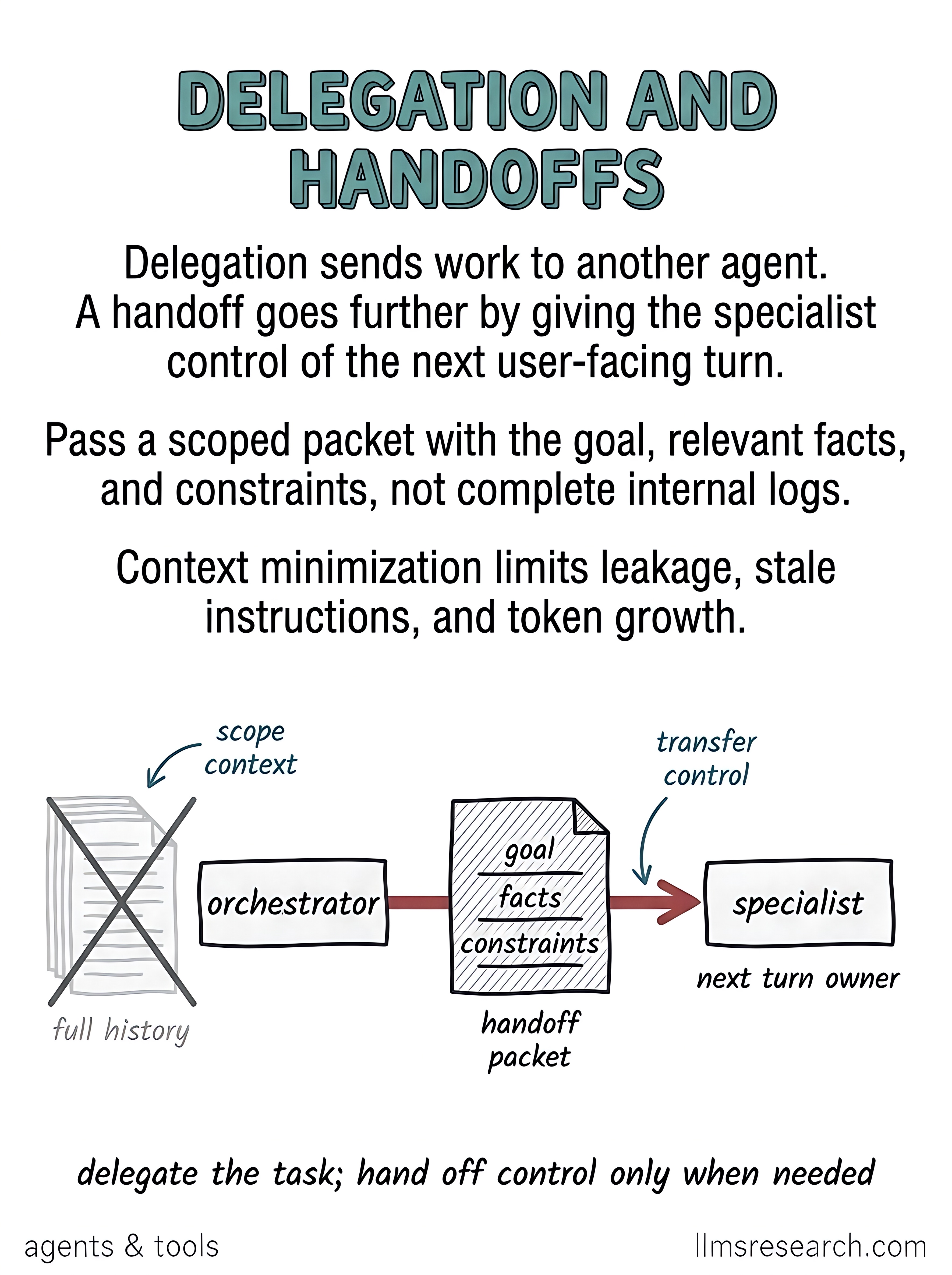
The card draws a left-to-right transfer. An orchestrator on the left sends a red arrow through a hatched handoff packet in the center to a specialist on the right. Inside the packet are three rows: goal, facts, and constraints. Above the arrow is a teal label transfer control. Behind the orchestrator sits a faded stack labeled full history, with a charcoal X blocking it from the arrow and a callout scope context. Below the specialist is plain text next turn owner. The bottom line reads delegate the task; hand off control only when needed.
Delegation assigns work while the orchestrator may still own the conversation. It might call a specialist, receive a result, summarize for the user, and continue. A handoff goes further by making the specialist the next turn owner: the user talks to that agent directly on the following step. Both patterns should pass a scoped packet, not a dump of internal logs. Include the objective, facts the specialist needs, and constraints such as tone, tools, or deadlines. Omit internal reasoning traces, failed attempts, and irrelevant history. Context minimization reduces token cost, stale instructions, and accidental leakage of secrets from one role to another.
This differs from orchestrator-worker setups where a lead agent stays in control while workers return results upstream. It also differs from wrapping a specialist as a bounded tool with a fixed schema. Handoffs change who speaks next; delegation alone may not. The packet is the contract either way.
Use delegation when the orchestrator must synthesize multiple specialists or guard the user experience. Use a handoff when the user should interact directly with the domain expert, such as moving from triage to billing support. Design packets as explicit structured objects you can log and review, and treat handoffs as a deliberate product choice because they are harder to unwind than a single tool result.