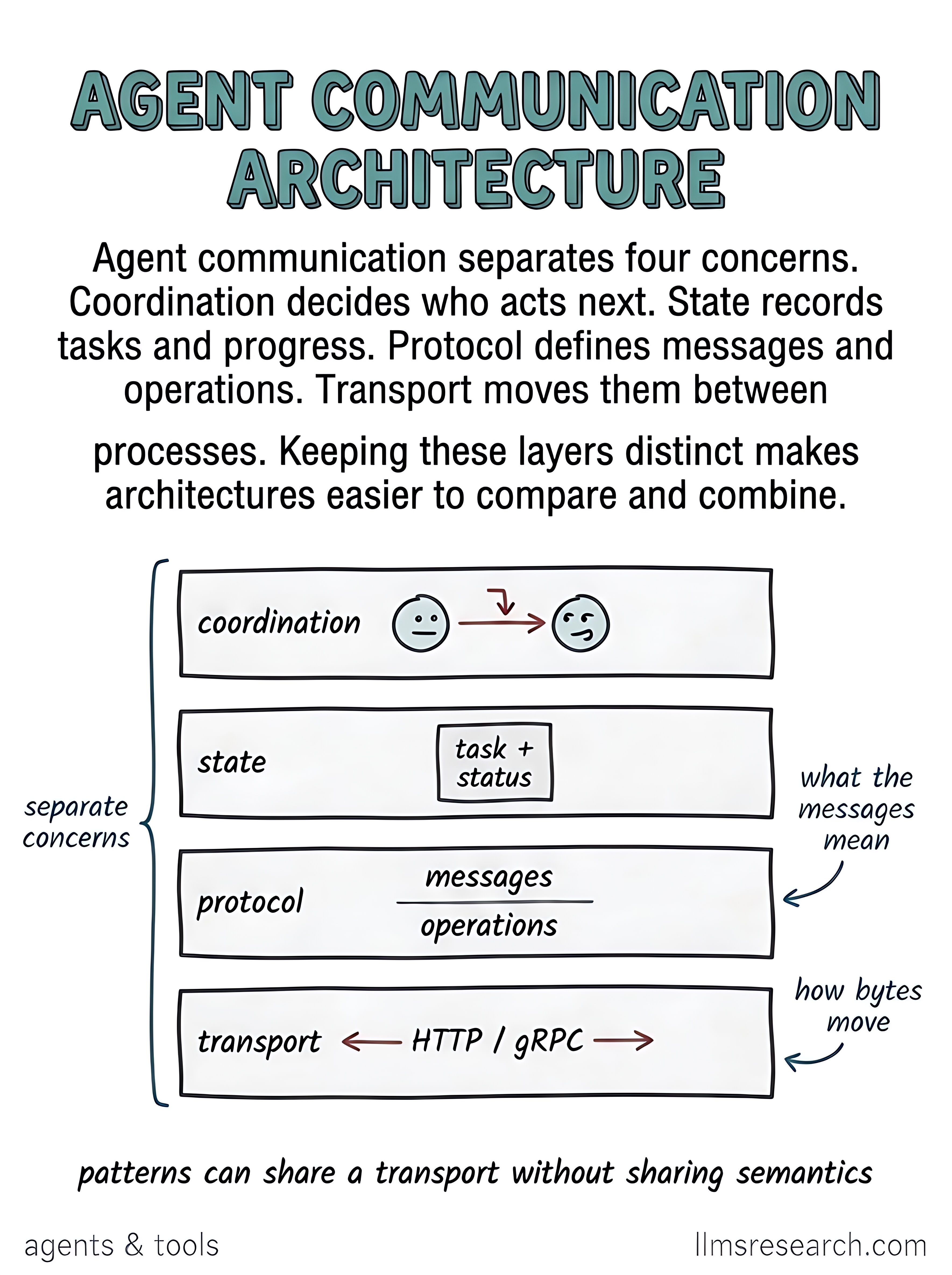
The card stacks four narrow bands from top to bottom: coordination, state, protocol, and transport. Coordination shows two agent nodes with a delegation arrow. State holds a small task card labeled task plus status. Protocol lists messages and operations. Transport shows one connection labeled HTTP or gRPC. A teal bracket on the left spans all four bands with the label separate concerns. Callouts point to protocol for what the messages mean and to transport for how bytes move. A line below reads that patterns can share a transport without sharing semantics.
These four labels are a vocabulary for comparing designs, not a claim that A2A or any other spec names them as normative layers. Coordination is the policy layer: who delegates to whom, when to fan out, when to merge results. State is whatever durable record tracks work in flight, task identifiers, status fields, artifact references, or conversation history scoped to a job. Protocol is the contract for payloads and operations, independent of whether you call them messages, tasks, or tool results. Transport is the wire mechanism, HTTP, gRPC, WebSockets, or a message broker, with no requirement that one transport maps to one protocol.
Keeping the layers distinct makes tradeoffs visible. Two teams can reuse the same HTTP stack while assigning different meanings to their message shapes. Changing transport may still require adapters, but a stable protocol contract limits how much coordination logic must change. Mixing every concern in one module makes failures harder to locate. Network retries and turn ownership, for example, solve different problems. This card complements multi-agent topology surveys; it does not replace MCP server discovery or prescribe a single stack.
Use the stack when documenting or reviewing a system. Ask whether coordination policy is explicit, whether state survives process restarts, whether protocol types are versioned, and whether transport retries could duplicate side effects. Real products often collapse layers in code but still benefit from naming them when debugging cross-agent failures.