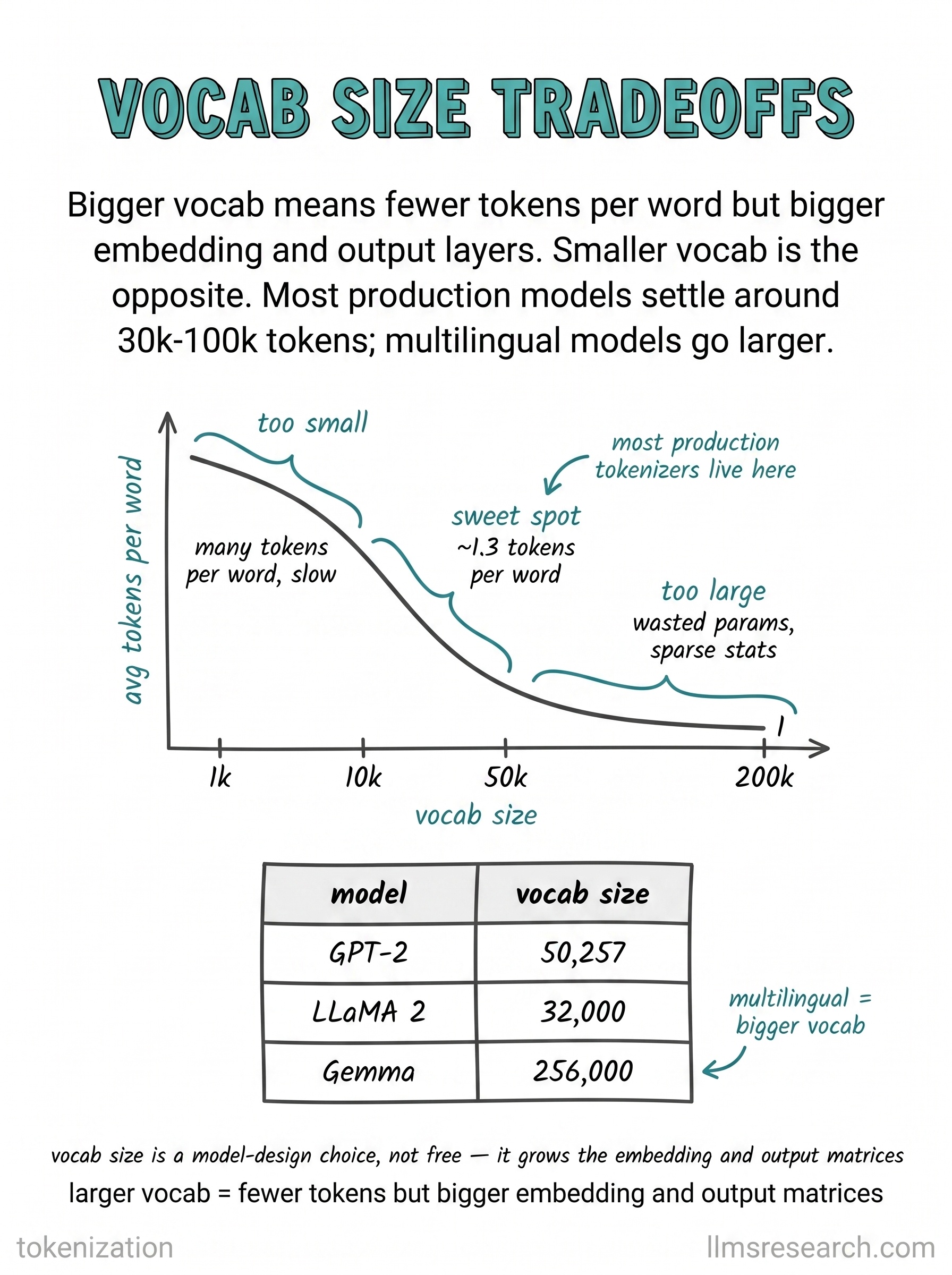
BPE will build a vocabulary of whatever size you ask for, which turns the size itself into a decision. The card plots the one quantity that moves as you change it: the average number of tokens it takes to spell a word.
Read the curve left to right. A small vocabulary sits high on the left. With few merges learned, words fragment into many pieces, so sequences are long and slow. As the vocabulary grows, words get absorbed into single tokens and the curve falls, until it flattens near one token per word. Past that point you are adding vocabulary entries that each appear rarely, so they collect little training signal and mostly waste capacity. The card marks the useful middle as the sweet spot, around 1.3 tokens per word, where most production tokenizers live.
The cost that pulls against a large vocabulary is not shown on the curve but named underneath: the vocabulary size sets the height of two matrices, the input embedding table and the output projection. Both scale directly with it. Double the vocabulary and you double the parameters in those layers, whether or not the extra entries earn their keep. So the choice trades sequence length against model size, and neither direction is free.
The examples ground it. GPT-2 used about 50k, LLaMA 2 about 32k, and Gemma jumps to 256k. The outlier is the tell: models meant to handle many languages need a much larger vocabulary, because a tokenizer tuned mostly on English shatters other scripts into tiny pieces. That connects straight to what a token actually costs to run, which the next cards pick up.