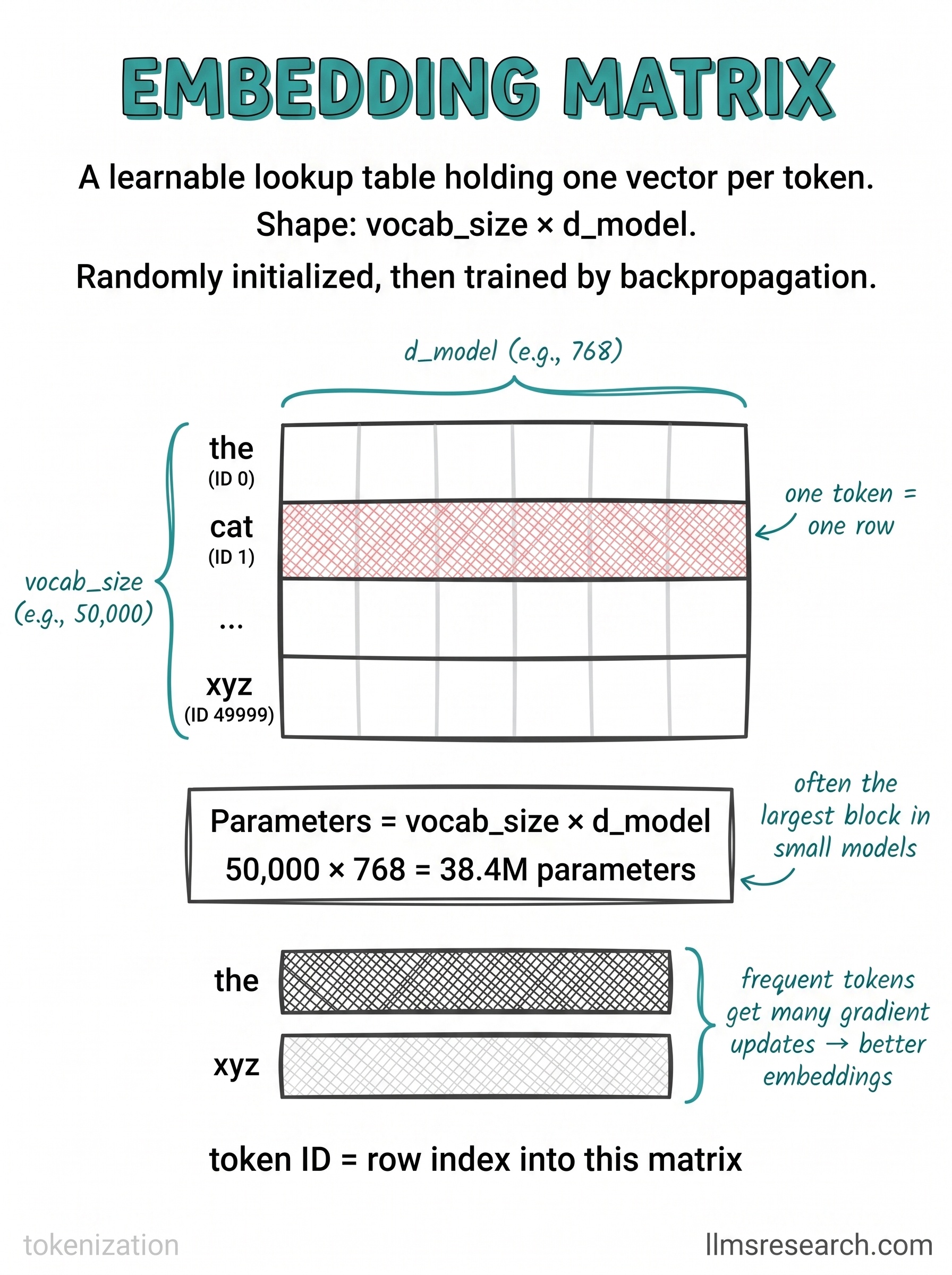
Tokenization ends with integers, but a network cannot compute with an ID like 4302 directly. The number is just a label; it has no useful magnitude. The embedding matrix is the bridge from that label to a vector, and it is the first learned component every token passes through.
The card draws it as a tall table. It has one row per token in the vocabulary and a fixed width, d_model, that is the size of the vector the model uses internally, often something like 768. Looking up a token is exactly that: the token ID is a row index, so token 1 grabs row 1 and nothing more. There is no arithmetic in the lookup itself, just a selection.
What matters is that the rows are learned. They start as random numbers and are updated by backpropagation along with the rest of the model, so over training each row drifts toward a vector that is useful for predicting text. The values in a token’s row are not assigned by anyone; they are shaped entirely by how that token is used.
The size box is a useful reality check. Parameters here equal vocabulary size times d_model, so a 50,000-token vocabulary at width 768 is already 38 million parameters in this one table. In small models the embedding matrix is often the single largest block, which is the other half of the vocabulary-size tradeoff from the earlier card. The card also notes that frequent tokens get many gradient updates and end up with better-trained rows, while rare tokens are touched seldom and stay rougher.
This is the true handoff point. Everything upstream was about turning text into IDs; from here on the model works with these vectors, and the next chapter is about what those vectors come to mean.