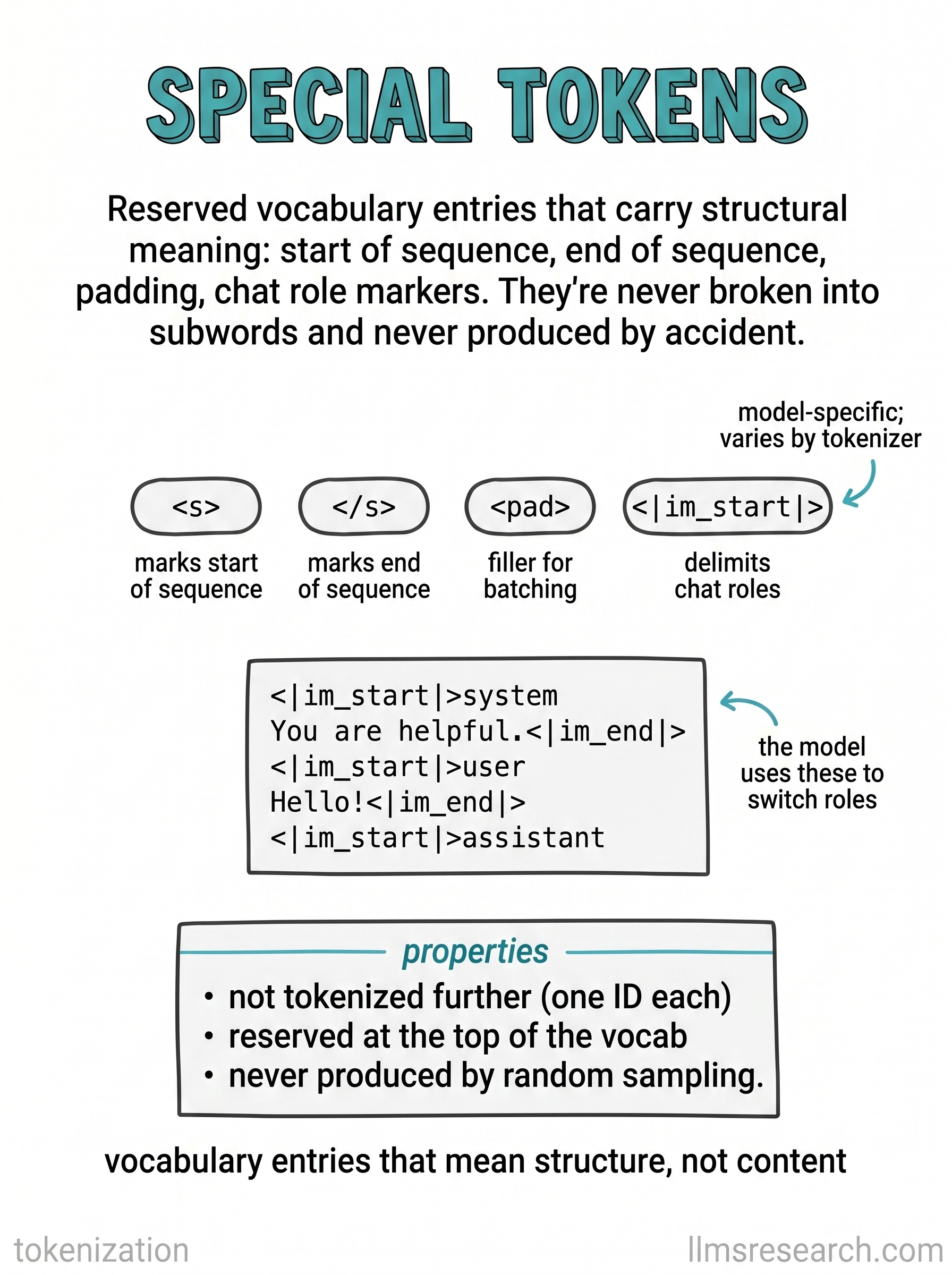
Not every token stands for a piece of text. A handful are reserved to mark
structure, and the model treats them differently from everything the tokenizer
learned by merging. The card shows the usual set: a start-of-sequence marker, an
end-of-sequence marker, a padding filler, and role markers like <|im_start|>.
The important thing about these is that they are atomic. A normal word can be
broken into subwords, but <|im_start|> is a single ID that is never split, and
random sampling during generation will not produce it by chance. They sit in a
reserved region of the vocabulary, set aside before the ordinary tokens.
Their real job shows up in chat. The block in the middle of the card is a chat template: role markers wrap each turn, so the model can tell the system instruction apart from the user’s message apart from its own reply. To the model this is not formatting, it is the signal that says “a new speaker starts here”. The reason a chat model behaves so differently from a raw text model is largely that it was trained on text laid out with these markers.
Two consequences worth carrying forward. First, the exact markers are model-specific: the ones a given tokenizer uses are not portable to another model, and getting the chat template wrong tends to degrade responses quietly rather than error out. Second, because these tokens mean “structure”, letting untrusted user input contain the literal marker strings is a real risk. If a user can inject a role marker, they can pretend to be the system. That is one root of prompt injection, which later cards return to. Here the point is narrower: some tokens mean structure, not content, and the model leans on them.