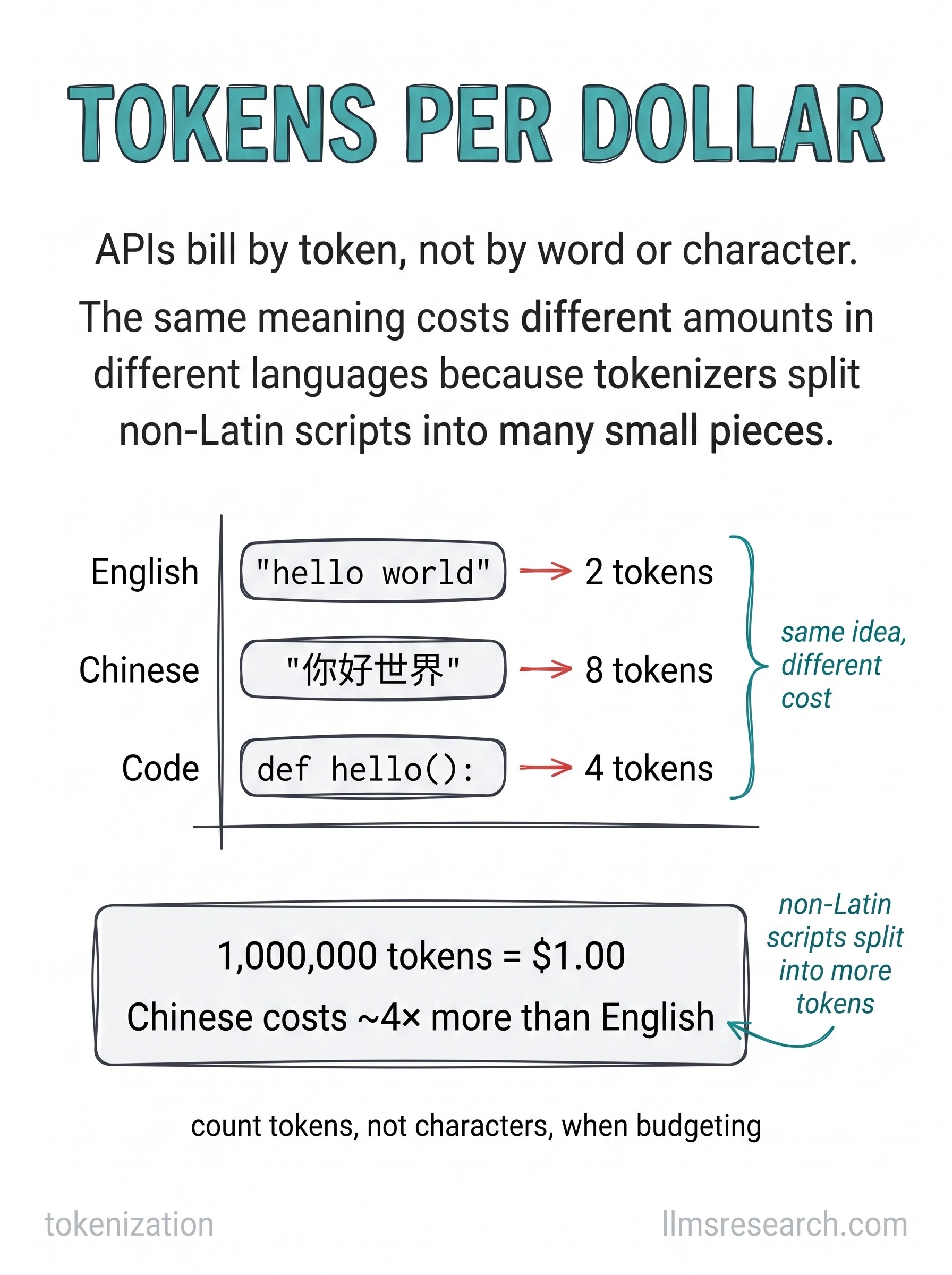
Once you know a tokenizer splits text unevenly, the billing consequence follows directly: providers charge per token, so the cost of a request depends on how the tokenizer happens to cut your specific text, not on how much you meant to say.
The card lines up three inputs of roughly equal meaning. “hello world” in English is two tokens. The same greeting in Chinese is eight. A short line of code is four. The words carry the same information, but the token counts, and therefore the prices, are several times apart. The reason is the one from the vocabulary cards: tokenizers are trained mostly on English-heavy text, so English gets long, efficient tokens while other scripts fall back to many small pieces.
The takeaway box makes the asymmetry concrete. At a fixed price per million tokens, Chinese runs around four times the cost of English for the same content. That is not a surcharge anyone set deliberately. It is a side effect of where the tokenizer’s merges were learned, and it lands on exactly the users whose language was underrepresented in training.
The practical habit this should leave you with is to budget in tokens, not words or characters. A document that looks short can be expensive if it is in a script the tokenizer handles poorly, or full of unusual formatting, or heavy with numbers that fragment. When you estimate cost or fit something into a context limit, count the tokens the actual tokenizer produces rather than trusting the visible length.