The previous card said subwords are the right granularity. BPE is how you actually find them. It is worth knowing because it is not a clever linguistic model, just a counting loop, and yet it produces the vocabulary almost every major LLM uses.
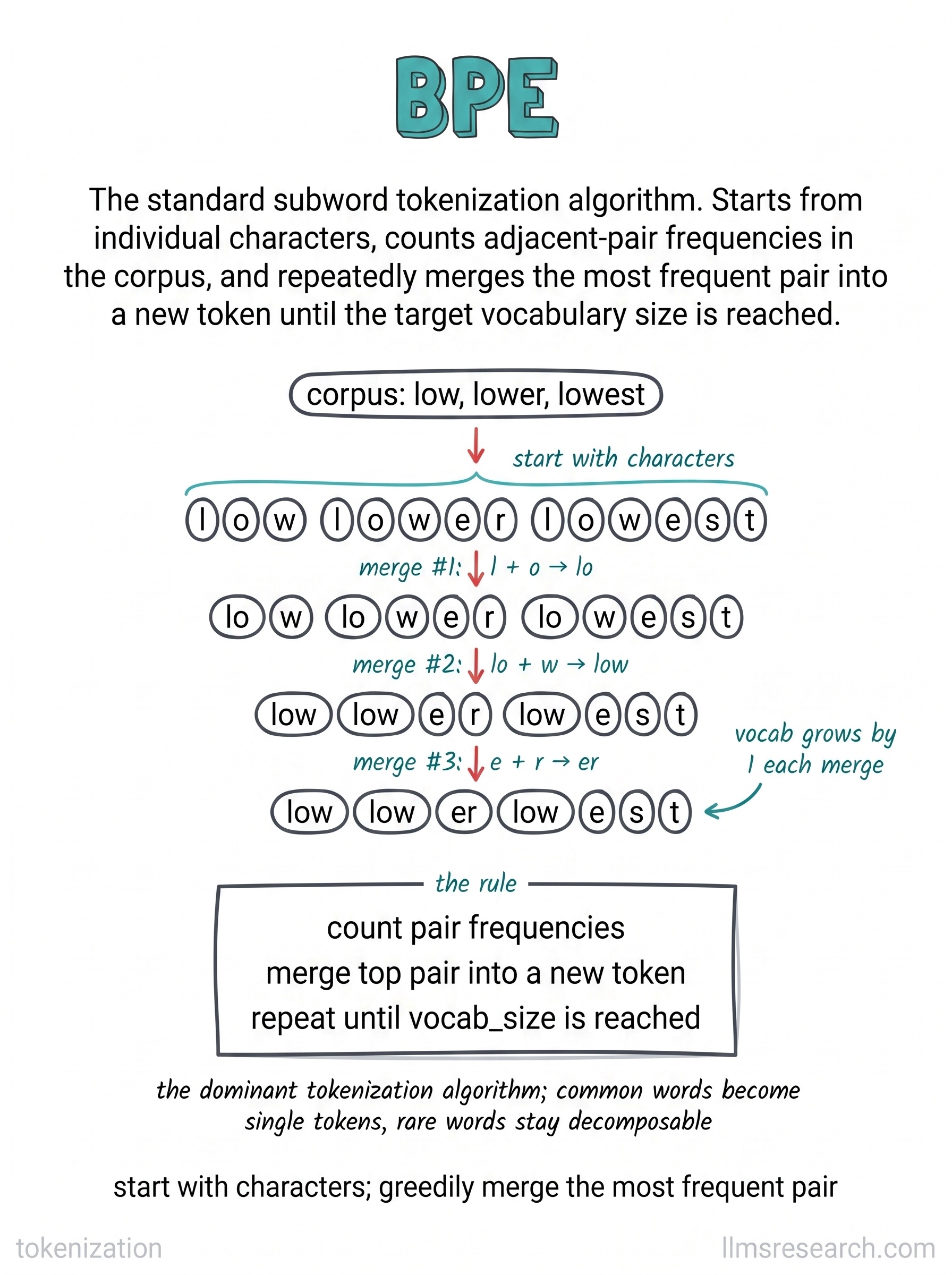
The card runs the algorithm on a tiny corpus, “low, lower, lowest”. Start by
breaking everything into individual characters. Count how often each adjacent
pair appears across the corpus. Merge the single most frequent pair into one new
token, add it to the vocabulary, and rewrite the corpus with that merge applied.
Then repeat. In the example, l and o merge first because they co-occur most,
producing lo; next lo and w merge into low; then e and r into er.
Each pass adds exactly one token to the vocabulary.
The rule box states the loop plainly: count pair frequencies, merge the top pair, repeat until the vocabulary reaches its target size. That target is the only real knob. Stop early and you get a small vocabulary of short pieces; run longer and common words get absorbed into single tokens.
What makes this work is what the frequency counting implies. Pieces that appear
constantly, like low or ing or the, get merged early and end up as whole
tokens, so ordinary text is compact. Pieces that are rare never accumulate enough
count to merge, so an unusual word stays broken into smaller known parts rather
than failing outright. That is the property the earlier cards promised: common
words become single tokens, rare words stay decomposable, and it falls directly
out of merging by frequency.
The merge list learned here is fixed at training time and shipped with the model. Tokenizing new text just means replaying those same merges in order.