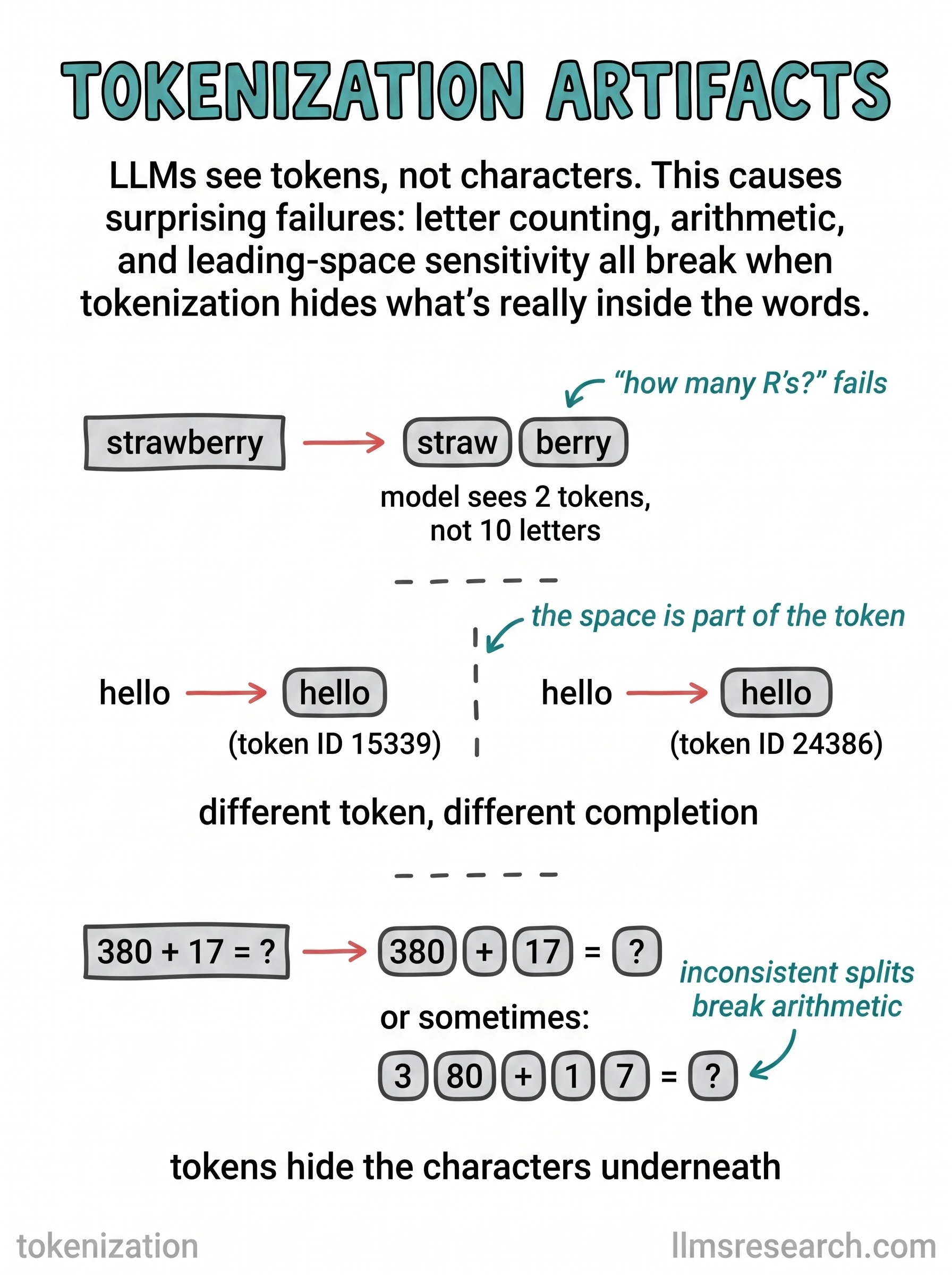
Most of the odd, viral failures of language models trace back to one fact from the very first card: the model reads tokens, not characters. The card collects three cases where that gap becomes visible.
The first is the letter-counting question that keeps going wrong. Ask how many
r’s are in “strawberry” and the model often miscounts, because it never sees the
letters. To it, “strawberry” is two tokens, straw and berry, and the
individual characters inside those tokens are not something it has direct access
to. Counting letters asks it to look at a level it does not operate on.
The second is leading-space sensitivity. The card shows “hello” and ” hello” mapping to two completely different token IDs. A word at the start of a line and the same word after a space are, to the model, different inputs, and can lead to different continuations. This surprises people because the two look identical on screen. The space is quietly part of the token.
The third is arithmetic. “380 + 17” might tokenize cleanly, or it might split as
3, 80, 1, 7 depending on the surrounding text. Numbers do not have stable
token boundaries, so the digits the model needs to add are not laid out
consistently. Inconsistent splits make reliable place-value arithmetic hard,
which is part of why models reach for tools when the math has to be exact.
None of these are bugs in a particular model. They are consequences of the representation, so they tend to appear across models and improve slowly. Knowing the cause is the useful part: when a model fumbles spelling, counting, or digits, the tokenizer is usually the reason, and the fix is to change the task rather than scold the model.