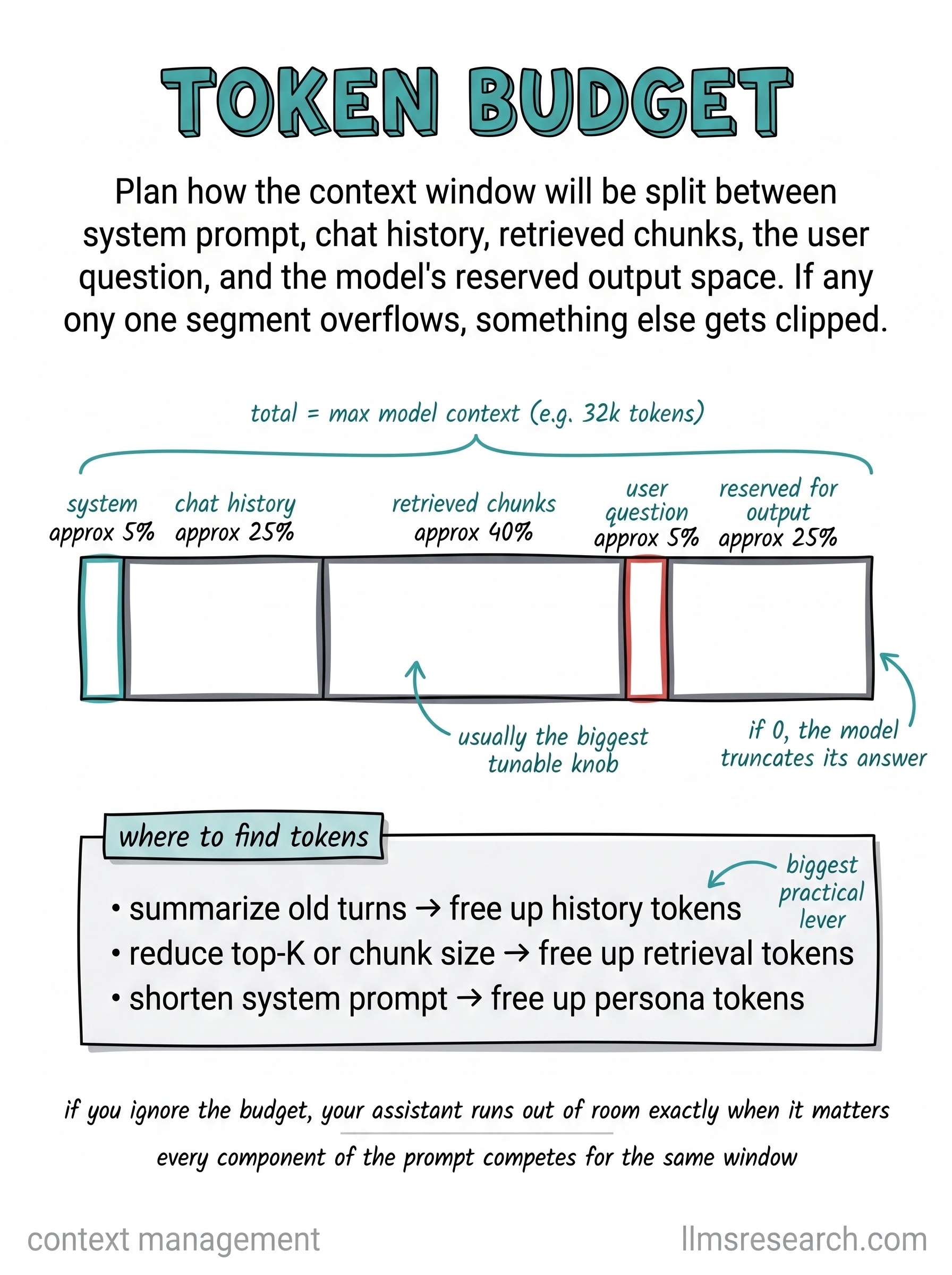
The card shows a stacked bar for one request against a hard context limit. Segments label system prompt, prior turns, retrieved passages, the current user message, and a reserved slice for the model’s reply. A side note lists ways to reclaim tokens: shorten system text, compress history, retrieve fewer chunks, or lower max output.
Every component competes for the same ceiling. If retrieval and history consume most of the window, the model may never see the latest user instruction or may stop mid-answer when output space runs out. APIs often expose input and output token counts separately, but the underlying constraint is unified: what fits in one forward pass. Budgeting is therefore a product decision, not an afterthought.
Start from the output reserve. If you need a thousand tokens of JSON, subtract that before choosing how many documents to inject. Measure typical system and tool schemas with your tokenizer; byte estimates mislead on multilingual or code-heavy prompts. Instrument per-request breakdowns in logs so spikes in history length are visible before users hit quality cliffs.
Reclaim strategies trade fidelity for space. Summaries lose detail. Dropping oldest turns forgets early constraints unless the system prompt repeats them. Aggressive retrieval top-k cuts recall. The card’s stacked bar is a checklist: name each consumer, assign a cap, and revisit when you change models because window size and tokenizer vary across providers. Good answers depend as much on what you omit as on what you include.