Everything so far has described a single forward pass without asking how long the input can be. The context window is that limit: the largest number of tokens the model can hold in view at one time. This chapter is about pushing that limit and paying for it.
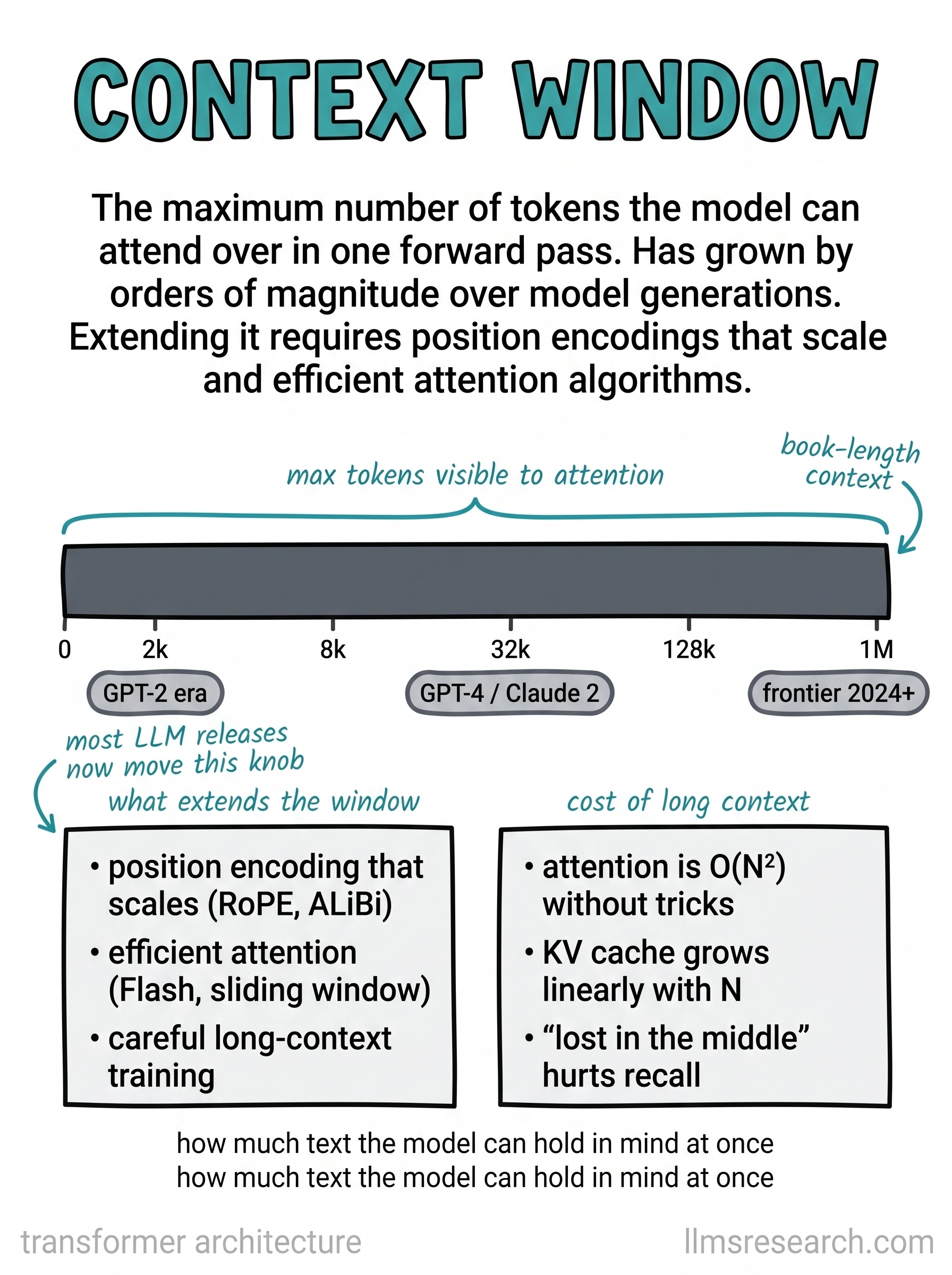
The bar traces how the limit has moved. GPT-2 era models sat near 2k tokens, the GPT-4 and Claude 2 generation reached the tens of thousands, and frontier 2024 and later models advertise up to a million, what the card calls book-length context. The annotation notes that most recent releases now move this knob, meaning context length has become one of the headline numbers a new model is judged on. The scale is logarithmic, so each labeled step is a large multiplicative jump, not a linear one.
Two things make extension possible, listed on the left. Position encodings have to keep working at lengths never seen in training, which is why methods like RoPE and ALiBi matter here, both covered earlier. Attention has to stay affordable, which is where Flash Attention and sliding-window attention come in, both later in this chapter. Careful long-context training is the third piece: a model does not reliably use a long window just because the architecture permits it, it has to be trained on long inputs.
The right box is honest about what long context costs. Attention is quadratic in sequence length without special techniques, so doubling the window quadruples the attention compute. The KV cache grows linearly with length, consuming memory that scales with every token kept. And the lost-in-the-middle effect means recall of information placed in the center of a long input degrades, so a large window does not guarantee the model actually attends well across all of it.
That last point is worth keeping separate from the headline number. A one-million token window is a capacity, not a promise of uniform attention across it. The rest of this chapter covers the techniques that make long windows both possible and cheaper, starting with the KV cache.