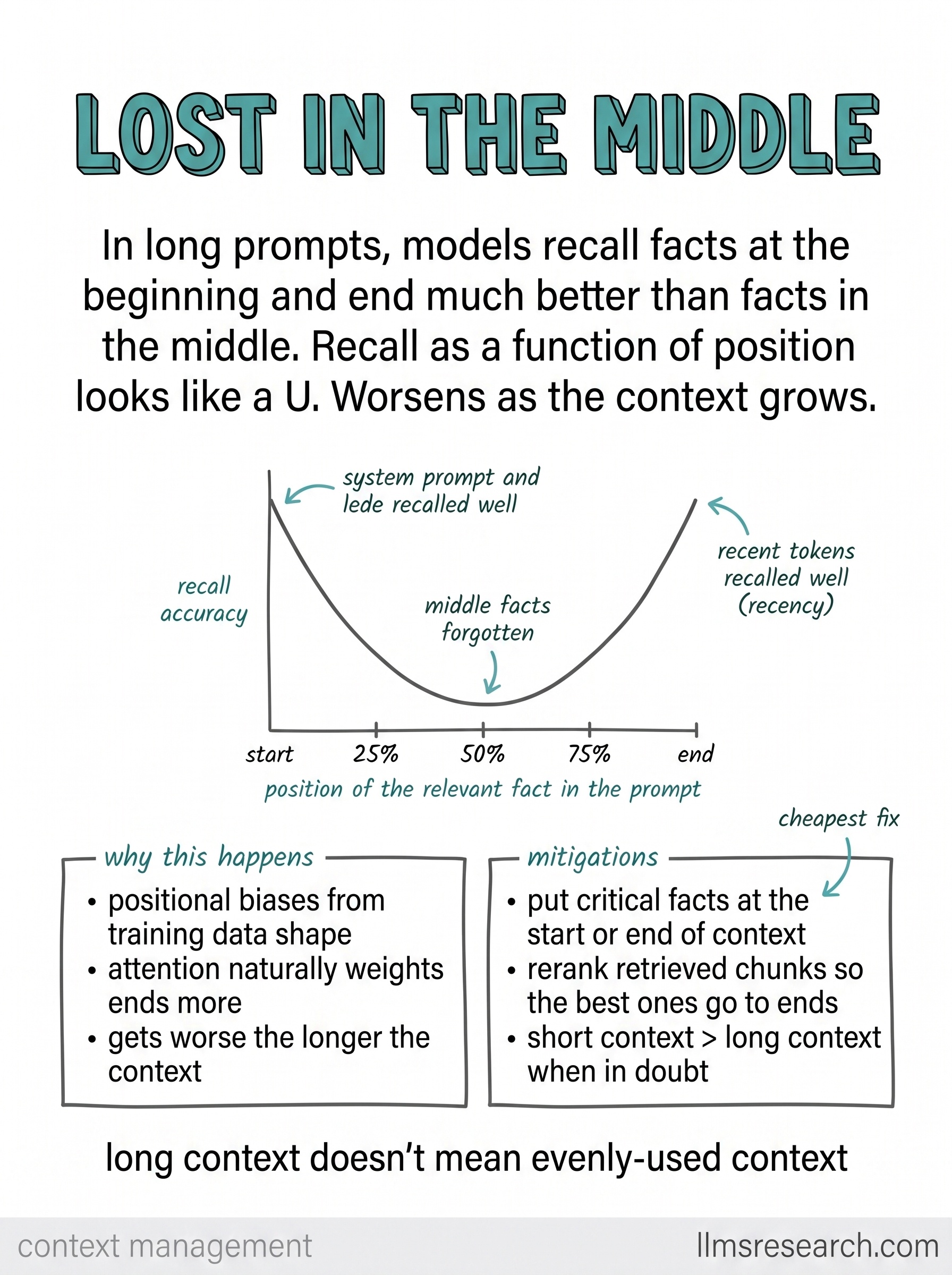
The card plots a U-shaped curve: position along the prompt on the horizontal axis, answer accuracy on the vertical. Performance is high for evidence placed near the beginning and near the end, and dips for material in the central band. The shape matches published needle-in-a-haystack findings across several long-context models.
Attention is technically global, but training distributions and positional biases favor recency and salient anchors. Middle paragraphs look like bulk context, so specific facts there receive weaker effective signal. This interacts with RAG: dumping many chunks in arbitrary order can hide the one supporting sentence exactly where recall is worst.
Mitigations are structural. Put critical instructions in system or the final user turn. Repeat key constraints briefly before the question. For retrieval, rerank and place the strongest chunk last among documents or adjacent to the query. Use compression that preserves cited spans rather than aggressive summarization that drops names and dates from the center of a long brief.
When evaluating long-context features, test middle placement deliberately. A demo that only checks facts at the top or bottom overstates readiness. The card pairs with context window capacity: a million-token slot does not mean every token is equally usable. Design prompts and retrieval order as carefully as you choose model size.