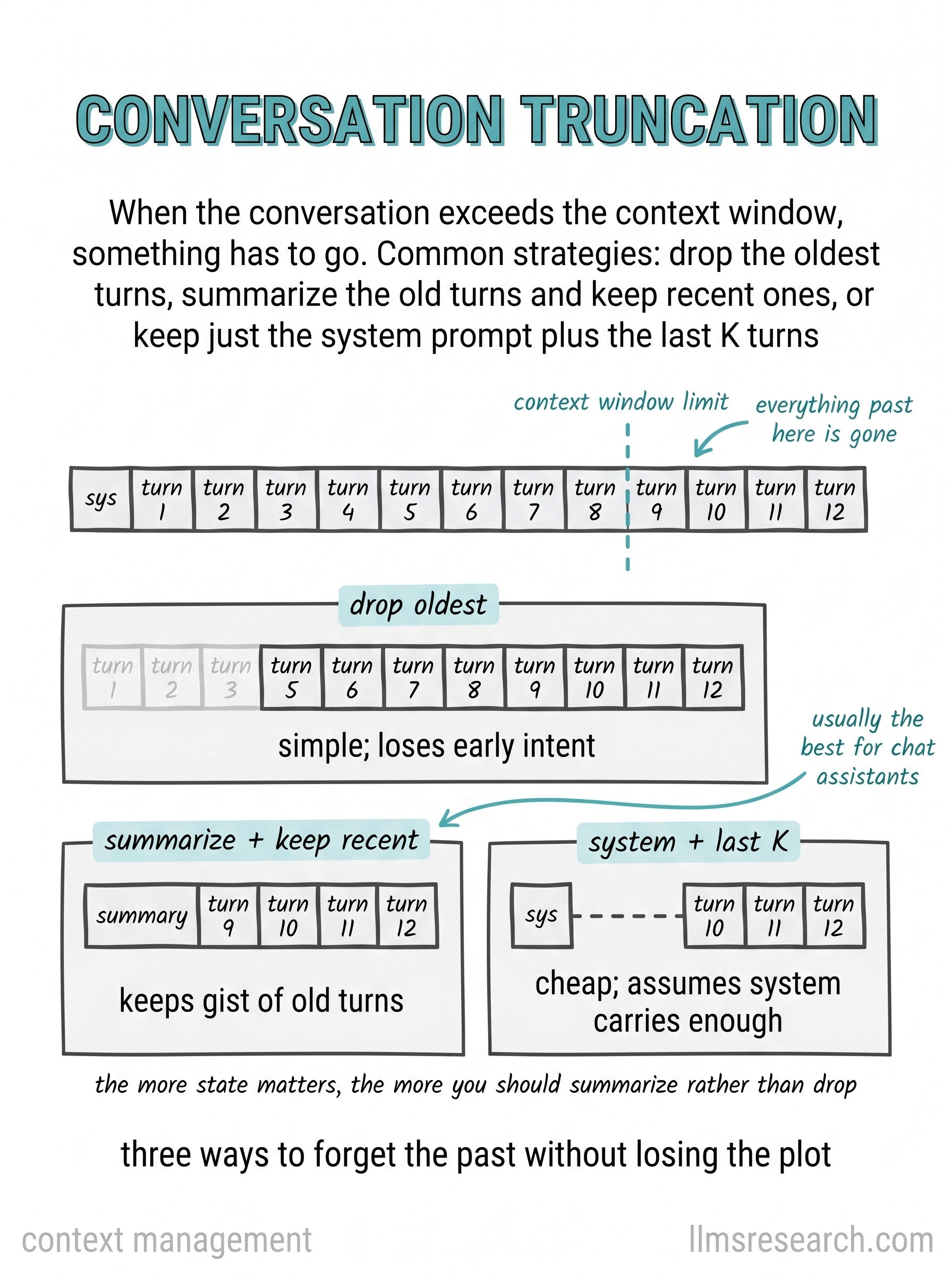
The card draws a long chat timeline overflowing a window boundary. Three strategies appear below. Drop-oldest removes early turns until the thread fits. Summarize-then- keep-recent replaces the distant past with a short summary while leaving the latest exchanges intact. System plus last K turns keeps only the system message and a fixed number of recent user-assistant pairs, discarding everything earlier.
Truncation is the default behavior in many SDKs when you do nothing. That makes the choice explicit policy. Dropping oldest is simple and stateless but forgets user preferences stated at the start unless they live in system. Summary buffers preserve themes but can smear details. Last-K is predictable for billing and debugging but may delete tool results the model still needs.
Implement truncation with token counts, not turn counts alone, because one message can carry a huge paste or retrieval payload. Reinsert immutable instructions into system after aggressive cuts. When tools wrote critical facts to early turns, mirror those facts into a scratch summary or external memory before deletion. Surface to users when context was trimmed so they know to restate constraints.
Truncation interacts with lost-in-the-middle: keeping only recent turns puts old facts far away or out entirely. Retrieval-augmented context can re-inject facts on demand instead of hoarding full transcripts. The card’s point is comparative: all three strategies fit the same limit, but they forget different things, so pick based on what your application cannot lose.