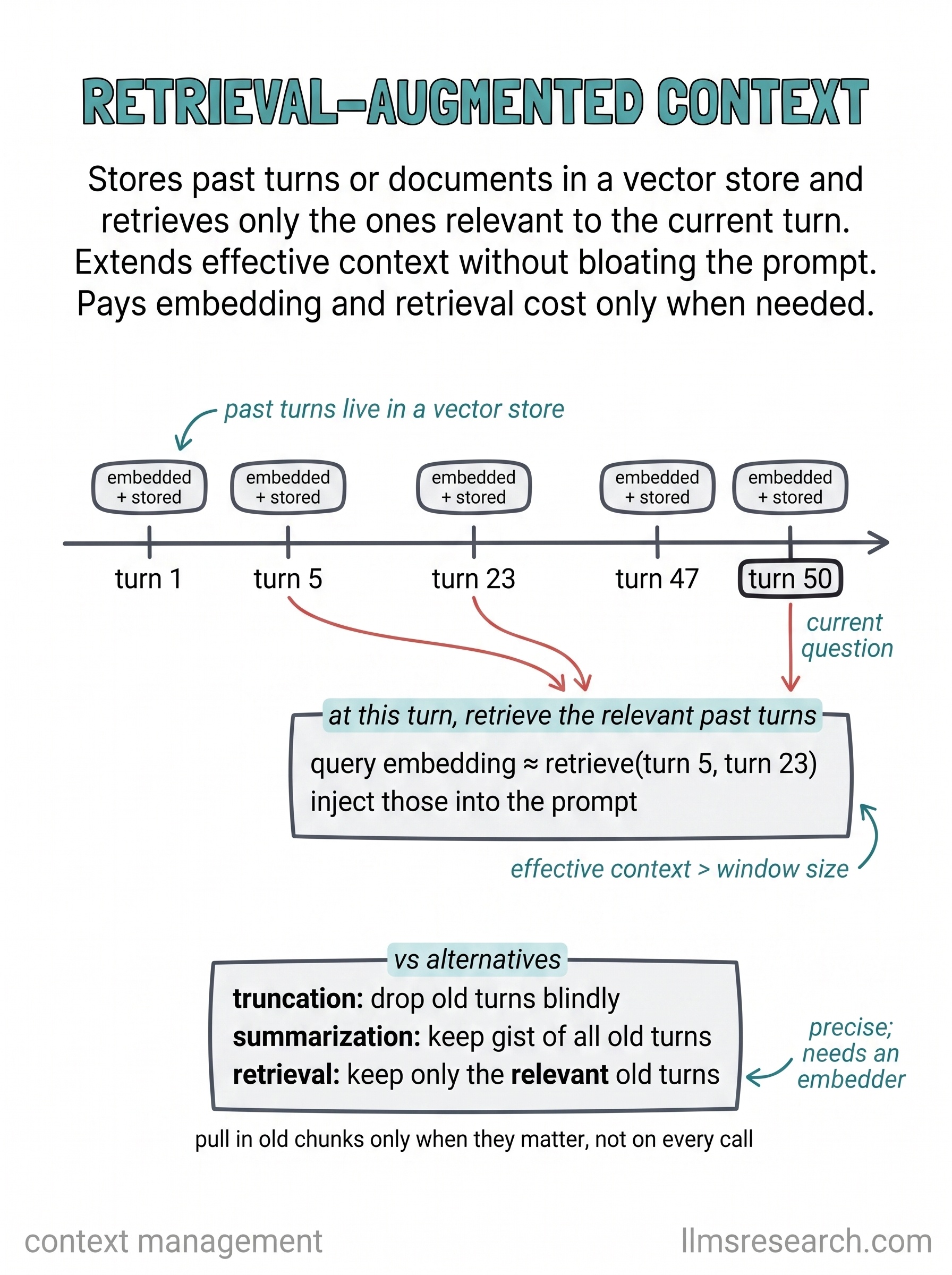
The card shows a conversation timeline with retrieval events at specific turns. When the user asks about a policy detail, a retriever fetches two chunks from a document store and inserts them before the model answers. Later, a different query triggers a fresh fetch. An annotation stresses that retrieval widens effective context, not the hard token ceiling of the model.
The mechanism is query-conditioned selection. Embeddings or hybrid search find passages similar to the current need. Those passages become prompt tokens the model conditions on for that reply only. Unlike stuffing an entire corpus once, just-in- time retrieval keeps the window focused and updates evidence as the topic shifts. It pairs naturally with truncation: drop old transcript text while still accessing archived facts through search.
Design choices matter. Chunk size, overlap, reranking, and citation format affect faithfulness. Place retrieved text in delimited, lower-trust regions per instruction hierarchy. Budget how many tokens retrieval may consume so user instructions and output reserve remain intact. Log sources for audit and detect when retrieval misses return empty context rather than letting the model improvise.
Retrieval does not remove hallucination; it channels the model toward supplied text. Injection risks remain if documents contain hostile instructions, so treat corpora as untrusted unless curated. The card’s timeline view is the operational picture: context is a living bundle assembled per turn, not a static prefix, which is how long products stay coherent without sending every past token on every call.