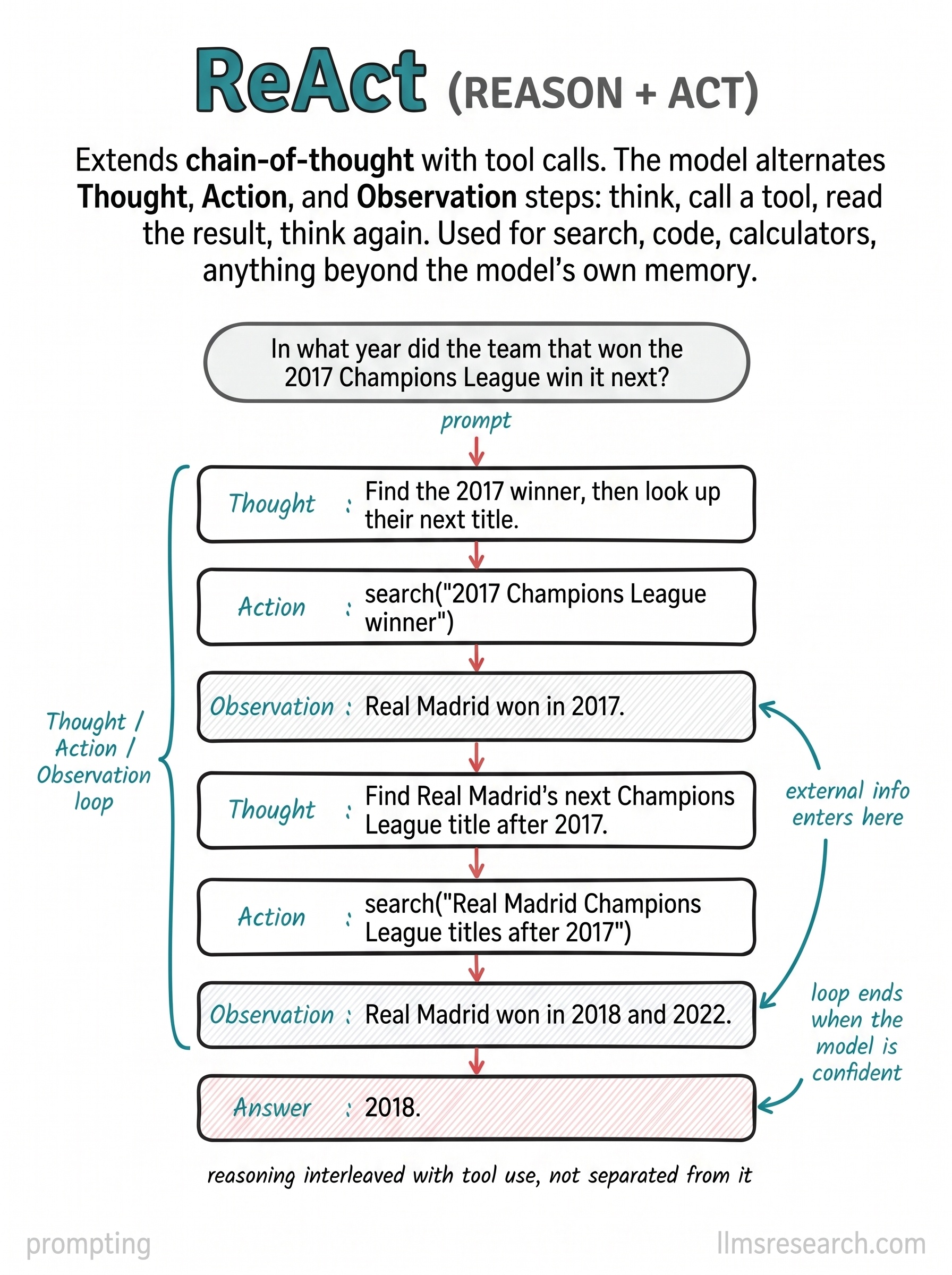
The card diagrams the Thought, Action, Observation, Thought cycle as a loop. A concrete trace sits beside it: the model wonders who won a recent tournament, issues a search action with a query string, receives a snippet observation, thinks again, and finishes with a cited answer. The hero is alternation between internal planning and external evidence, not a single monologue.
Thought tokens let the model decompose goals and choose tools without committing to a final answer prematurely. Action tokens map to a structured call your runtime executes: search, calculator, database lookup, code run. Observation tokens inject tool output back into context so the next thought conditions on fresh facts. The pattern reduces hallucination on questions where parametric memory is stale or ambiguous.
Implementations need a strict action parser, timeouts, and permission checks. The loop stops when the model emits a finish action or when you hit step limits. Without caps, agents can repeat useless searches. Log each leg for debugging and apply instruction hierarchy so observations from the open web stay untrusted input.
ReAct sits between pure CoT and full autonomous agents. It is CoT plus grounded steps you control. Pair it with retrieval-augmented context when conversations are long and facts arrive just in time. The card’s trace is the design template: name the gap, act to close it, read the world, then reason forward until the user question resolves.