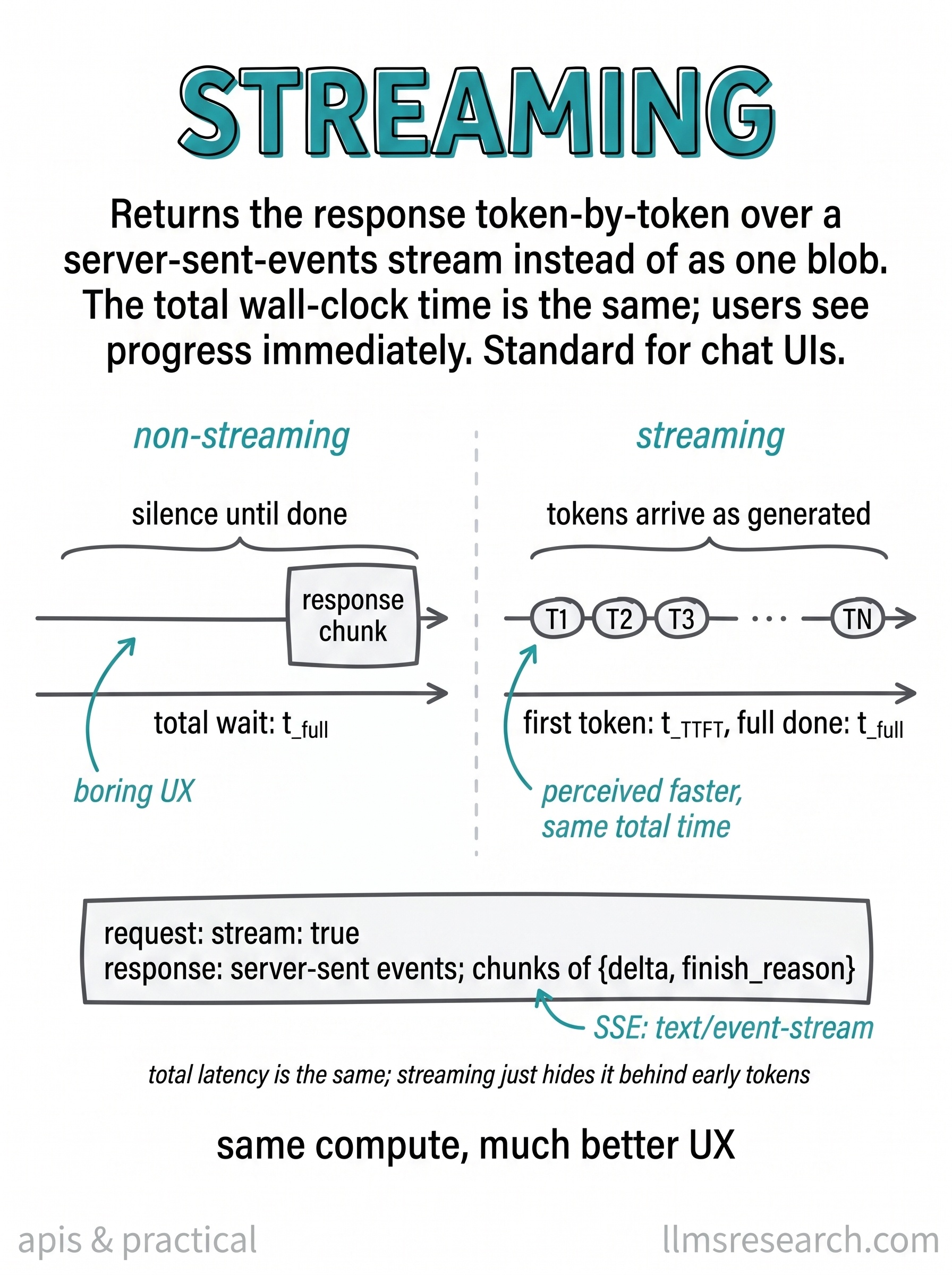
The card splits a timing diagram into two halves. On the left, non-streaming mode shows a long flat wait and then the full response appearing at once. On the right, streaming mode shows small token pills arriving at regular intervals across the same overall duration. The labels make the contrast explicit: silence until done versus tokens arriving as generated.
Mechanically, streaming does not skip work. The model still runs prefill over the prompt and then decodes output tokens one at a time. Total latency to the last token stays near t_full in both modes. What changes is when bytes reach the client. In non-streaming, nothing is visible until the server has finished. In streaming, the first token can appear at t_TTFT while decode continues.
The API switch is a request flag, usually stream set to true. The response then uses server-sent events rather than a single JSON body. Chunks arrive as small JSON objects, often carrying a delta with the next text fragment and sometimes a finish_reason on the final event. The content type is text/event-stream, and the client must parse a sequence of partial updates rather than one parsed object.
That difference is almost entirely about perceived speed. Users see progress immediately, which makes chat UIs feel responsive even when the model is still thinking or decoding. The card’s bottom note states the point plainly: total latency is the same, streaming just hides it behind early tokens. Standard chat interfaces adopt streaming for that reason.
For implementation, wire the client to append deltas as they land and to handle an abrupt end if the connection drops mid-stream. Measure TTFT separately from throughput after the first token. Streaming improves first paint; it does not by itself reduce the bill or shorten the full decode unless you also cap output or change the model.