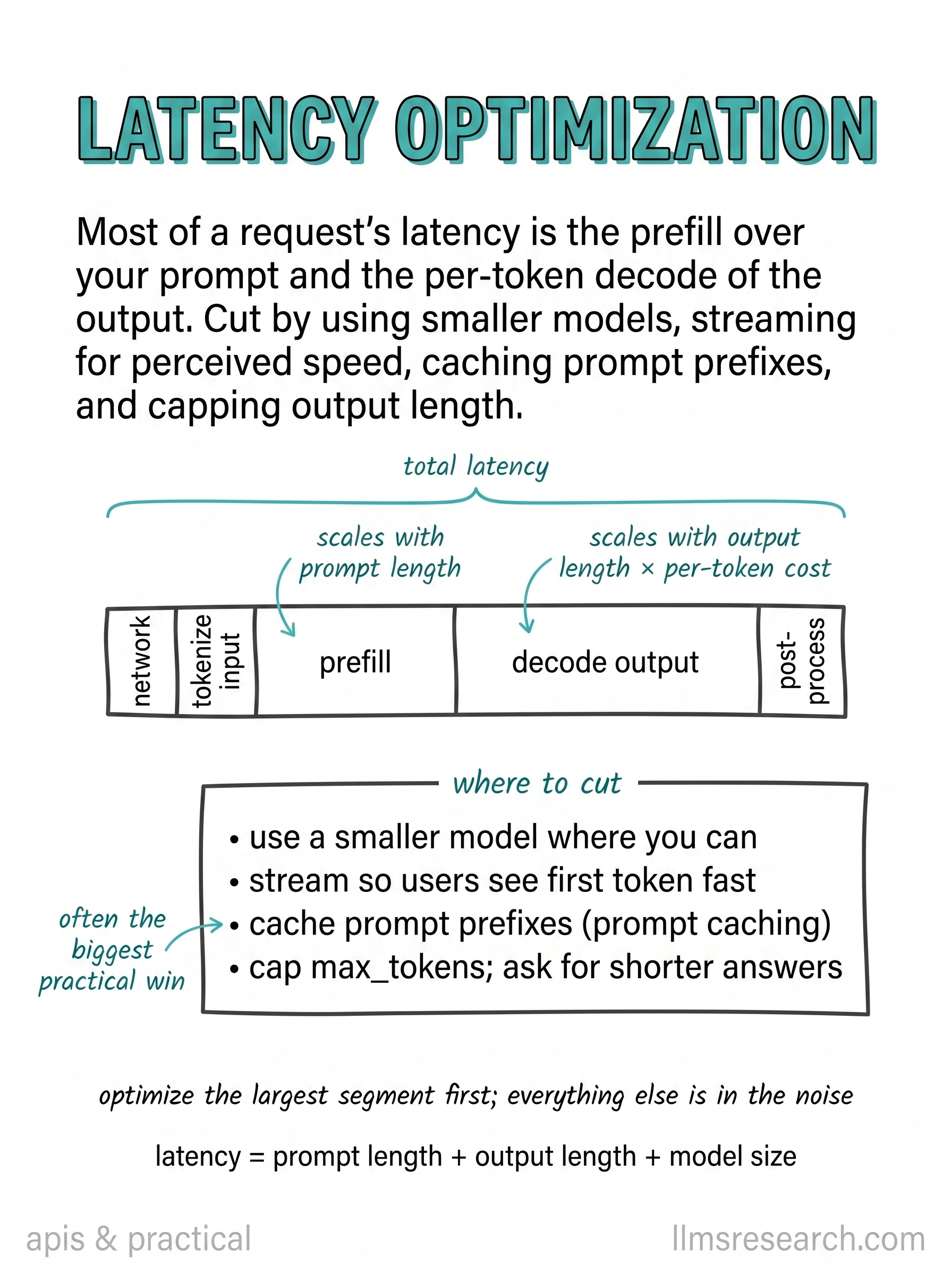
The card shows a horizontal stacked bar labeled as the total latency budget for one API call. Five segments sit side by side: network, tokenize input, prefill, decode output, and post-process. Prefill and decode are drawn wide. Network, tokenization, and post-processing are narrow slivers by comparison.
Prefill is the forward pass over the entire prompt before the first output token can be emitted. Its cost scales with prompt length: more input tokens mean more attention work up front. Decode is the per-token generation that follows. Its cost scales with how many output tokens you ask for and how expensive each decode step is on the chosen model. The annotations on the card tie those two segments directly to prompt length and output length.
Smaller segments still exist. Network RTT matters for edge clients talking to distant regions. Tokenization is usually minor unless inputs are huge. Post- processing covers parsing, safety filters, or tool routing on the way out. The card’s footer line compresses the budget into a useful rule: latency is prompt length plus output length plus model size, with everything else often in the noise.
The where-to-cut box lists the knobs that actually move the bar. Use a smaller model where quality allows. Stream so users see the first token while decode continues. Cache stable prompt prefixes so repeat calls skip full prefill on the shared head. Cap max_tokens and ask for shorter answers when verbosity is not required. Prompt caching is called out as often the biggest practical win when the same system prompt or document bundle appears on many requests.
Optimization should target the largest segment first. If prefill dominates, shorten or cache the prompt before you tune decoding parameters. If decode dominates, reduce output length or move to a faster model tier. Streaming improves perceived latency without changing total compute. Measure TTFT and tokens per second separately so you know which side of the bar you are actually shrinking.