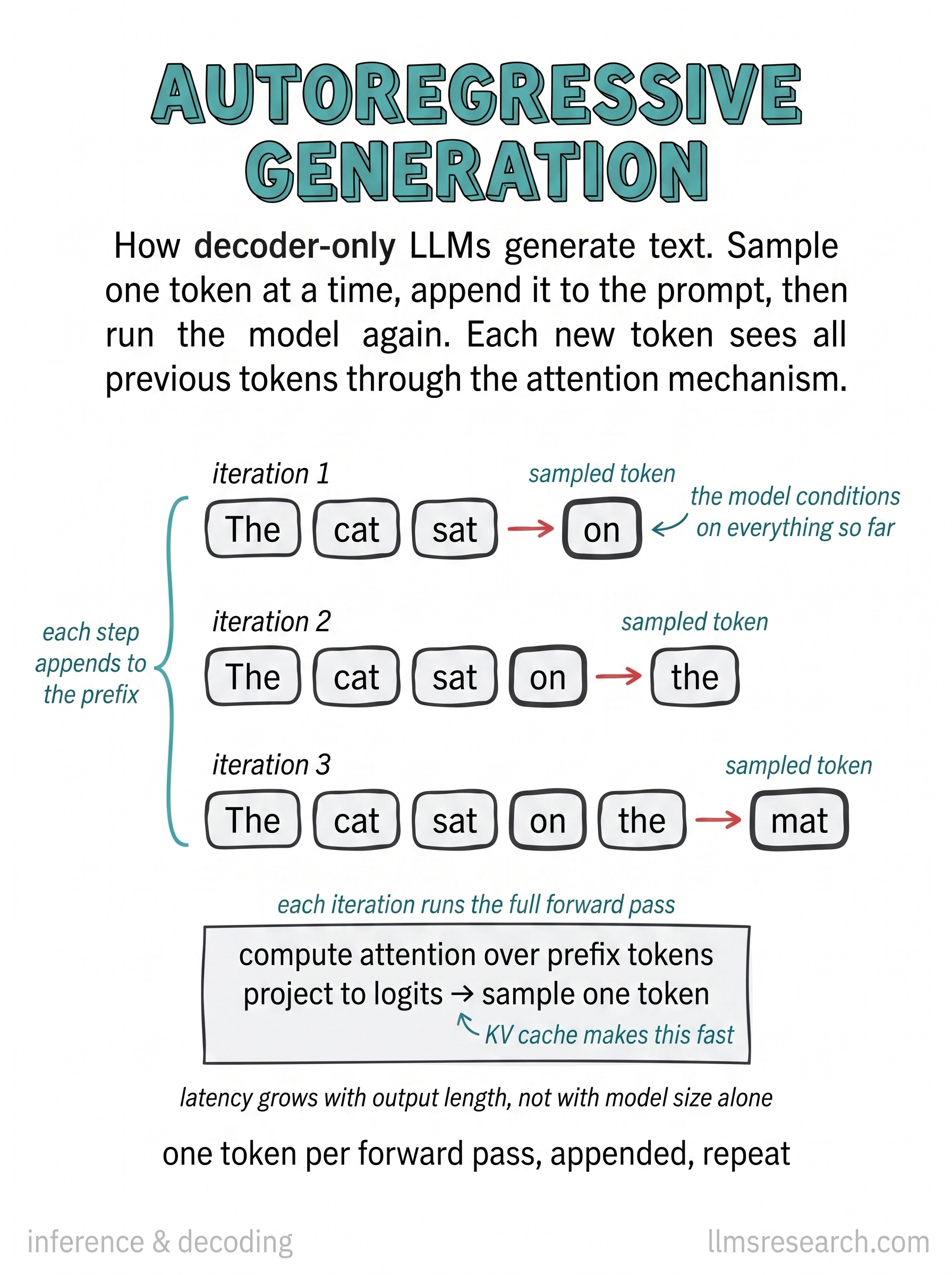
Training taught the model to predict one next token. Generation is what happens when you let it do that repeatedly and feed the results back in. The card walks through three iterations of the same loop: the model reads “The cat sat”, samples “on”, appends it, reads “The cat sat on”, samples “the”, and so on. Each new token is chosen while conditioning on everything produced so far, which is what “autoregressive” means.
There is no separate planning phase. The model does not decide on a sentence and then write it out. It commits to one token, and only then considers the next, with the token it just emitted now part of the context it reasons over. This is why a single early word can steer a whole response, and why the same prompt can produce different answers on different runs when the sampling introduces variation.
The cost of doing it one token at a time
The loop has an obvious inefficiency. If each step reran the full model over the entire growing prefix, the work would balloon as the text got longer. The KV cache is the fix noted on the card. Each token’s intermediate attention values, its keys and values, are computed once and stored, so every later step reuses them instead of recomputing the past. New work per step stays roughly constant rather than growing with the prefix.
The line at the bottom is the practical takeaway, and it is a common source of confusion about speed. Latency is driven mainly by how many tokens you ask the model to produce, not by the model’s size alone. A large model and a small one both generate strictly one token per forward pass; a long answer is slow because it is long. That distinction shapes almost every decision about serving cost, streaming, and how these systems feel to use.