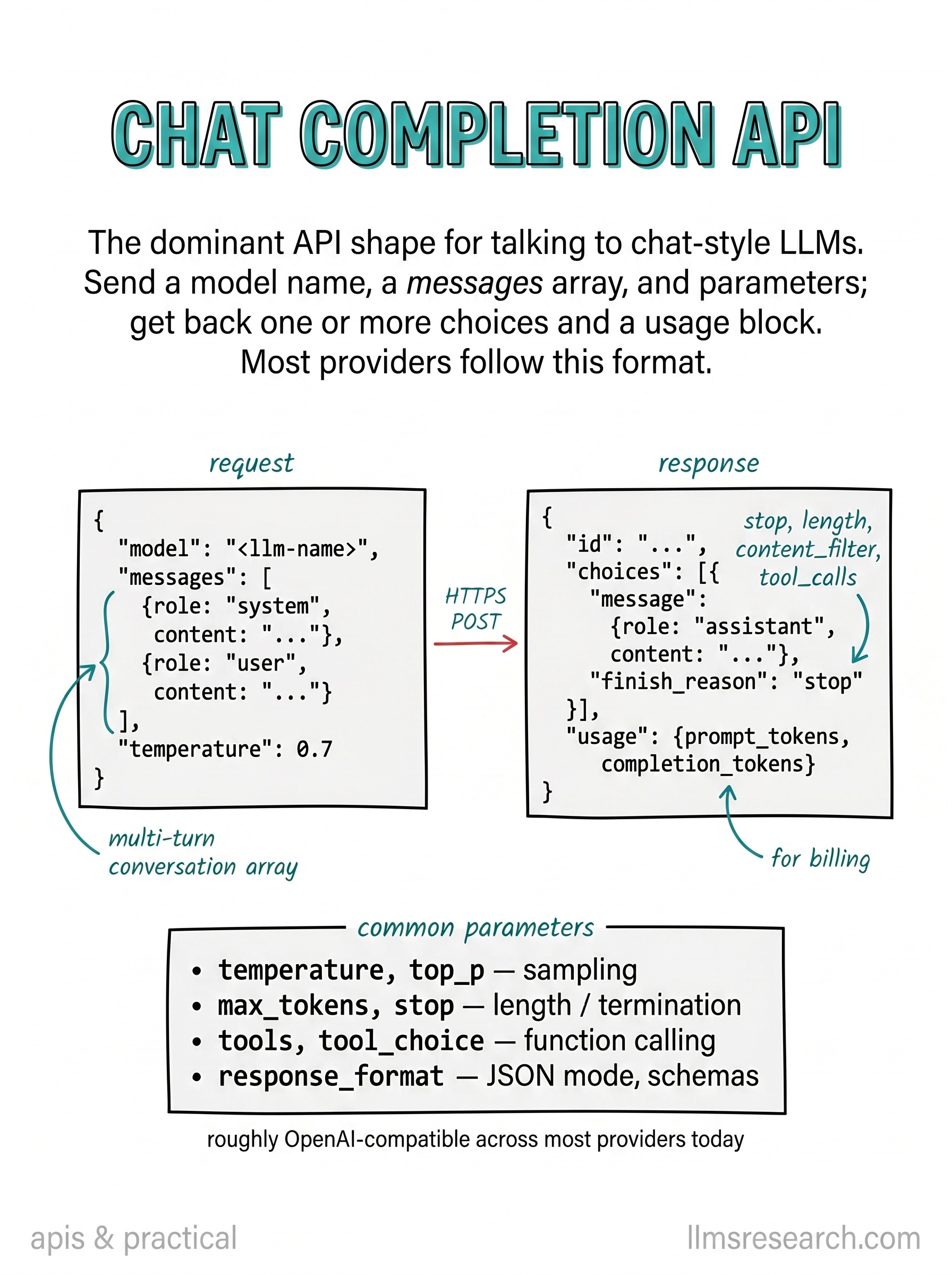
The card draws the dominant API shape for talking to chat-style LLMs as two side-by-side JSON blocks. On the left is the request: a model name, a messages array, and a few parameters. On the right is the response: an id, one or more choices, and a usage block. A red arrow between them marks the HTTPS POST that carries the exchange.
The messages field is the structural center. It is an ordered array of role and content pairs, typically system, user, and assistant turns. That array is how the API represents a multi-turn conversation in one call. The model reads the full sequence, not just the latest user line, so system instructions and prior turns ride along in the same payload.
The response mirrors that structure. Each choice contains an assistant message and a finish_reason that tells you why generation stopped: a natural stop, a length cap, a content filter, or a tool call. The usage block reports prompt_tokens and completion_tokens. Providers use those counts for billing, so the numbers in the response are the authoritative record of what the call consumed.
Below the pair, a small parameter list names the knobs most clients touch. Temperature and top_p control sampling. max_tokens and stop sequences bound output length and termination. tools and tool_choice enable function calling. response_format can request JSON or schema-constrained output. The exact names vary slightly by vendor, but the layout is largely OpenAI-compatible across major providers today.
The practical takeaway is to treat this endpoint as a contract, not a chat window. You assemble the messages array deliberately, set parameters for the task, and read finish_reason plus usage on the way out. If generation ends on length rather than stop, the answer may be truncated. If usage is higher than expected, the full prompt, including system text and history, is what counted.