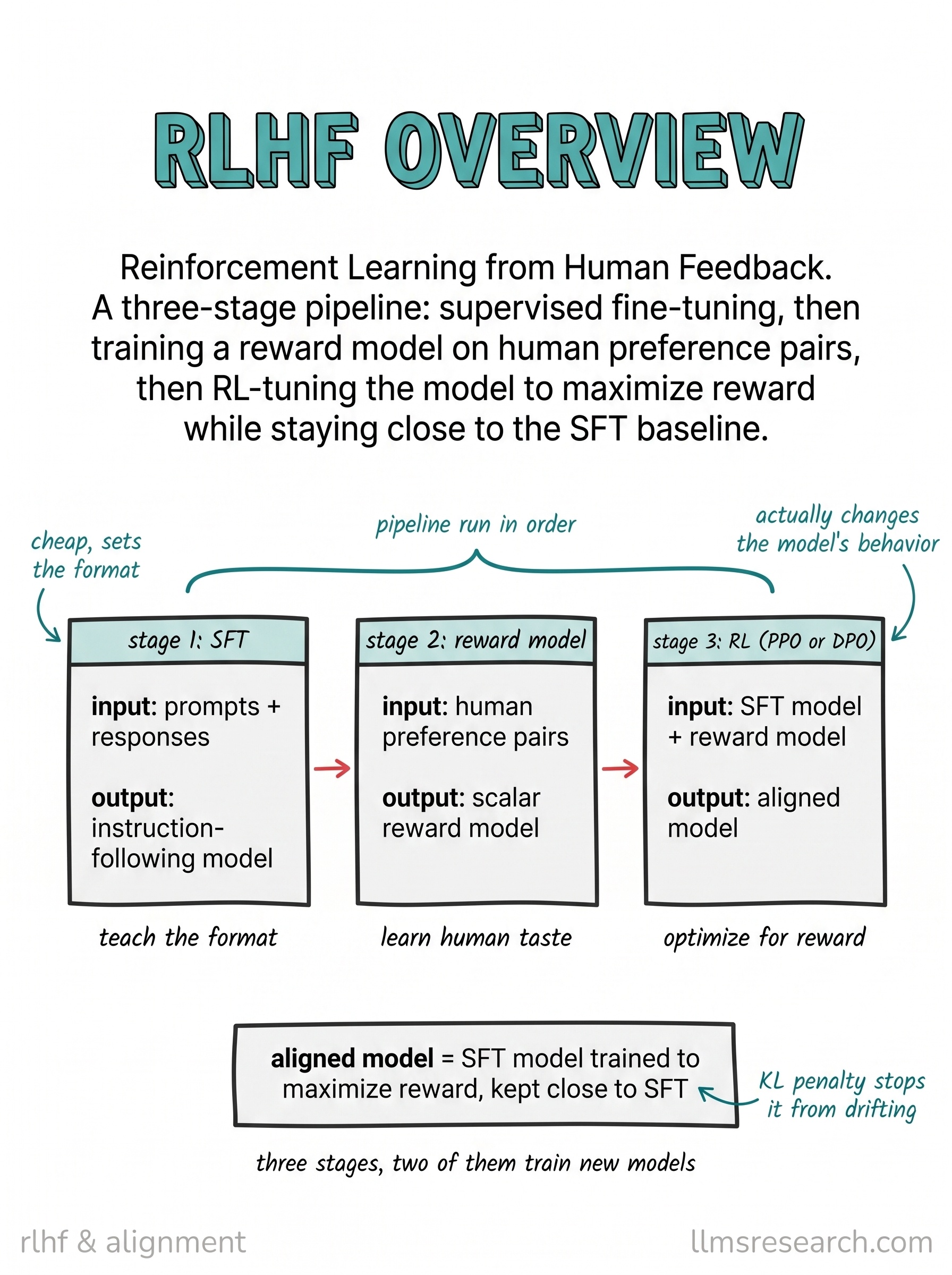
RLHF is the recipe that turns an instruction-following model into one whose answers line up with what people actually prefer. The card lays it out as three boxes read left to right, and the order matters because each stage consumes the output of the one before it. Stage one is supervised fine-tuning: feed the model prompts paired with good responses so it learns the format of an answer. Stage two trains a reward model on human preference pairs. Stage three uses reinforcement learning to adjust the model so its outputs score higher under that reward, held near the SFT model by a penalty.
The reason the pipeline splits into three is that each stage solves a problem the others cannot. SFT is cheap and it fixes format, but it can only imitate the responses it was shown, so it never learns that one acceptable answer is better than another equally acceptable one. Ranking teaches that. Collecting a scalar quality label for every possible response is impractical, but asking a person which of two responses is better is easy, and the reward model turns those comparisons into a score any response can be graded against. With a score in hand, RL can search for responses the reward model likes rather than just copying a fixed set.
The card marks stage one as the cheap step that sets the format and stage three as the one that actually changes behavior, which is a useful way to hold the division in mind. SFT gets the model into the right shape; the reward model captures human taste; RL is where the model starts producing answers no human wrote but that people would have preferred. Two of the three stages train entirely new models, the reward model and the final policy, and only SFT reuses labeled examples directly.
The note about staying close to the SFT baseline points at the failure mode that makes stage three delicate. A model optimizing hard against a learned reward will find responses that score well without being good, so the objective includes a term that keeps the trained policy near the SFT starting point. That tension, chase reward but do not drift, runs through every card in this chapter, from the reward model that supplies the signal to the KL penalty that supplies the brake.