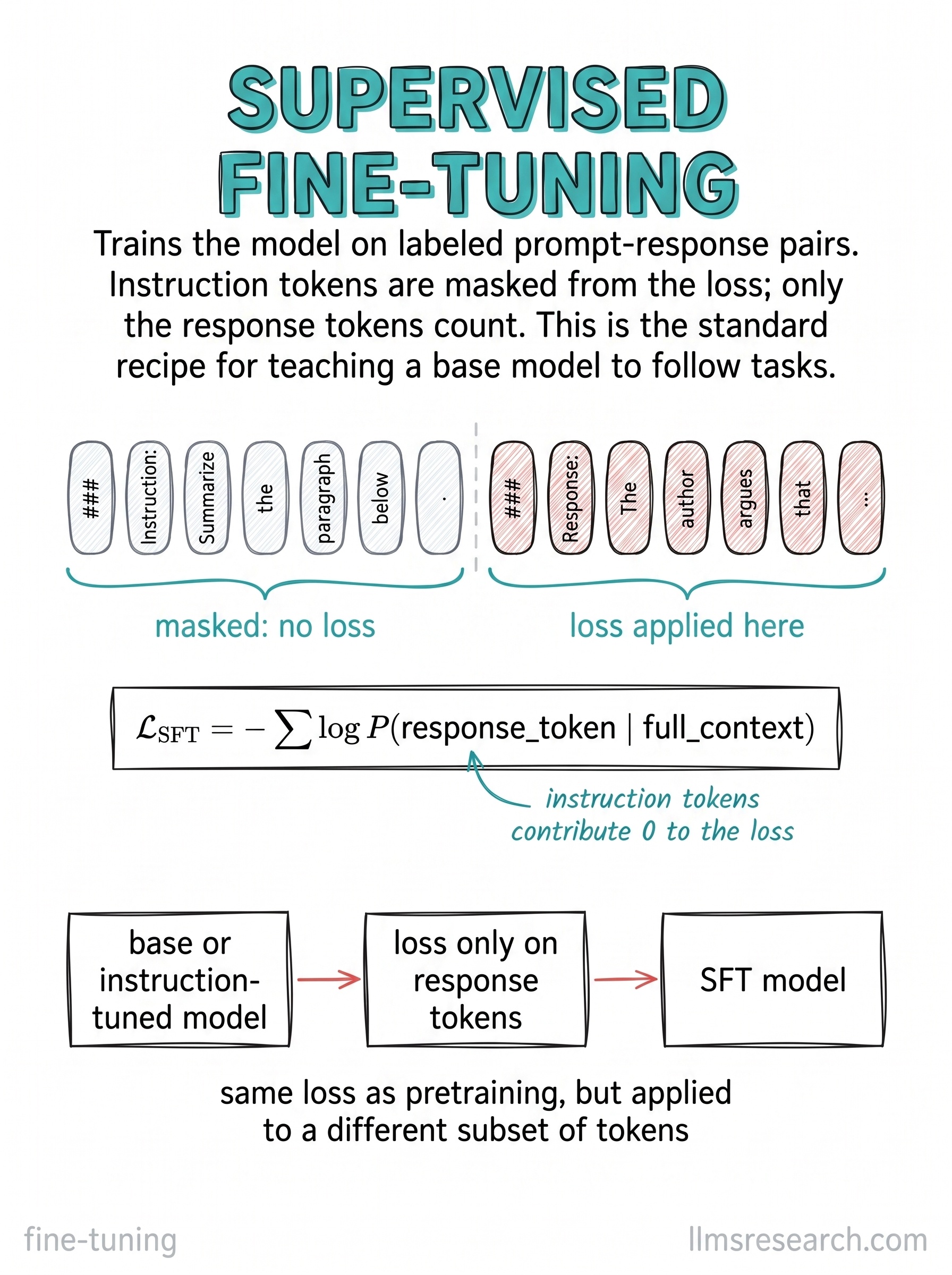
Supervised fine-tuning is the concrete training procedure behind instruction tuning, and its defining detail is which tokens count toward the loss. The card lays a single training example out as a row of tokens split into two halves. On the left, the instruction tokens (”### Instruction: Summarize the paragraph below.”) are marked masked, no loss. On the right, the response tokens (”### Response: The author argues that …”) are marked as the part where loss is applied.
The reason for the split follows from what we are trying to teach. The instruction is given to the model at inference time, so there is no value in training it to predict those tokens. What we want is for the model, having read the instruction, to produce a good response. So the loss is computed only over the response tokens, each one scored on how well the model predicted it given everything before it, instruction included. The formula on the card writes this as the negative sum of log P of each response token conditioned on the full context, with a note that the instruction tokens contribute zero to the loss.
Worth stressing is how little machinery this requires. It is the same cross-entropy loss and the same next-token objective from pretraining, as the caption says directly. The model still reads the instruction as context and attends to every token in it; the mask only changes where the gradient signal comes from. In practice this is implemented by setting the label positions for the instruction tokens to a value the loss function ignores, so their predictions are computed but never penalized.
The pipeline at the bottom of the card shows where SFT sits: a base or instruction-tuned model, then loss only on response tokens, gives an SFT model. This is the workhorse step for turning a raw predictor into something that follows tasks, and it is where most practical fine-tuning effort goes. The cards that follow ask a different question: once you have decided to fine-tune, do you update every weight, or only a small set of added ones?