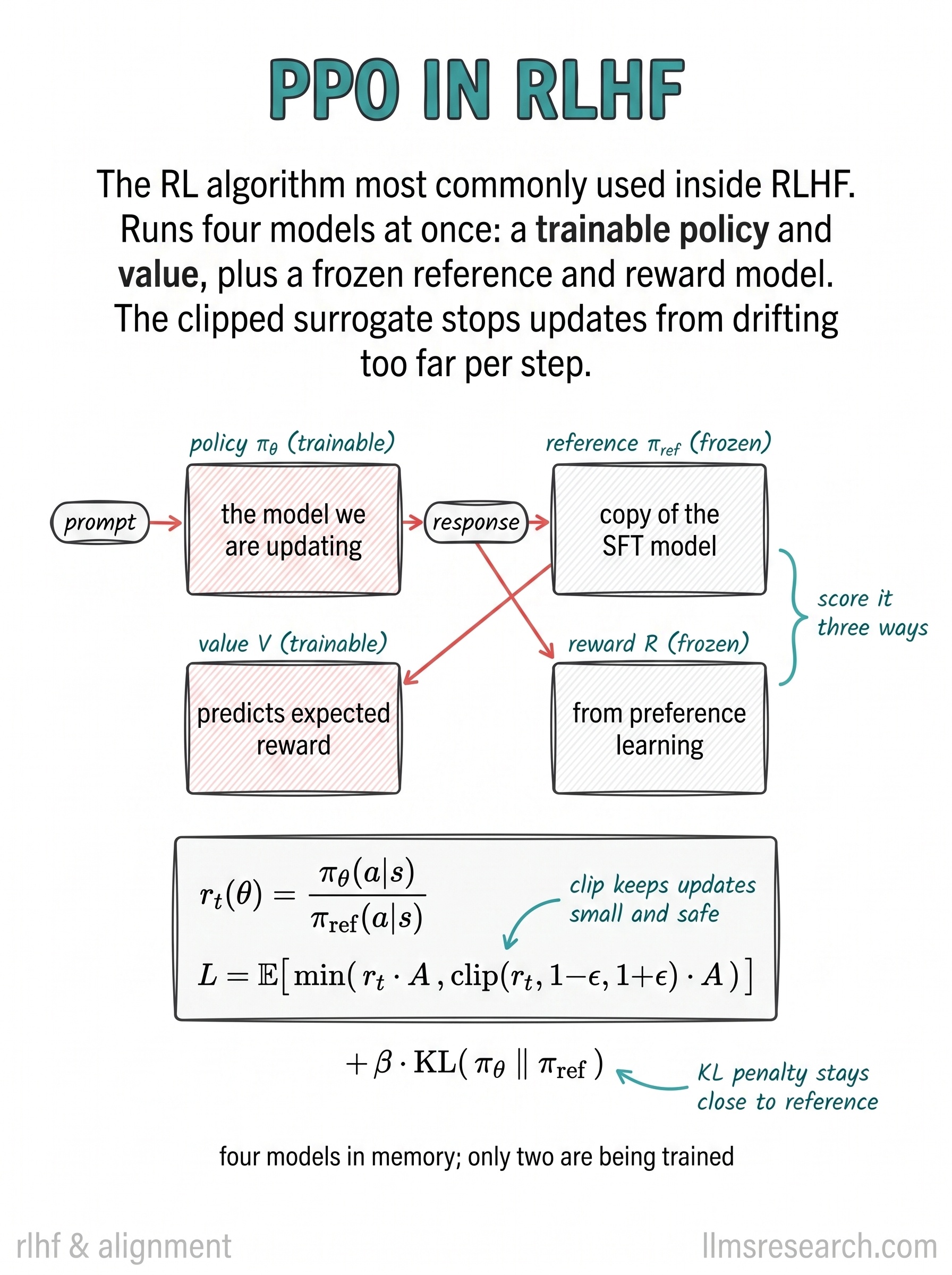
PPO, short for proximal policy optimization, is the algorithm that carries out stage three of RLHF. The card’s central image is a count of models, because the surprising part of PPO in this setting is how many networks are in memory at once. Four of them. The policy is the model being trained. A value head predicts the expected reward of a partial generation. A frozen reference policy is a copy of the SFT model that never updates. A frozen reward model supplies the score. Only the first two are learning; the other two are fixed graders and anchors.
Following the arrows explains why each is present. A prompt goes into the policy, which generates a response. That response is scored three ways, as the card notes: the reward model rates its quality, the reference policy says how likely it would have been under the original SFT model, and the value head estimates how good the policy expected to do. The reward gives the training signal, the value head reduces the variance of that signal so learning is less noisy, and the reference provides the baseline the policy is not allowed to wander far from.
The objective box holds the mechanism PPO is named for. It defines a ratio, the probability the current policy assigns to an action over the probability the reference assigned to it, and then it takes the smaller of two terms: that ratio times the advantage, or a clipped version of the ratio times the advantage. The clip holds the ratio inside a band around one, so a single update can only move the policy a bounded amount even when the reward suggests a large step. The card’s annotation, that the clip keeps updates small and safe, is the whole point. Reward signals in this setting are noisy proxies, and an unclipped step chasing a spike in reward is how a policy breaks itself.
Below the clipped term sits the KL penalty, beta times the divergence between the policy and the reference. It is the second brake, and it gets its own card next. For now the takeaway is the one the caption states: four models occupy memory but only two are trained, which is why PPO-based RLHF is expensive to run and why the simpler alternatives later in the chapter, DPO in particular, are attractive when the full apparatus is more than a project needs.