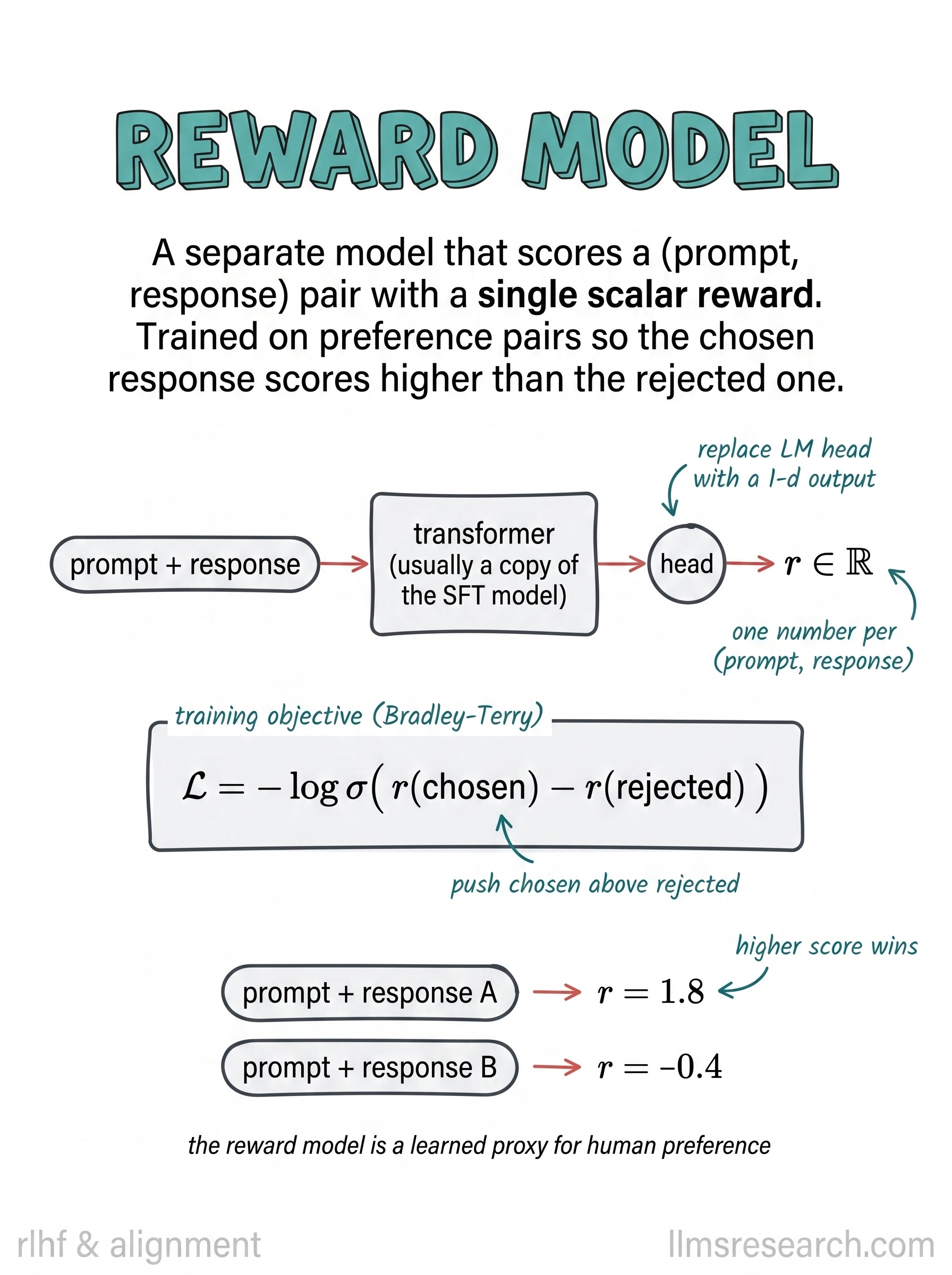
The reward model is the piece that lets reinforcement learning grade responses no human has looked at. The card draws it as a familiar transformer, usually a copy of the SFT model, with the language modeling head swapped for a one-dimensional output. A prompt and a response go in; a single number comes out. That number is the model’s estimate of how much a person would prefer this response, and it is the only signal stage three of RLHF gets to optimize against.
Replacing the head is a small architectural change with a large consequence. The usual head produces a distribution over the vocabulary, one score per possible next token. Here it produces one scalar for the whole sequence, read off the final position. The body of the network is left intact and warm-started from the SFT model, so the reward model already understands language before it ever sees a preference label. Training only has to teach it to compress that understanding into a single quality number, which is why a copy of the SFT model is the natural starting point.
The training objective on the card is where the preference data from the previous card turns into a score. The loss is the negative log of a sigmoid applied to the reward of the chosen response minus the reward of the rejected one. Read plainly, it pushes the chosen score above the rejected score, and the sigmoid means the loss keeps caring until the gap is comfortably positive rather than merely nonzero. This is the Bradley-Terry form spelled out in full on the next card; here it is enough to see that the model never predicts an absolute quality, only the direction of each comparison, and the scalar emerges from fitting many of them at once.
The worked example makes the payoff concrete. Response A scores 1.8, response B scores negative 0.4, and the higher number wins, so A is judged the better answer. The caption’s framing, that the reward model is a learned proxy for human preference, is the honest description and also the warning. It is a proxy, not the thing itself, so a policy that optimizes it too aggressively can climb the proxy’s score while drifting away from what people actually wanted. That gap is exactly what the KL penalty later in the chapter exists to contain.