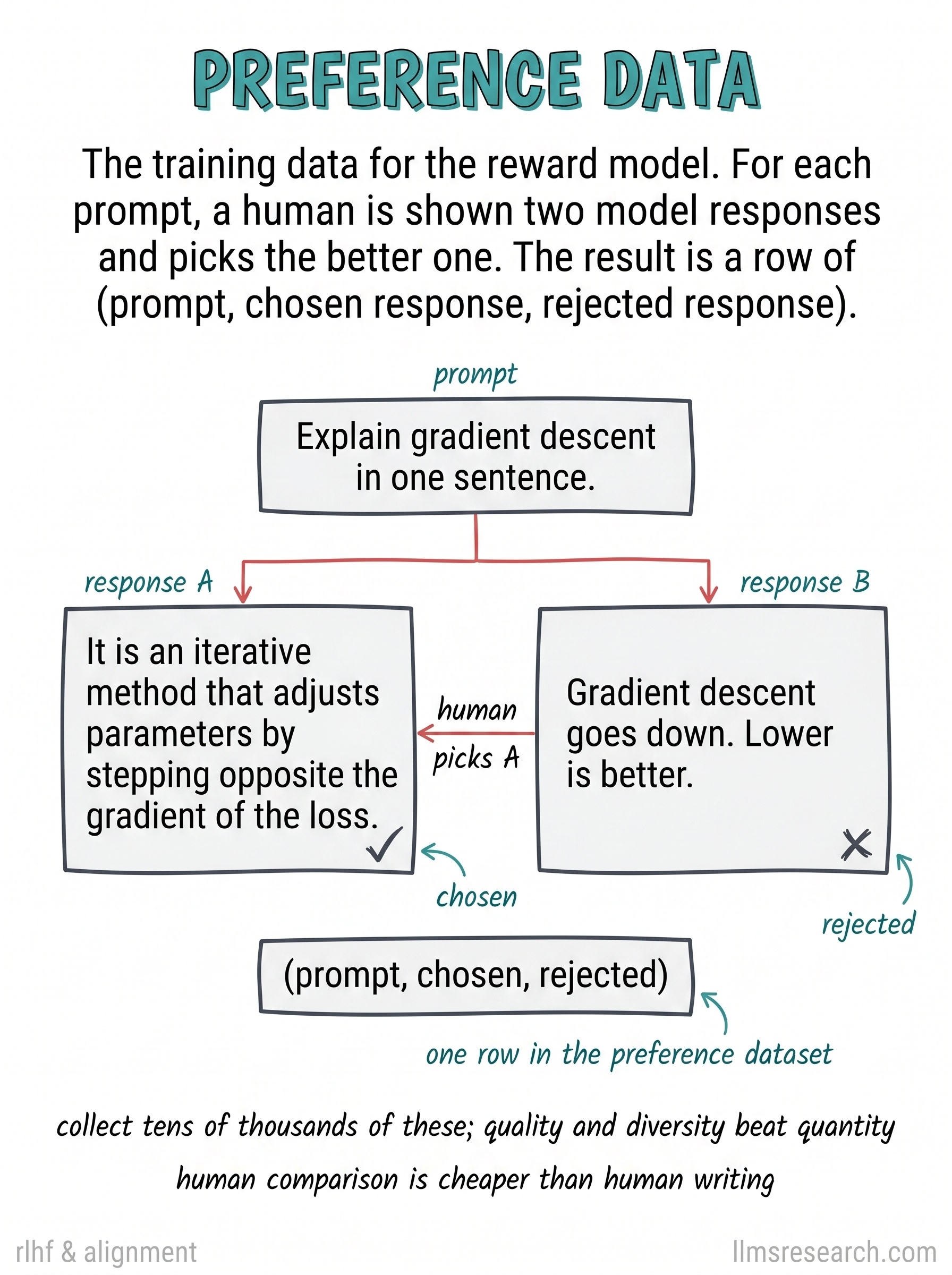
Preference data is what the reward model learns from, and the card shows one row of it in full. A prompt asks the model to explain gradient descent in one sentence. Two candidate responses come back, labeled A and B. A person reads both and picks A as the better answer. That single act of comparison becomes a training row written as a triple: the prompt, the chosen response, and the rejected response. Thousands of these rows are what stage two of the RLHF pipeline trains on.
The design choice worth dwelling on is why the label is a comparison rather than a score. If you asked annotators to rate a response from one to ten, different people would anchor the scale differently and the same person would drift over a long session, so the numbers would be noisy and hard to compare across raters. Asking which of two responses is better sidesteps all of that. People are far more consistent at relative judgments than absolute ones, and a pile of consistent comparisons carries more usable signal than a pile of shaky ratings. The card’s note that comparison is cheaper than writing points at the same economy: a person does not have to author a good answer, only recognize one.
Each row records only that chosen beat rejected for this prompt, nothing about by how much. That is deliberate. The reward model will convert many such binary outcomes into a continuous score, and the machinery that does the conversion is the Bradley-Terry model on the next card. The preference data supplies the raw wins and losses; the score is inferred from them.
The caption’s remark that quality and diversity beat quantity is the practical lesson. A reward model trained on comparisons that all look alike learns a narrow slice of what people want and generalizes poorly to prompts outside that slice. Coverage across topics, difficulties, and failure modes matters more than sheer row count, because the reward model can only grade dimensions of quality that its training comparisons actually varied.