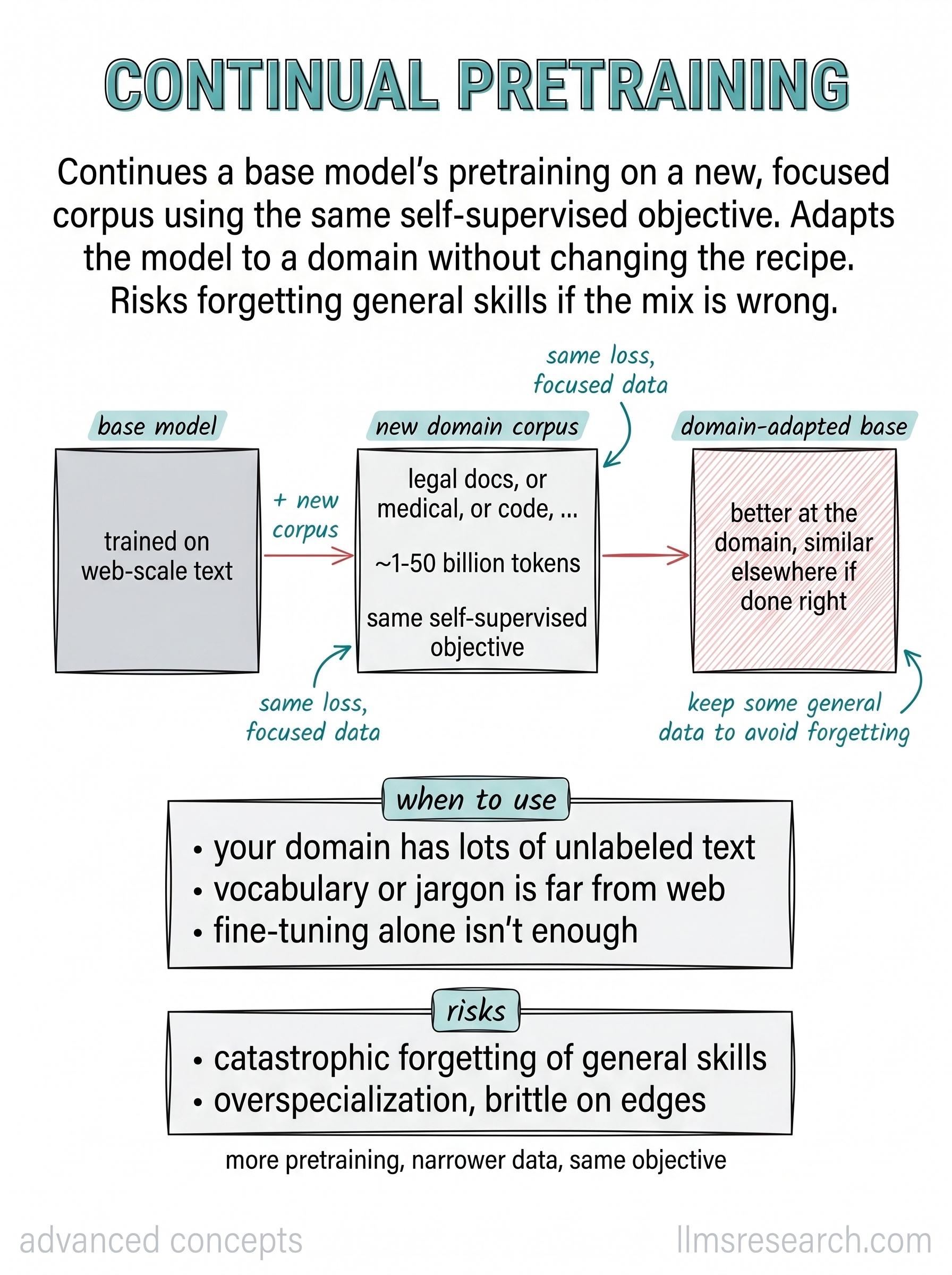
Continual pretraining sits between ordinary fine-tuning and training from scratch. Instead of teaching the model to follow tasks, it keeps running the original pretraining objective, next-token prediction on raw text, but on a new corpus focused on one domain. The card draws it as a two-stage pipeline: a base model trained on web-scale text, plus a new domain corpus of legal or medical or code documents on the order of 1 to 50 billion tokens, produces a domain-adapted base that is better at the domain and, if done right, similar elsewhere.
What separates this from the instruction and SFT cards is that nothing about the recipe changes. The card repeats the phrase same loss, focused data on both sides of the diagram to make the point. There are no instruction and response pairs and no masked loss; the model simply reads more text of a particular kind and predicts it token by token, exactly as in the original run. The output is still a base model, not an assistant. It has absorbed the vocabulary, phrasing, and patterns of the domain, and would typically go through instruction tuning afterward to become usable.
The card’s when-to-use list marks the situations where this is worth the cost: the domain has a large amount of unlabeled text, its vocabulary or jargon sits far from ordinary web text, and fine-tuning alone has not been enough. That last condition is the practical trigger. Light fine-tuning adjusts behavior but does not deeply reshape what the model knows, so when a domain is genuinely distant from the pretraining distribution, more pretraining on domain text can move the model in a way fine-tuning cannot.
The risk is the same one the catastrophic forgetting card described, now applied to a heavier process. Continuing to train on a narrow corpus pulls the weights toward that domain and can erode general skills, and the card lists catastrophic forgetting and overspecialization as the two dangers. Its mitigation is also familiar: keep some general data in the mix to avoid forgetting, shown by the annotation on the domain-adapted output. The summary line ties it together, more pretraining, narrower data, same objective. This closes the fine-tuning chapter; the next part turns from supervised adaptation to alignment from preferences.