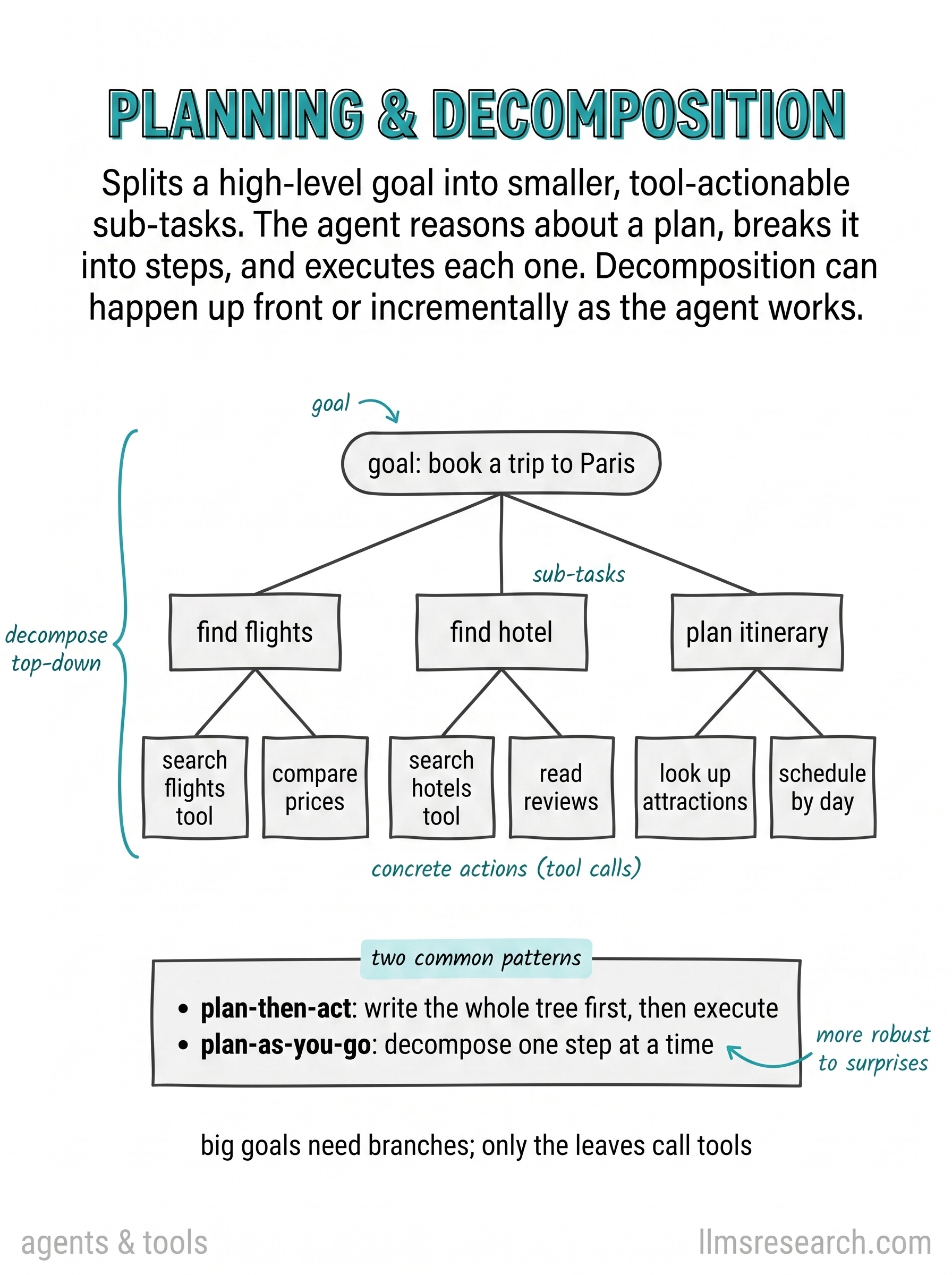
The card shows a tree. At the root sits a high-level goal, something like “prepare a quarterly report.” That goal splits into sub-tasks: gather sales data, pull support tickets, draft the narrative. Each sub-task splits again until the leaves are small enough to execute directly, run this SQL query, fetch this file, write this section. The visual is task decomposition: breaking an ambiguous request into parts the agent can handle sequentially or in parallel.
Planning is what produces that tree. Before or during execution, the model (or a separate planner module) proposes an ordered list or hierarchy of steps. The agent loop then works through the leaves, marking nodes complete and revising the plan when a step fails or returns unexpected data. A flat loop without planning tends to improvise one step at a time, which works for short tasks but drifts on multi-stage work.
Decomposition also controls context. Each sub-task can be handed to the model with only the information relevant to that step, rather than the entire project history. That reduces noise in the context window and makes it easier to retry a single branch without replaying the whole run. Multi-agent systems often assign different branches to different specialized agents, but a single agent benefits from the same structural idea.
The practical takeaway is to match planning depth to task uncertainty. A fixed pipeline needs little decomposition; an open-ended research or coding task benefits from an explicit plan the agent can update. Plans should be treated as hypotheses, not contracts. When a sub-task fails, the tree gets pruned or rewritten rather than forcing the agent to finish a broken branch. Good decomposition is the difference between an agent that looks busy and one that reaches the actual goal.