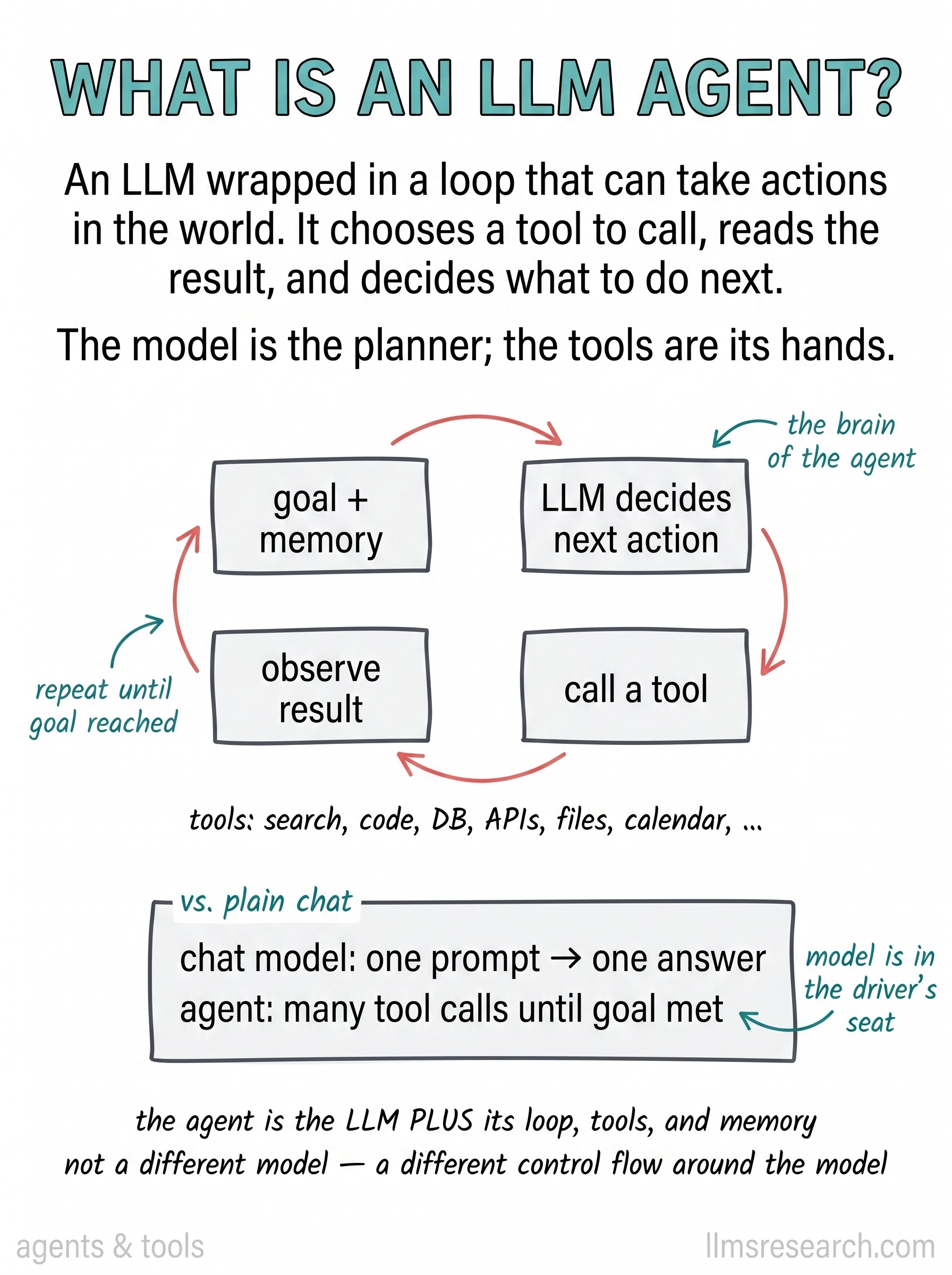
The card draws a contrast that matters more than any definition. On one side sits a plain chat model: a user asks a question, the model answers once, and the exchange ends. On the other sits an agent loop: the model reads the task, decides what to do next, calls a tool, reads what came back, and decides again. The hero diagram is that loop, with arrows cycling through decide, act, and observe until something tells the system to stop.
The word “agent” here does not mean a separate kind of model. It is the same LLM, wrapped in orchestration code that gives it tools and keeps calling it until the job finishes or a budget runs out. Each pass through the loop appends new messages to the context: the model’s own tool call, the tool’s return value, and whatever the model says next. The growing transcript is both the agent’s working memory and the record of everything it has tried so far.
What changes compared to single-turn chat is control flow. A chat model has no channel to the outside world unless you paste information in. An agent can query a database, run code, search the web, or call any API you wire up, then fold the result back into the next model call. The model still only emits text, but that text can be a structured tool invocation rather than a final answer, and the runtime executes it and feeds the outcome back.
The practical takeaway is architectural. Building an agent means defining which tools exist, how their results are formatted, when the loop stops, and what state persists between steps. The model supplies judgment about what to try next; the surrounding code supplies persistence, execution, and guardrails. Tool use, stopping conditions, and error handling each get their own card in this chapter because they are the parts you must design around the model, not properties the model provides on its own.