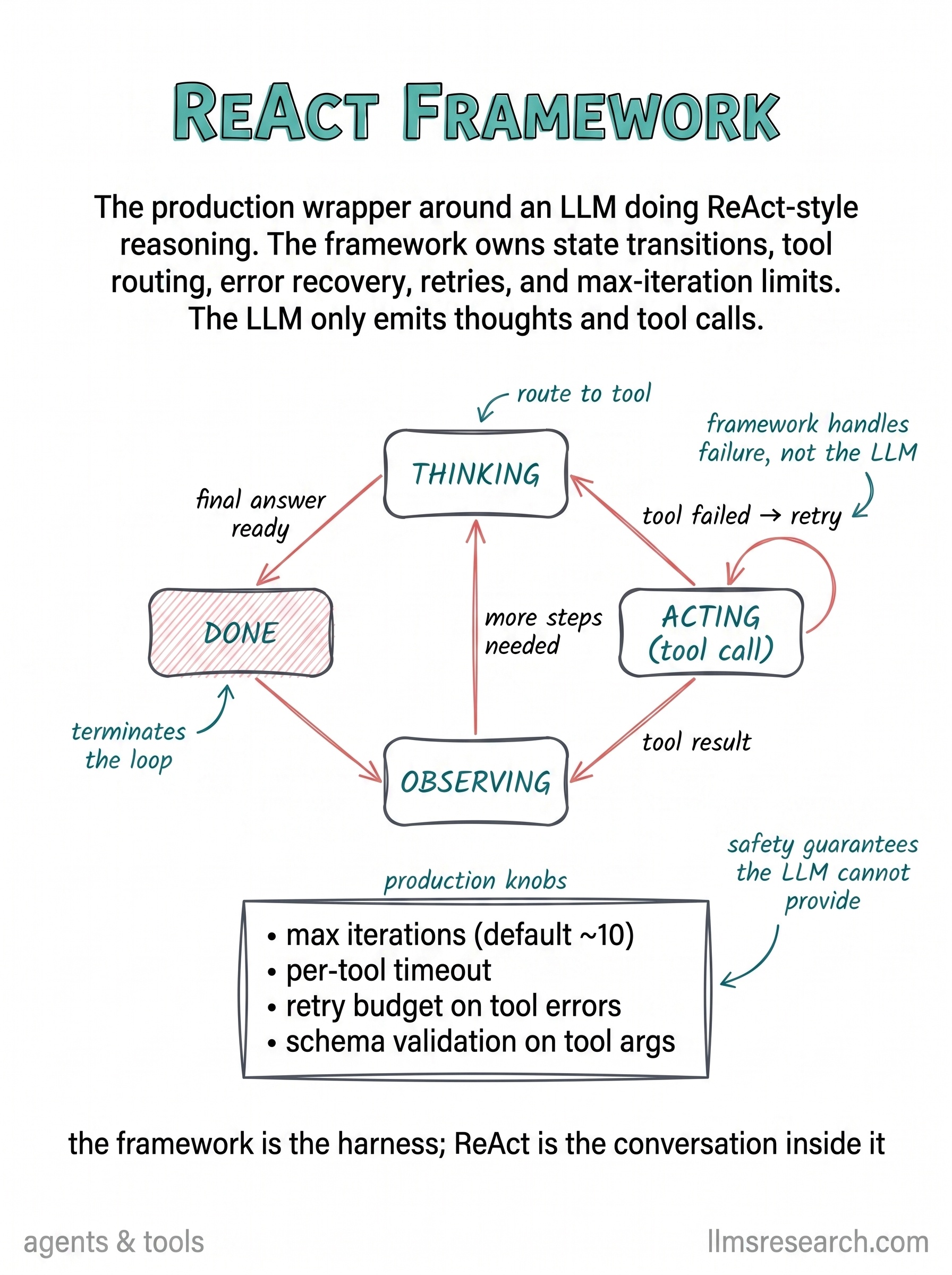
ReAct, short for Reasoning and Acting, names a pattern where the model alternates between explicit thought steps and tool use. The card does not show a single example trace. It shows the state machine you wrap around an LLM in production: states for reasoning, acting, observing results, handling failures, and stopping. That framing matters because a research paper trace and a deployed agent are different things.
In the ideal trace, the model writes out what it plans to do, calls a tool, reads the observation, updates its reasoning, and continues. The production view adds the parts a demo often skips. When a tool call fails, the machine routes to a retry or fallback path rather than passing a raw stack trace to the user. When the model emits malformed JSON, a parser error loops back for correction. When the same action repeats without progress, a detector forces exit. Each transition is an explicit branch, not an accident of prompt wording.
The value of interleaving thought and action is interpretability and grounding. The reasoning steps give you a readable log of why the agent chose each tool. The observation steps anchor those choices in returned data rather than in guesses from weights. Neither guarantee is perfect: reasoning can be post-hoc rationalization and observations can be misread. But the structure makes failures easier to diagnose than a black-box sequence of tool calls.
Building ReAct in practice means defining the message format the model should follow, training or prompting it to respect that format, and implementing the state machine that enforces retries, budgets, and termination. The agent loop card describes the outer while-block; ReAct describes one disciplined way to structure what happens inside each iteration. Error handling and stopping conditions are the other half of making that pattern reliable enough to ship.