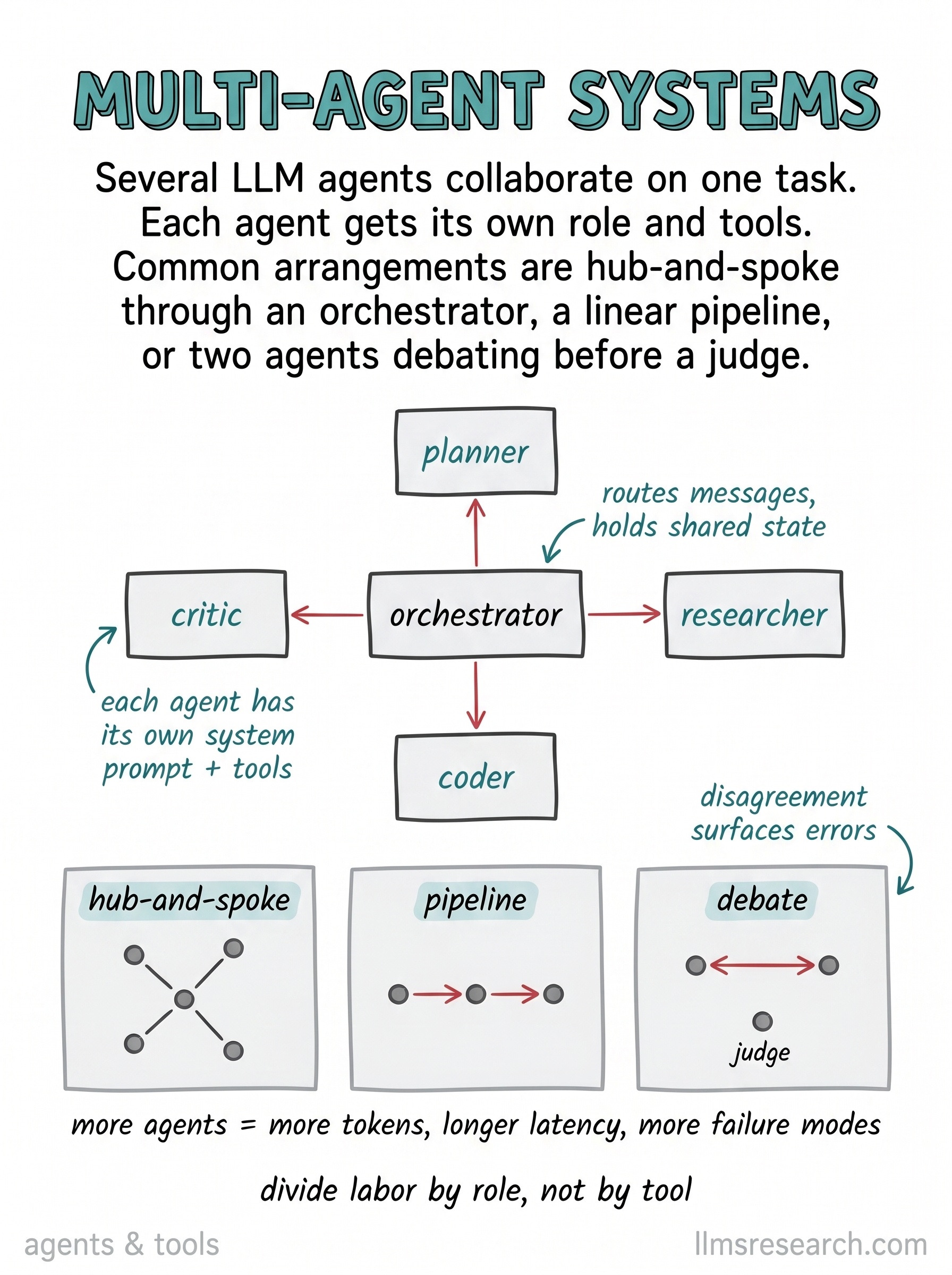
The card shows several agents around a single task, connected through a central orchestrator or through direct messages between peers. Each agent has a narrow role: researcher, coder, reviewer, or domain specialist. The orchestrator assigns sub-tasks, collects results, and decides what happens next. Three small sub-diagrams sketch common patterns: one lead agent delegating to workers, a chain where output passes from agent to agent, and a group that argues or critiques before converging on an answer.
The motivation is specialization and context isolation. One model trying to plan, implement, test, and document in a single thread accumulates noise and conflicting instructions. Splitting roles gives each agent a shorter prompt, clearer tools, and a smaller slice of the problem. A coding agent does not need the researcher’s full web search history; it needs the spec. That separation also limits how far a mistake in one branch propagates.
Coordination cost is the tradeoff. Every handoff adds latency, tokens, and opportunities for miscommunication. An orchestrator must serialize results, detect when a worker is stuck, and merge partial outputs into something coherent. Without explicit schemas for what each agent returns, synthesis becomes another fragile LLM call. Patterns that look elegant in a diagram can be expensive and brittle if sub-tasks are too fine-grained.
Use multi-agent setups when the problem naturally factorizes and when parallel work saves wall-clock time, not when a single well-tooled loop would suffice. Orchestrator-worker fits independent sub-tasks like gathering sources in parallel. Sequential handoffs fit pipelines where each stage transforms the artifact. Debate or reviewer agents help when you want a second opinion on high-stakes output, at the price of extra model calls. The underlying building block is still one agent loop per participant; the system design is how those loops connect.