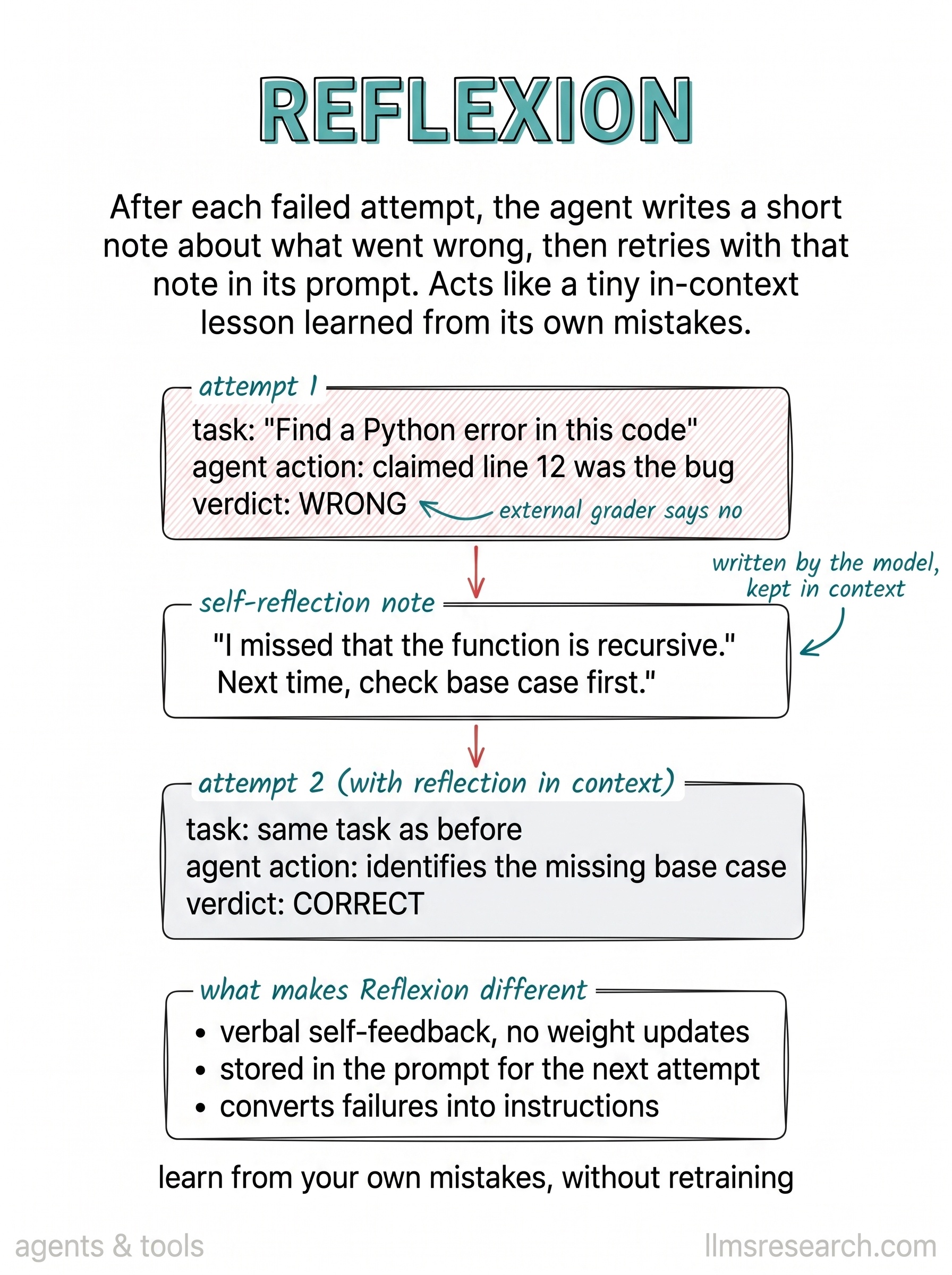
The card shows two attempts side by side. In the first, the agent tries the task and fails: a test does not pass, a tool returns an error, or an external checker marks the output wrong. Instead of starting from scratch, the agent writes a reflection, a short note to itself about what went wrong and what to try differently. In the second attempt, that note sits in context, and the agent succeeds by avoiding the earlier mistake. The hero is the loop: attempt, verdict, reflect, retry.
Reflexion treats failure as data rather than as a dead end. The verdict can come from unit tests, a human label, a reward model, or a simple rule that checks the output format. The reflection step asks the model to articulate the gap between what it did and what was required. That text is cheap to generate and cheap to store, but it carries forward lessons that would otherwise disappear when you reset the conversation.
Mechanically, this is still the same agent loop with an extra message type. After a failed attempt, the runtime appends the reflection to persistent state and either restarts the inner loop or continues within a step budget. The model does not update its weights; learning happens in context, across attempts within a session. That makes Reflexion a prompting and orchestration technique rather than a training method.
The practical limit is how honest and specific the reflection is. Vague notes (“try harder”) help little. Useful ones name the failed assumption, the wrong tool choice, or the misread observation. Pairing Reflexion with concrete verifiers, tests, lint output, or structured error messages, gives the reflection step something real to react to. Used that way, it is a lightweight way to squeeze more success out of a fixed model without fine-tuning.