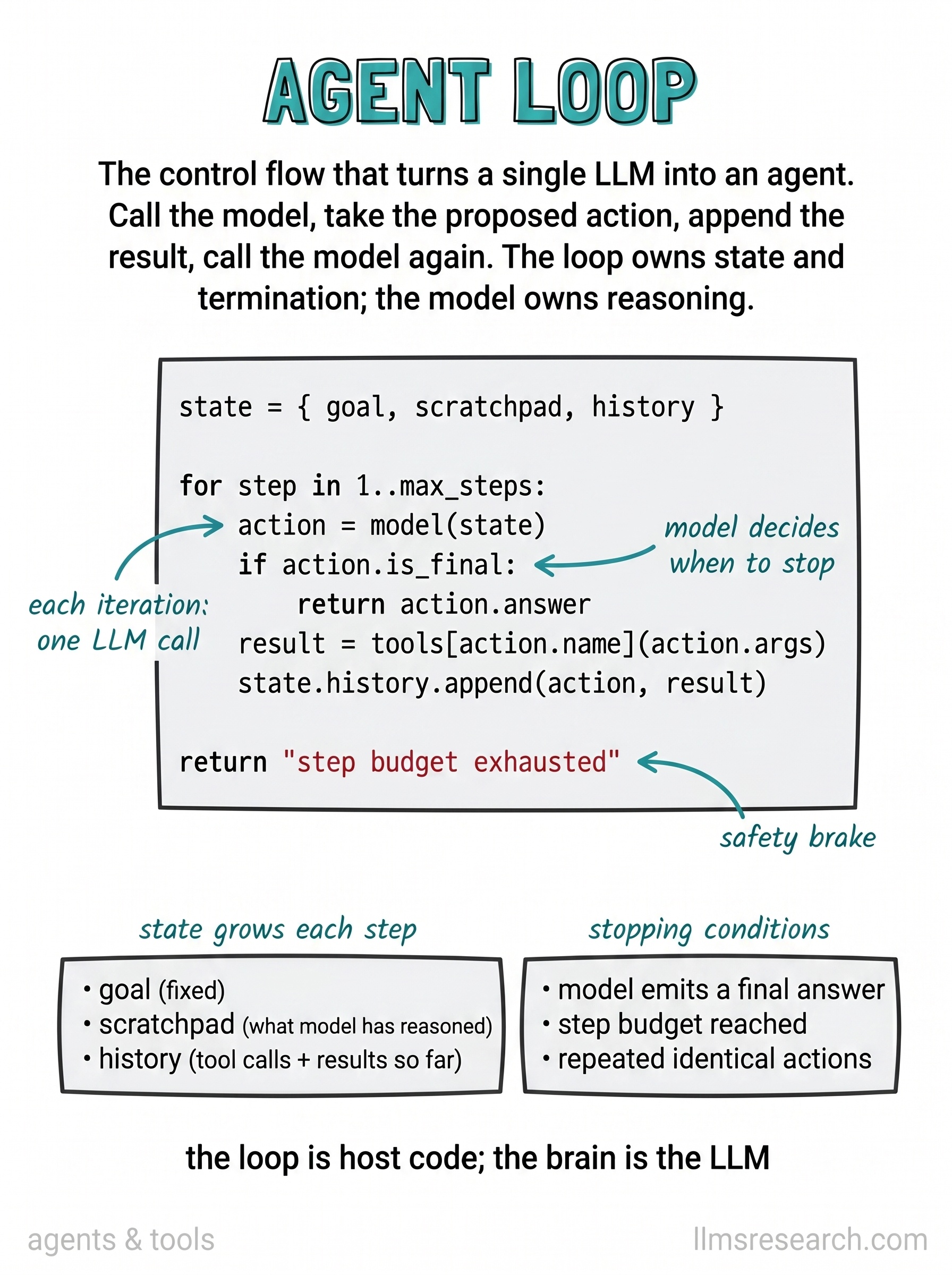
The card renders the loop as pseudocode, and that framing is deliberate. This is not a single model invocation but a program that keeps calling the model until something tells it to halt. The while-block wraps each turn: append the latest messages to state, call the LLM, inspect the response, branch on whether it is a tool call or a final answer, execute tools if needed, and loop again. State, tools, and termination each have an explicit role in the diagram.
State is the accumulated conversation plus any structured fields you maintain outside the model, such as a task list, retrieved documents, or intermediate results. Every iteration reads from that state and writes back to it. Tools are the functions the runtime can execute when the model requests them. Termination is the set of conditions that break the loop: the model emits a final answer, a step counter hits its limit, the same action repeats without progress, or a time or cost budget expires.
The loop is where agent behavior actually lives. The model does not know it is inside a while-block; it sees a growing transcript and responds to the latest turn. The orchestrator decides whether to keep going, which tools to expose, and when to force a stop. That separation is useful: you can swap models, change tool sets, or tighten budgets without retraining anything, because the loop logic is ordinary application code.
In production, the loop is also where reliability work concentrates. Logging each iteration makes debugging tractable when an agent wanders or fails silently. Wrapping tool execution in try/catch and feeding errors back to the model lets the agent recover from bad calls rather than crashing. And explicit step caps prevent runaway cost when the model never reaches a final answer. Stopping conditions and error handling are separate cards because they spell out the branches this pseudocode block depends on.