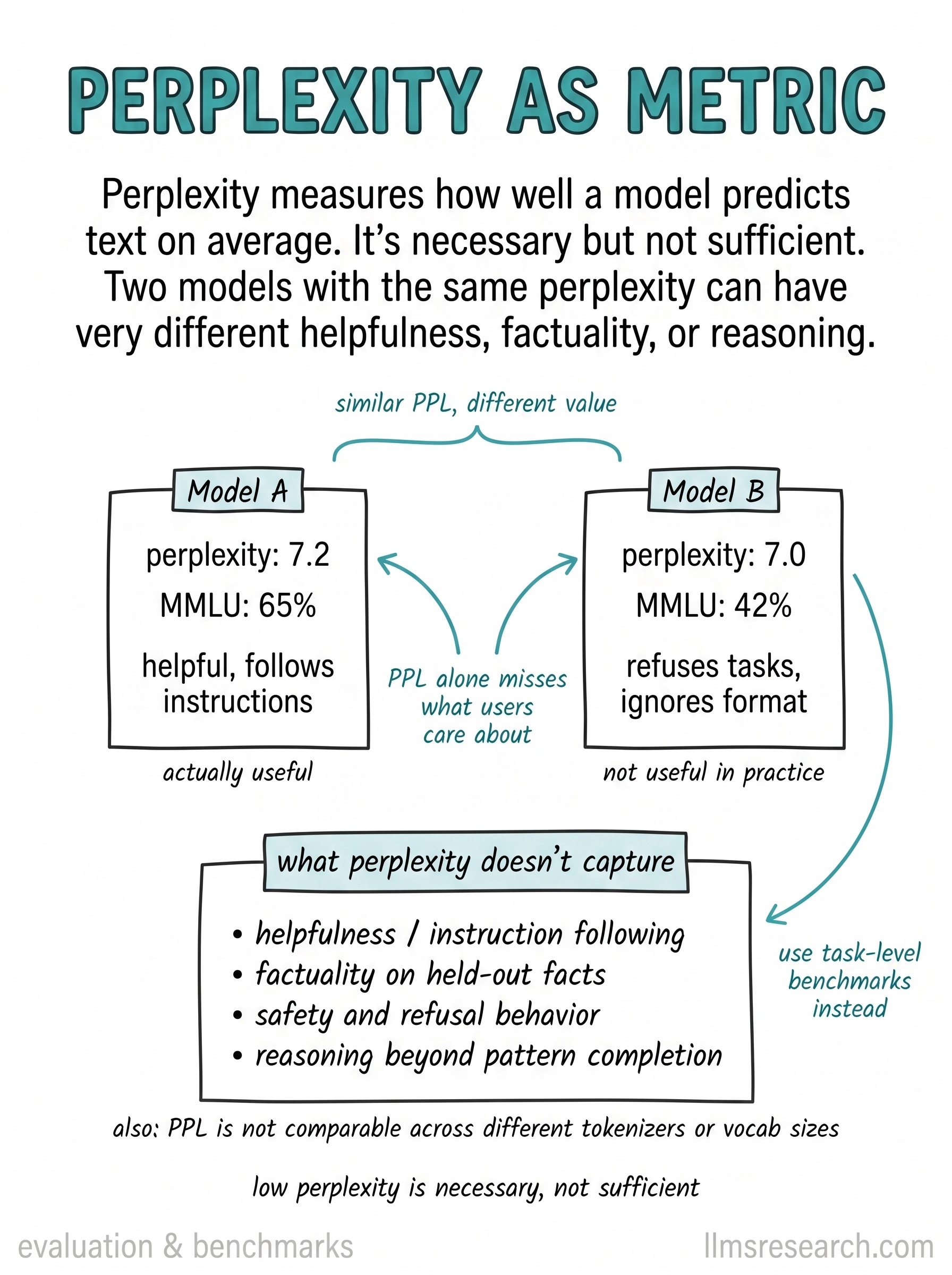
Perplexity is the standard readout of the language modeling objective, but it is often mistaken for a full quality score. The card makes that mistake visible with a counter-example. Model A and Model B sit side by side with nearly identical perplexity, around 7.2 and 7.0. Model A scores well on MMLU and follows instructions; Model B scores lower and refuses or ignores format. Similar perplexity, very different value in practice.
The middle box names what perplexity does not capture. It says nothing about helpfulness or instruction following, factuality on held-out facts, safety and refusal behavior, or reasoning beyond pattern completion. Those gaps matter because perplexity only asks whether the model predicted the held-out tokens well, not whether the predictions are useful, true, or safe in deployment.
The mechanism is straightforward. Perplexity is derived from cross-entropy loss on a validation set. Lower is better, and it tracks pretraining progress cleanly. The caption at the bottom states the practical rule: low perplexity is necessary, not sufficient. A model can be a strong token predictor and still be a poor assistant.
Two additional constraints keep the number honest. Perplexity is not comparable across different tokenizers or vocabulary sizes, since it is measured per token. And it reflects fit to text distribution, not task performance. The card’s takeaway is to use perplexity for training diagnostics and pair it with task-level benchmarks when you need to compare models for release or product decisions.