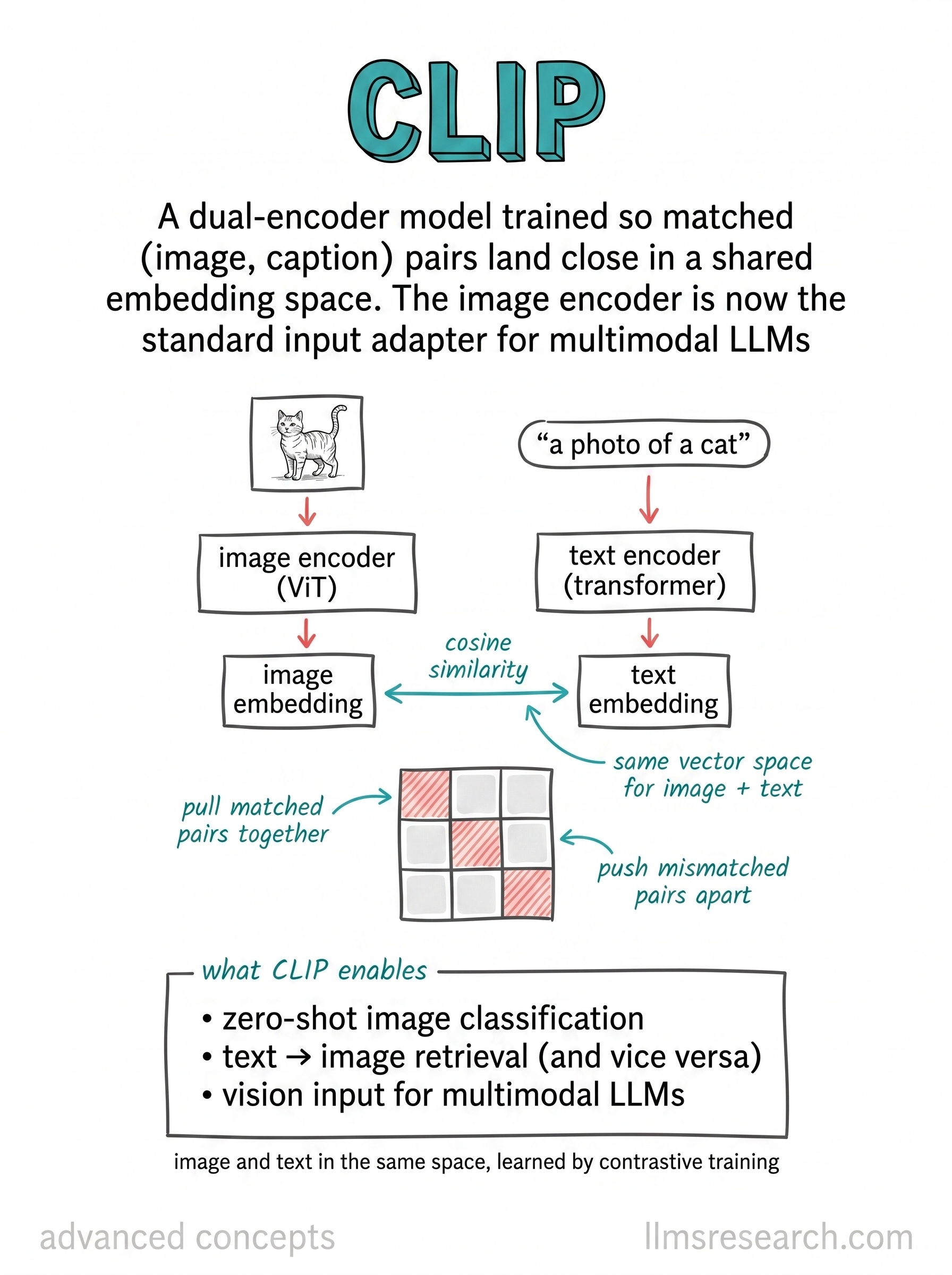
The card shows two parallel branches. An image passes through a vision encoder, typically a ViT, and becomes an image embedding. A caption passes through a text encoder, a transformer, and becomes a text embedding. A cosine similarity score sits between them. Below, a small matrix visualizes contrastive training: diagonal cells (matched pairs) are pulled together, off-diagonal cells (mismatched pairs) are pushed apart. The closing line states the outcome: image and text in the same space, learned by contrastive training.
CLIP does not generate captions or answer questions directly. It aligns representations. During training, the model sees many (image, text) pairs drawn from the web and learns to raise similarity on true pairs and lower it on pairs crossed within a batch. No classification labels are required for each image; the caption is the supervision. That scale of weakly paired data is what makes the embedding space general enough for downstream tasks the model was never explicitly trained on.
Zero-shot image classification is the familiar demo. At inference time, you embed an image once, embed a handful of candidate text prompts (“a photo of a dog,” “a photo of a cat,” …), and pick the highest cosine similarity. No fine-tuning step is needed for those candidates because the space already aligns language and vision. The same geometry supports text-to-image retrieval, image search by natural language, and ranking content by semantic nearness.
Many multimodal LLMs reuse CLIP-style or ViT-family encoders, sometimes initialized from CLIP weights, as the front end that produces visual tokens or features for the language model. The multimodal LLM card shows what happens after encoding; CLIP shows how a shared image-text space is learned in the first place. Cosine similarity in that shared space is the scoring function that makes retrieval and zero-shot selection work, which is why the embedding geometry matters as much as the encoder architecture.