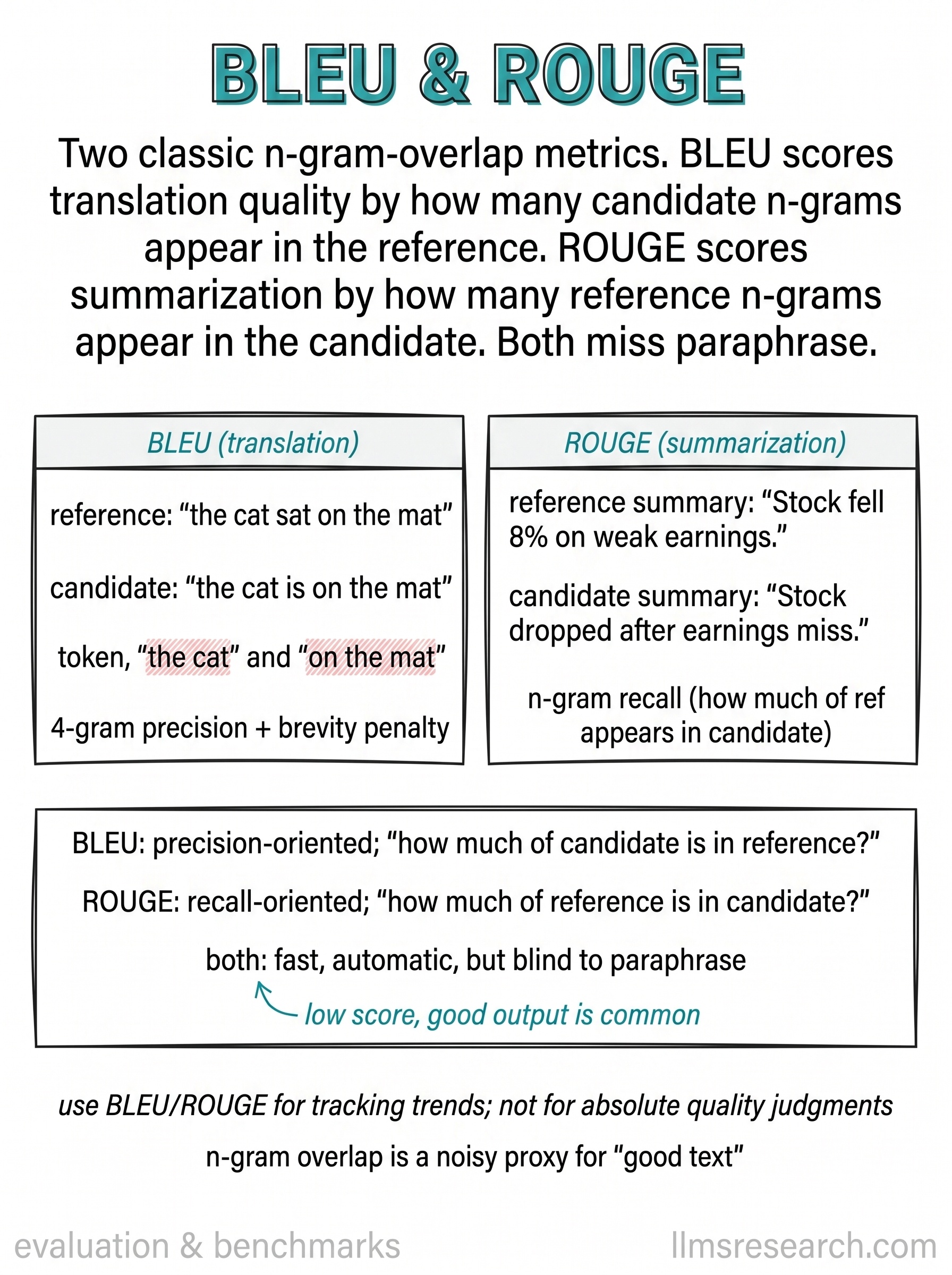
BLEU and ROUGE are the oldest automatic metrics still cited in NLP evaluation, and the card shows why they persist with two concrete panels. On the left, a translation example compares a reference sentence to a candidate. Matching n-grams are highlighted, and BLEU reports precision plus a brevity penalty. On the right, a summarization example pairs a reference summary with a candidate. ROUGE asks how much of the reference appears in the candidate, a recall-oriented view of overlap.
The comparison box below spells out the asymmetry. BLEU asks how much of the candidate appears in the reference, which suits translation where extra words hurt. ROUGE asks how much of the reference appears in the candidate, which suits summarization where missing key facts hurts. Both reduce quality to shared n-gram counts, which makes them cheap to compute at scale.
The blind spot is paraphrase. A candidate can be fluent and accurate while sharing few n-grams with the reference, and both metrics will score it low. The annotation on the card calls this out directly: low score with good output is common. That is why teams use BLEU and ROUGE to track trends across training runs or model versions, not to settle absolute quality judgments on their own.
For LLM work, these metrics still appear in machine translation pipelines and summarization benchmarks, but they are a weak fit for open-ended generation where many valid wordings exist. The practical takeaway is to treat n-gram overlap as a noisy proxy. Use it when you need a reproducible automatic signal, and reach for human evaluation or LLM-as-a-judge when paraphrase and meaning matter more than surface overlap.