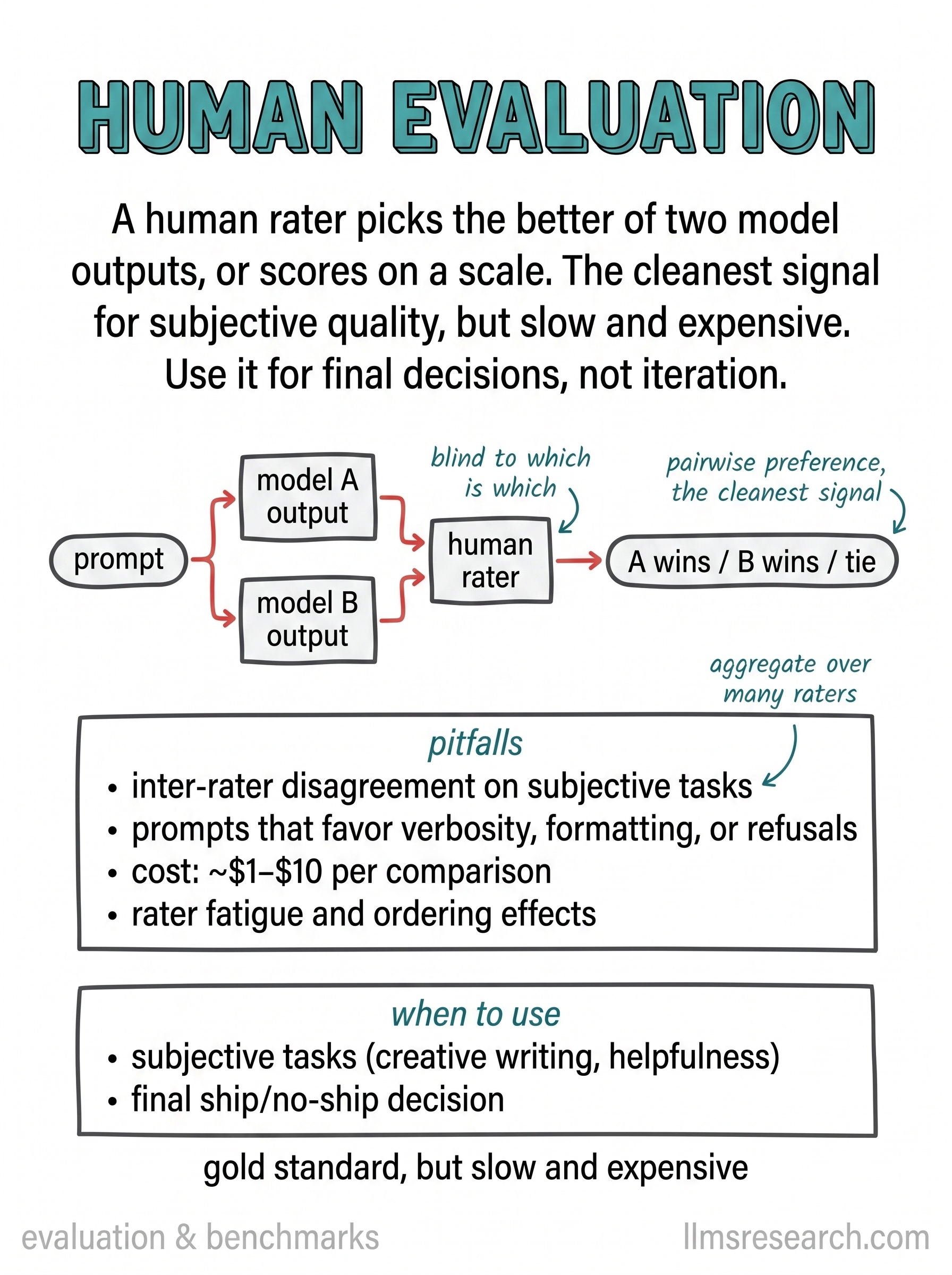
Automatic metrics miss most of what users care about in chat: tone, helpfulness, creativity, and whether an answer feels right. Human evaluation is the direct measure. The card draws a pipeline. One prompt branches to two model outputs. A human rater, blind to which model produced which answer, picks the better one or assigns a score. The result is a pairwise preference: A wins, B wins, or tie.
That pairwise setup is the mechanism teams rely on. Comparing two answers on the same prompt controls for prompt difficulty and isolates model differences. Likert scales work for single-output rating, but side-by-side comparison tends to produce cleaner, more consistent signal on subjective tasks. The annotation on the card calls pairwise preference the cleanest signal for a reason: it reduces the rater’s burden to a relative judgment.
The pitfalls box keeps expectations realistic. Raters disagree on subjective tasks, so you aggregate over many raters and many prompts. Prompt design can bias toward verbosity, formatting flourishes, or refusals that look cautious. Cost runs roughly one to ten dollars per comparison depending on task and vendor. Fatigue and ordering effects creep in during long sessions. None of these invalidate human eval, but they explain why it does not scale to every training iteration.
The when-to-use box draws the line. Reach for humans on subjective tasks like creative writing and helpfulness, and on final ship or no-ship calls where mistakes are costly. Use cheaper automatic or LLM judges for fast iteration during development. The card’s bottom line is blunt: human evaluation is the gold standard, but slow and expensive. Treat it as the last check, not the inner loop.