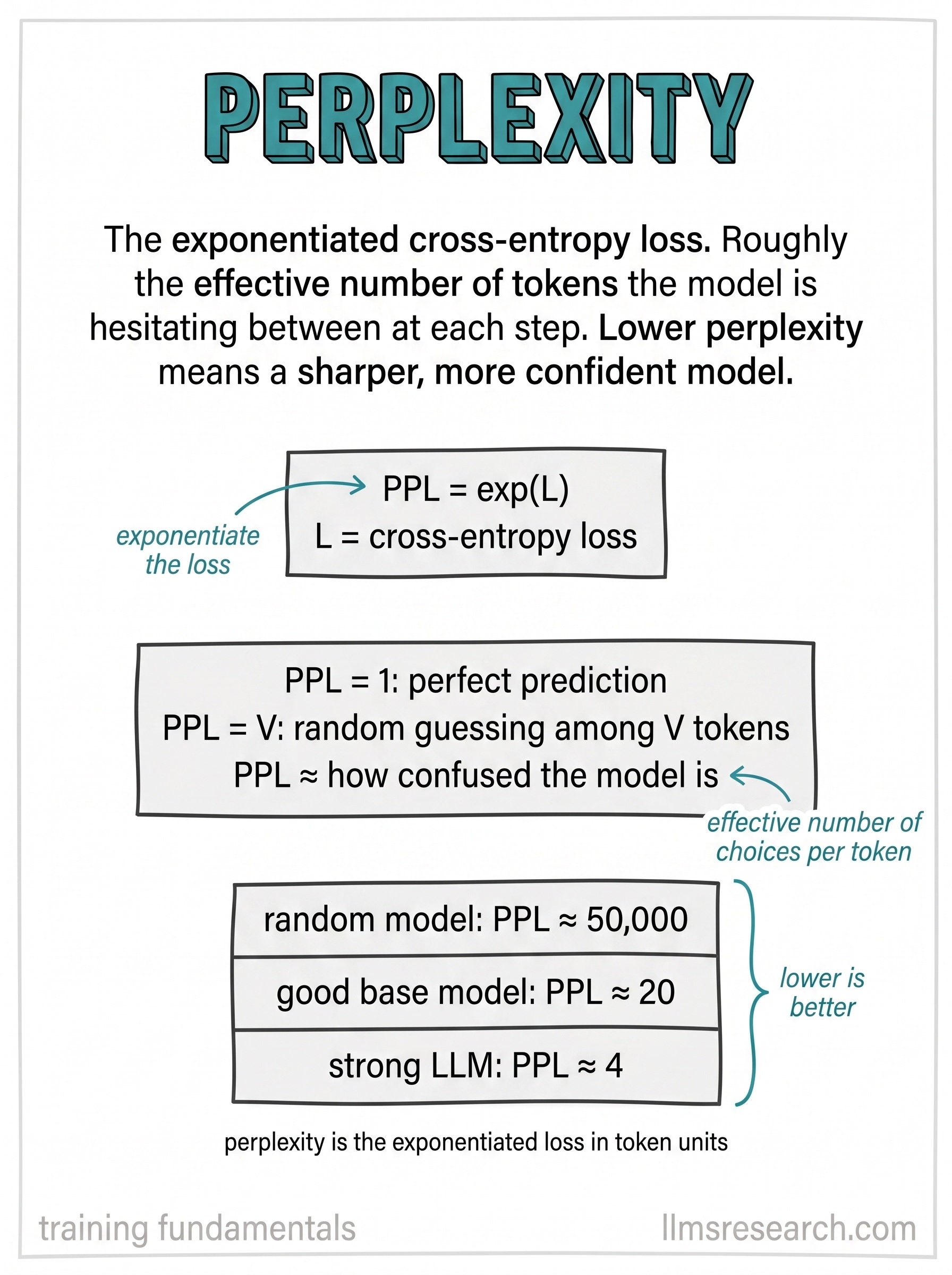
Cross-entropy loss is the right quantity to optimize, but it is awkward to read. A loss of 1.4 does not mean much on its own. Perplexity takes that same number and puts it back into units a person can reason about. The card gives the whole definition in one step: exponentiate the loss. If the loss is measured in nats, you raise e to the loss; the two operations have to use the same base to line up.
The payoff is the interpretation in the middle box. Perplexity is roughly the effective number of tokens the model is torn between at each position. A model that always knew the next token exactly would have perplexity 1, one choice, no hesitation. A model that had learned nothing and guessed uniformly across a vocabulary of size V would have perplexity V, as confused as a fair die with V faces. Real models sit between those poles, and the number tells you where.
The ladder at the bottom turns that into a rough quality scale. A random model over a 50,000-token vocabulary sits near 50,000. A decent base model lands around 20, meaning at each step it behaves as if choosing among roughly twenty plausible tokens rather than fifty thousand. A strong LLM pushes down toward 4 or lower. Each drop is larger than it looks, because perplexity is exponential in the loss: shaving a small amount off cross-entropy moves perplexity a lot at the low end.
Two cautions keep the number honest. Perplexity is only comparable across models that share a tokenizer, since it is measured per token and a different tokenization chops the same text into a different number of pieces. It also only reflects how well the model predicts held-out text, not whether that text is true or useful. It is the cleanest single readout of the training objective, which is exactly why it says nothing about the objective’s blind spots.