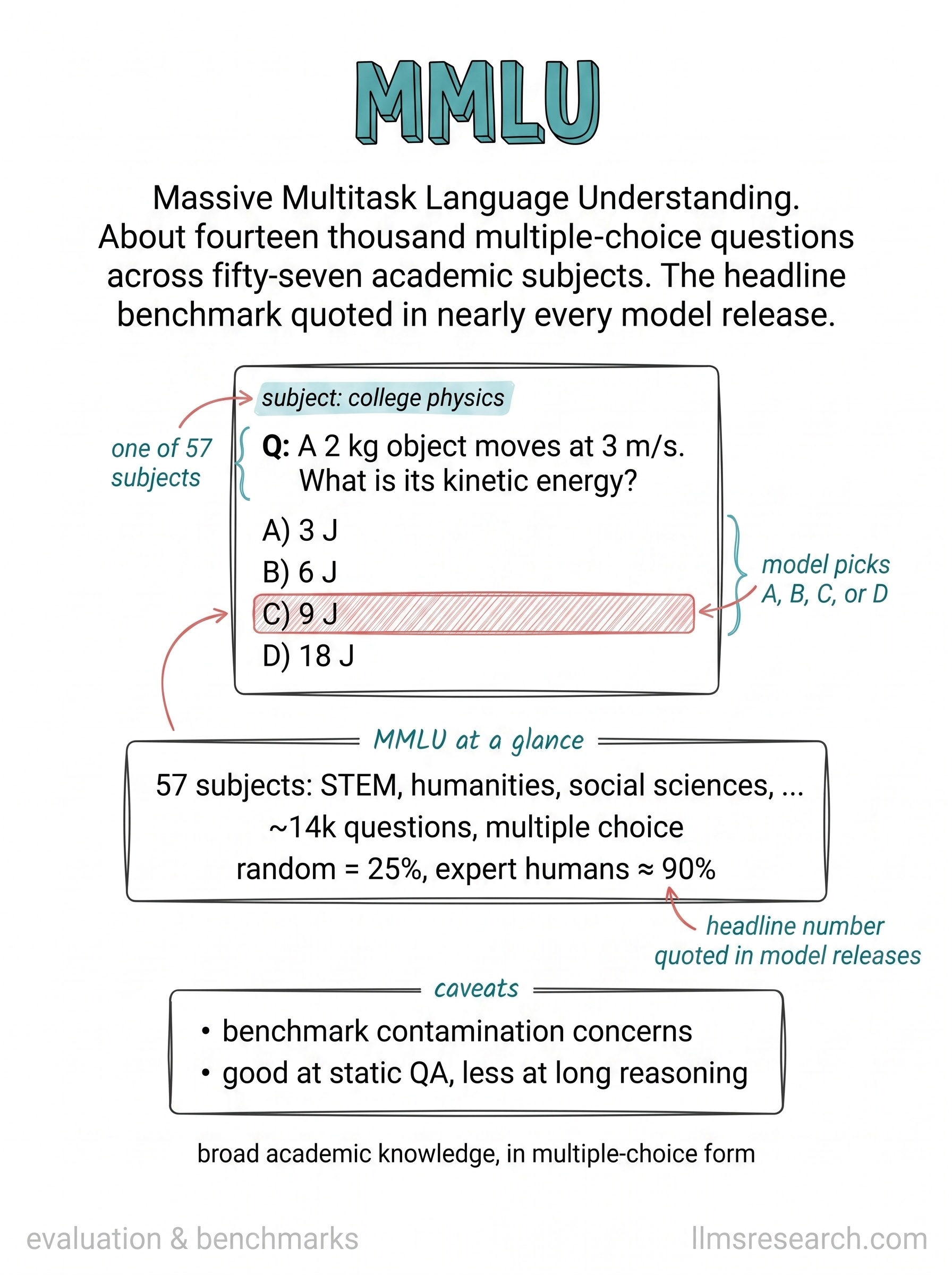
MMLU is the benchmark most often quoted in model release tables, and the card shows what a single item looks like. A college physics question asks for kinetic energy given mass and speed. Four options are listed, and the model picks A, B, C, or D. The subject tag reminds you this is one of fifty-seven topics spanning STEM, humanities, and social sciences.
The middle summary box gives the scale. Roughly fourteen thousand questions, all multiple choice. Random guessing yields about twenty-five percent. Expert humans score near ninety percent on many subsets. That gap between random and expert sets the range models are measured against, which is why the headline MMLU number travels so quickly in papers and blog posts.
The grading mechanism is simple and cheap. The model reads the question and options, outputs a letter, and accuracy is the fraction correct. No human rater is needed, and scores are reproducible given a fixed prompt and parsing setup. That simplicity is also the limitation. MMLU tests static question answering, not long chains of reasoning or tool use.
The caveats box names two recurring concerns. Benchmark contamination can inflate scores if questions leaked into training data. And strong MMLU performance does not guarantee strong performance on tasks that require extended reasoning or execution. The card’s bottom line is precise: MMLU measures broad academic knowledge in multiple-choice form. It is useful for comparison across models, but one number should not stand in for full capability.