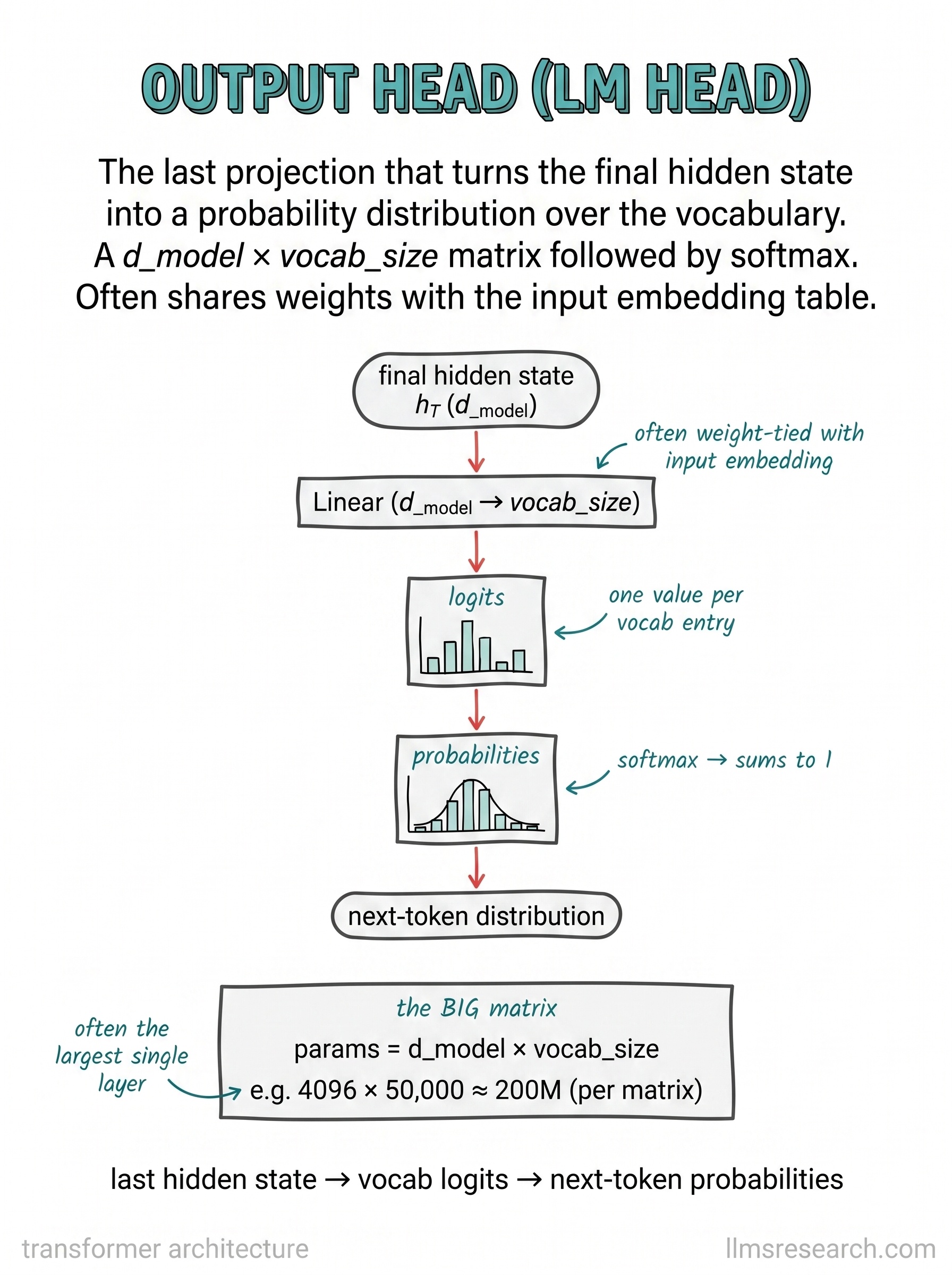
The stack of blocks produces a hidden state for each position, but a hidden state is a vector of features, not an answer. The output head is the last step that turns that vector into a prediction over actual tokens.
The flow down the middle of the card is short. The final hidden state h_T, of width d_model, goes through a linear layer that maps from d_model up to vocab_size, producing logits, one raw value per vocabulary entry. Softmax then converts those logits into probabilities that sum to one, giving the next-token distribution. The annotations name each step’s shape: logits are one value per vocab entry, and softmax is what makes the result a proper distribution. Everything the model knows about what comes next is expressed as this single vector of probabilities.
The weight-tying note is the interesting design detail. The input embedding table maps token IDs to vectors of width d_model; the output head maps a vector of width d_model back to scores over tokens. Those are inverse-shaped operations over the same vocabulary, so the same matrix can serve both, and the card notes the head is often weight-tied with the input embedding. Sharing the weights saves a large number of parameters and tends to help quality, though not every model does it.
The box at the bottom explains why anyone cares about one linear layer. Its parameter count is d_model times vocab_size, and with numbers like 4096 by 50,000 that is roughly 200 million parameters in a single matrix. The card calls it the big matrix and often the largest single layer. When a model has a large vocabulary, this one projection can dominate the parameter budget, which is part of why weight tying is attractive.
The one-line summary is the whole chapter’s endpoint: last hidden state to vocab logits to next-token probabilities. From here the model has a distribution to sample from, which is where decoding begins, and the way that distribution is trained is the language modeling objective.