The chapter has assembled a transformer block: attention, a feed-forward network, normalization, and residuals. This card is about how blocks are arranged into a full model, starting with the arrangement the original paper used.
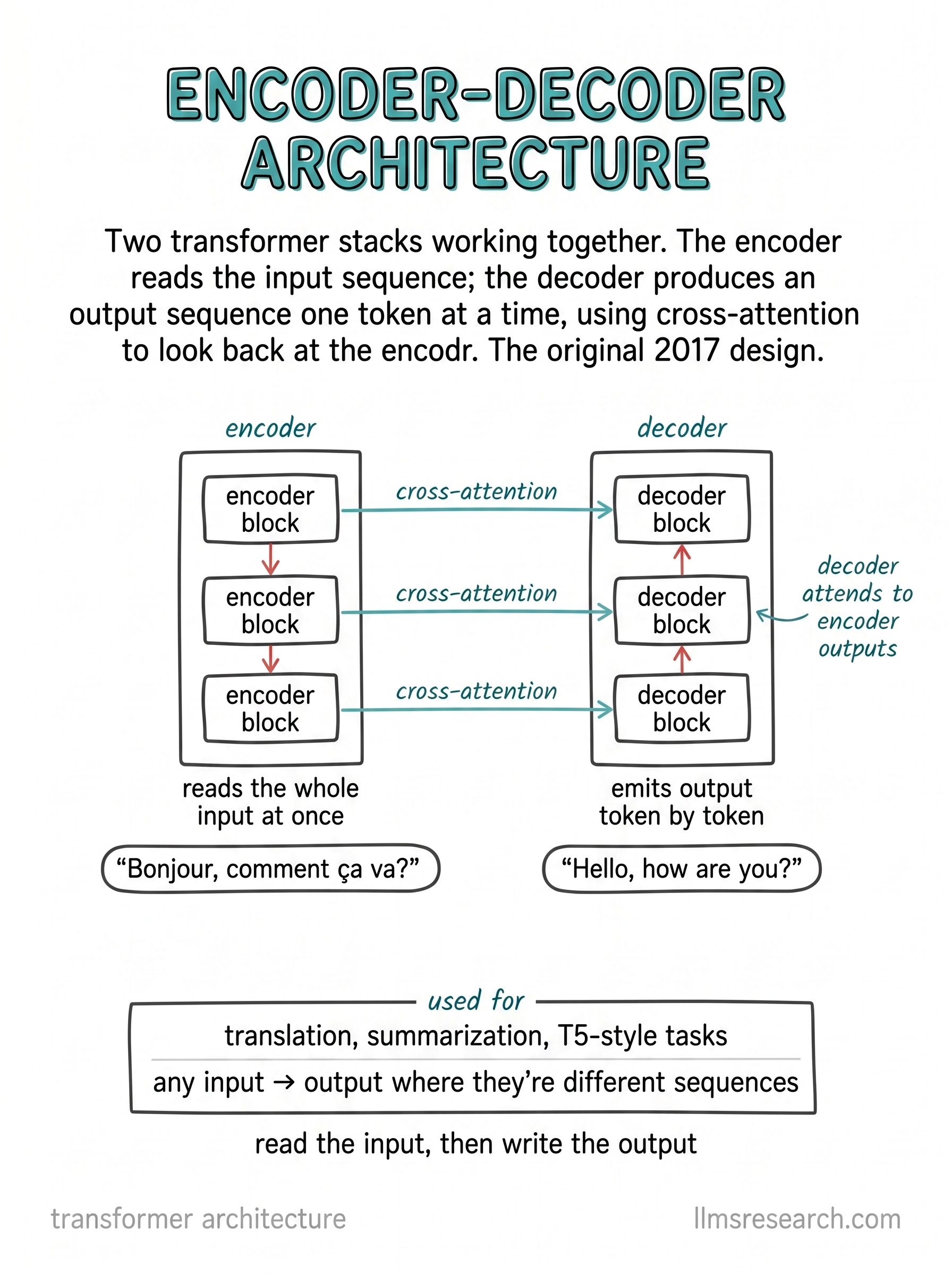
The diagram shows two stacks side by side. On the left, an encoder made of three blocks reads the whole input at once, so every position can attend to every other, in both directions. On the right, a decoder made of three blocks emits output token by token. The teal cross-attention arrows run from the encoder into each decoder block, and the annotation names the mechanism: the decoder attends to encoder outputs. That is the bridge covered in the cross-attention card, now shown in its original home. The decoder’s own attention over what it has generated stays causal, while cross-attention lets it consult the fully-read input.
The translation example makes the division concrete. The encoder ingests the French sentence, and the decoder produces the English one word at a time, checking the encoded French at every step through cross-attention. The two captions state the asymmetry cleanly: reads the whole input at once versus emits output token by token. One side comprehends, the other generates, and cross-attention is what connects them.
The use cases box explains when the two-stack design earns its extra machinery: translation, summarization, and T5-style tasks, or more generally any case where input and output are different sequences. When the task is to transform one text into a distinctly different text, having a dedicated reader and a dedicated writer is a natural fit.
The closing line, read the input then write the output, is the whole idea in five words. This was the 2017 starting point. The next two cards trace how the field split it apart, keeping only the encoder for understanding tasks or only the decoder for generation, and the comparison card weighs all three against each other.