Normalization keeps activation scales in check, but there is a second piece that makes depth work at all, and it is almost embarrassingly simple. A residual connection adds the sublayer’s input straight back to its output.
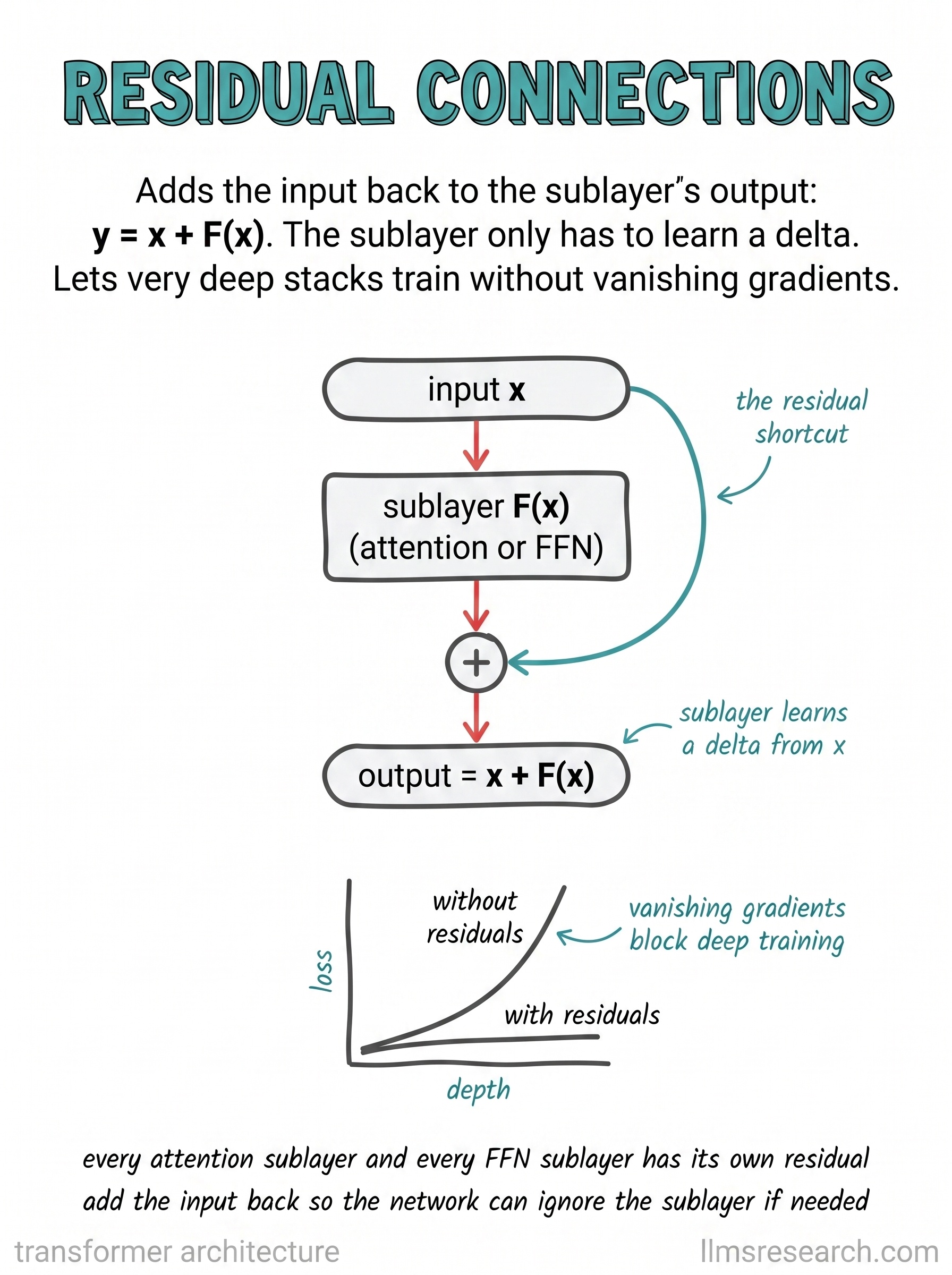
The diagram traces the whole idea. Input x goes into the sublayer, which is either attention or the FFN, producing F(x). The curved arrow on the right, the residual shortcut, carries x around the sublayer, and the two meet at the addition node. The result is output = x + F(x), stated in the formula at the top. The consequence is the annotation on the right: the sublayer only has to learn a delta from x. It does not need to reconstruct the useful information already in x and then modify it; it just produces the adjustment, and the shortcut supplies the rest.
The small plot at the bottom is the argument for why this is not optional. Without residuals, loss climbs sharply as depth increases, because vanishing gradients keep the early layers from receiving a usable training signal. With residuals, loss stays flat as depth grows. The shortcut gives gradients a direct path back through every layer, so a network that is dozens of blocks deep still trains. This is the mechanism that made deep transformers possible in the first place.
There is a quieter benefit in the closing line: add the input back so the network can ignore the sublayer if needed. If a particular sublayer is not helping for some input, it can learn to output something near zero, and the residual passes x through almost unchanged. The default behavior of a block is to preserve its input, and each sublayer earns its influence by improving on that.
The card’s other closing note ties this back to structure: every attention sublayer and every FFN sublayer has its own residual. Combined with the normalization placement from the pre-norm card, the residual is what defines the exact wiring of a transformer block.