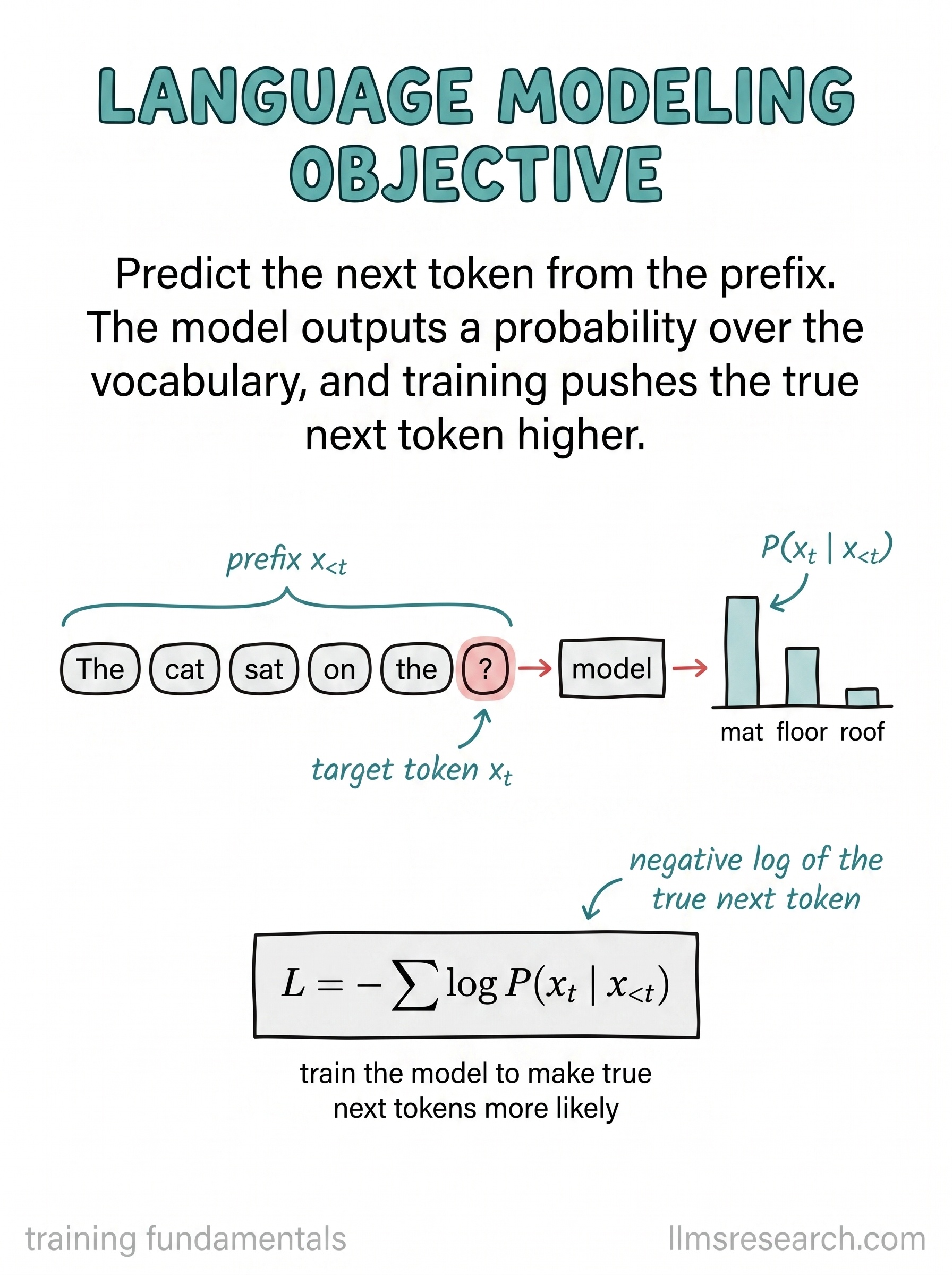
The task the model learns is almost embarrassingly simple. Given the tokens so far, guess the next one. The card shows it directly: the prefix “The cat sat on the” goes in, and the model produces a probability spread over the whole vocabulary, leaning toward “mat” but leaving weight on “floor” and “roof” too. It is a fill-in-the-blank exercise run over and over across a very large amount of text.
What makes this work as a training signal is that the answer is already in the data. The true next token is simply the word that came next in the original text, so no human has to label anything. The loss on the card, the negative log of the probability the model assigned to that true token, is large when the model is surprised and small when it was confident and correct. Training nudges the weights to make the observed continuation a little more likely each time, summed across every position in every sequence.
The surprising part is how much falls out of such a plain objective. To reliably predict the next token across billions of examples, a model ends up having to represent grammar, facts, a sense of tone, the shape of an argument, even fragments of reasoning, because all of those help it guess better. None of it is targeted directly. It is a side effect of getting good at prediction.
That framing also explains a limitation that shows up much later. The objective rewards continuations that are likely, which is not the same as continuations that are true. A fluent, plausible sentence and a correct one look identical to this loss as long as both are probable under the training text. The model is optimized to sound like its data, and most of what a deployed LLM does well, and some of what it does badly, traces back to that single line.