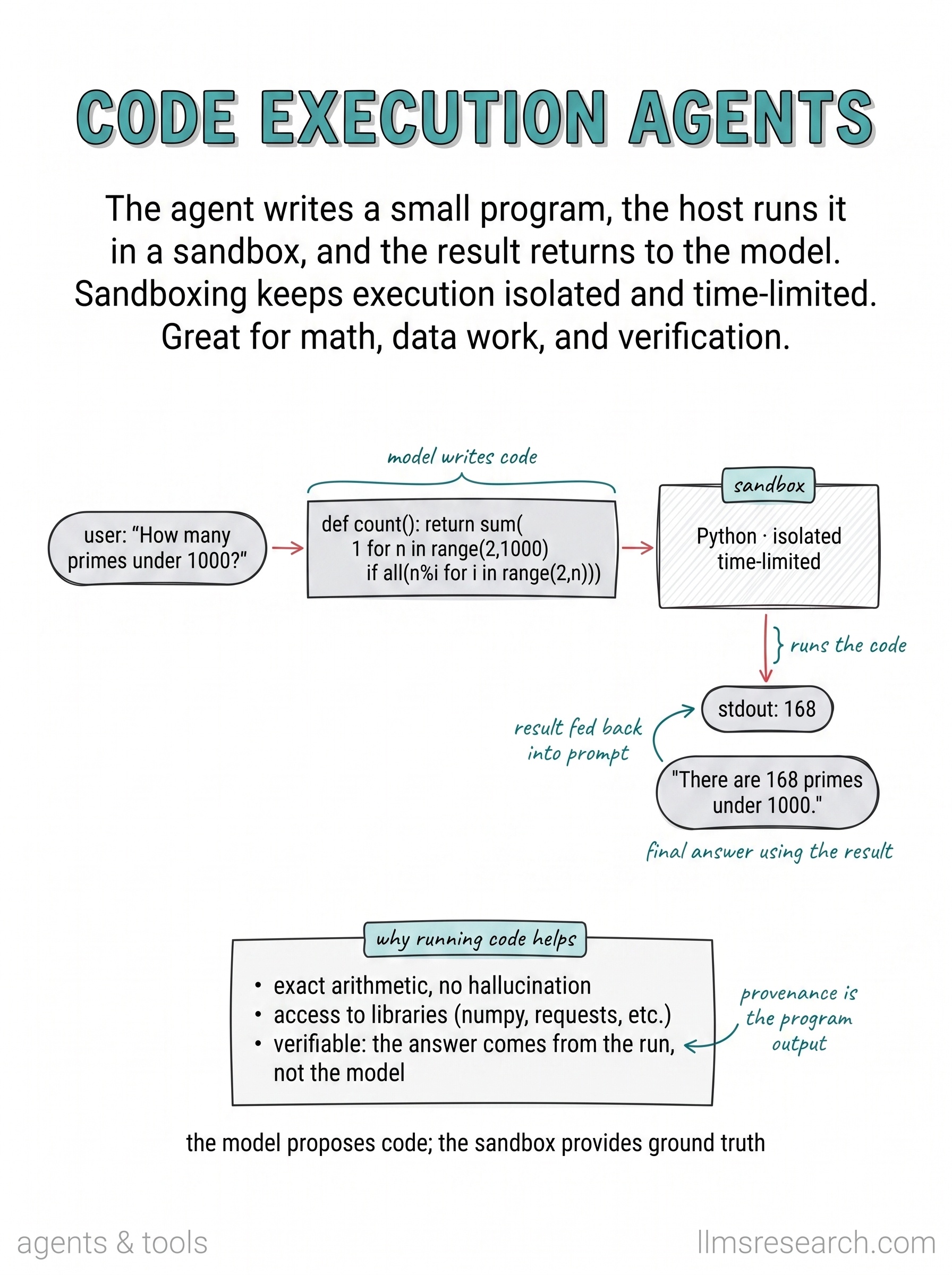
The card shows a tight loop: the agent drafts code, the runtime executes it inside a sandbox, and the result (output, exception, or exit code) returns to the model for the next edit. A short list on the card states why this beats relying on the LLM directly: exact arithmetic, deterministic data processing, and the ability to call libraries the model cannot simulate reliably in text.
Code execution is a specialized form of tool use. Instead of calling a fixed function with JSON arguments, the model produces a full program or script. The sandbox runs that code with restricted permissions: limited filesystem access, no or filtered network, timeouts, and memory caps. The agent sees real stderr and stack traces, which are often more actionable than a vague “something went wrong” in plain language.
The pattern fits tasks where the answer is computed rather than recalled. Aggregating a CSV, plotting a chart, parsing a log file, or probing an API with precise parameters are cases where hallucinated numbers or invented function names fail immediately. The model supplies intent and structure; the interpreter supplies correctness. Iteration handles bugs the same way a human developer would: read the error, patch the code, run again.
Safety notes are defensive and practical. Treat the sandbox as the only place untrusted code runs: isolate it from production credentials, sensitive files, and open network access unless a specific task requires otherwise. Cap runtime and output size so a runaway loop cannot exhaust resources. Log every execution for audit. Never execute model-generated code on the host machine without those walls. The model will sometimes propose dangerous calls; the sandbox and permission policy are what keep that from becoming incident response.