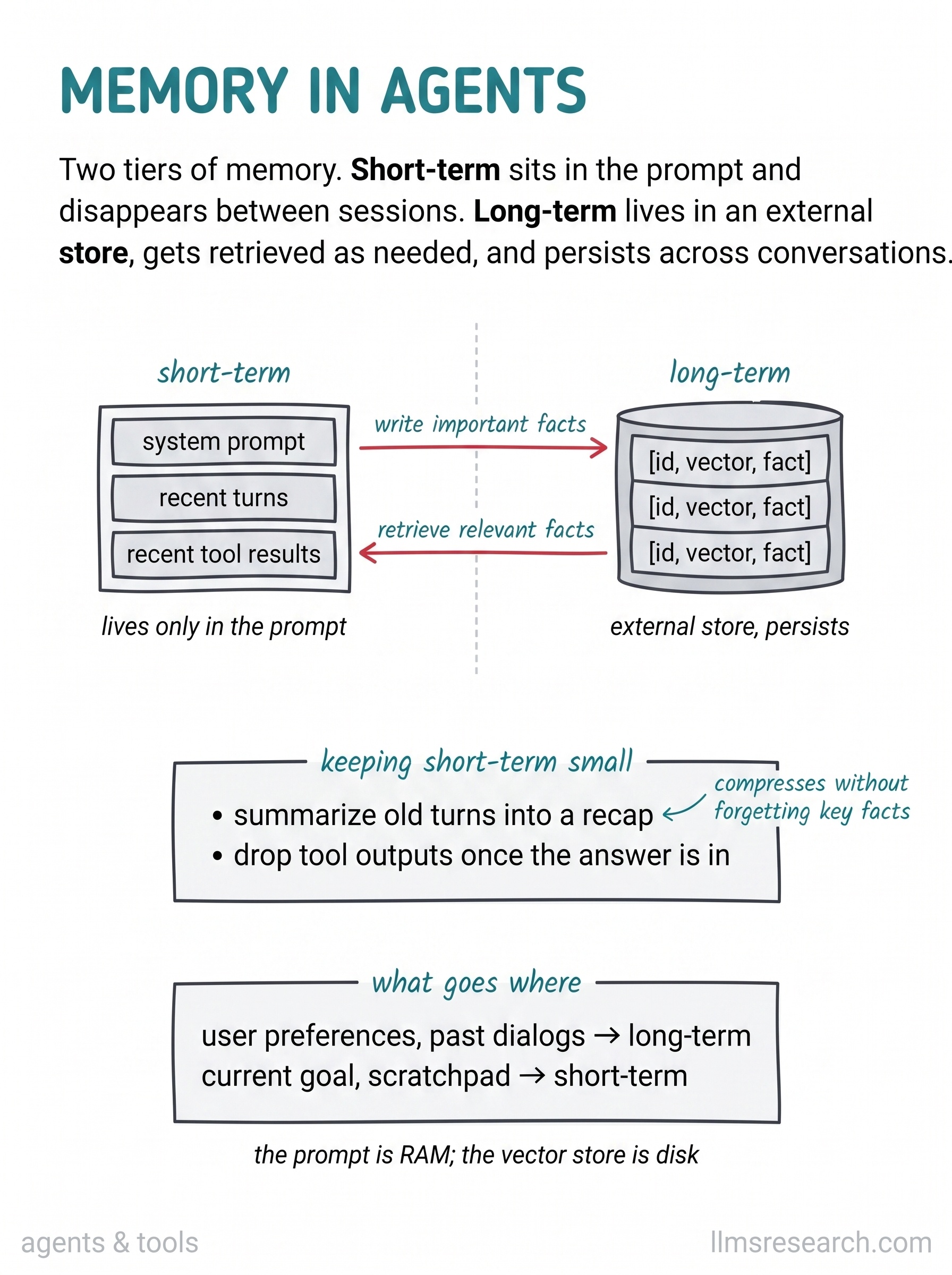
The card draws a two-tier diagram. Short-term memory is the context window itself: every message, tool result, and reflection the agent has accumulated in the current run. The model can attend to all of it, but only up to the window’s fixed size. Long-term memory sits outside the model, typically a vector store or database the agent queries and updates. Facts learned in one session can be written there and retrieved in the next, without fitting the entire history into a single prompt.
Short-term memory is working memory. It holds the plan, recent observations, and whatever the agent needs for the next decision. As a loop runs for dozens of steps, that buffer fills. Tool outputs are especially bulky: a long API response or file contents can crowd out earlier reasoning. The card notes summarization as one way to compress older turns into shorter digests, keeping recent detail while dropping verbatim text from early steps.
Long-term memory is episodic and semantic storage across runs. The agent can embed a note (“user prefers CSV exports”), store it, and later retrieve it when a similar task appears. Retrieval looks like RAG: embed the current query, pull the nearest stored entries, inject them into the prompt. Writes happen when the agent explicitly saves something or when the runtime checkpoints progress at the end of a session.
The design tension is freshness versus capacity. The context window is exact but limited; external memory scales but may retrieve the wrong entries or stale facts. Production agents usually combine both: keep the active task in full detail in short-term memory, offload stable preferences and reference material to long-term storage, and summarize aggressively when step counts climb. Memory is not a feature of the model; it is part of the orchestration you build around the loop.