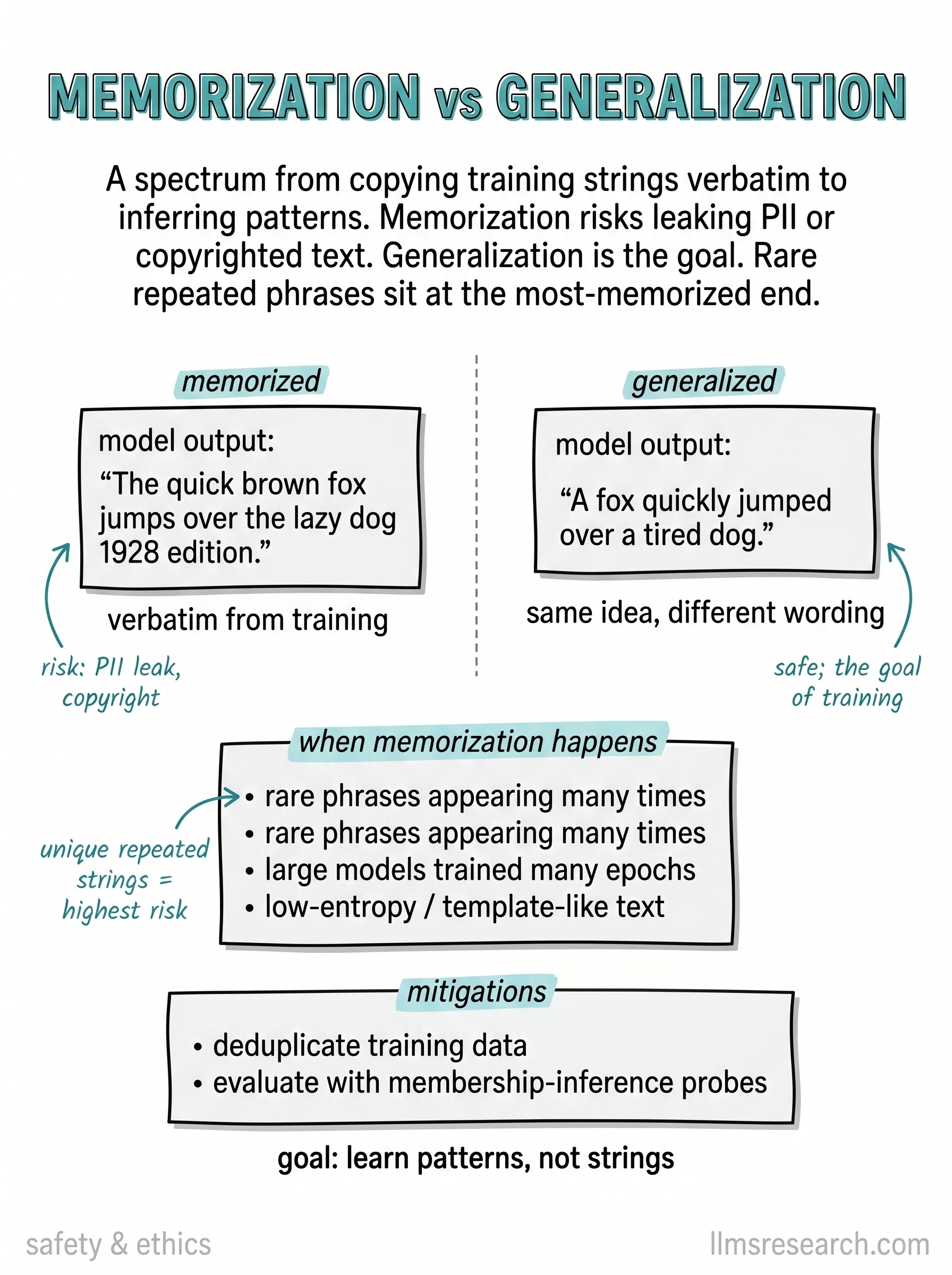
Language models are trained to predict text, but the training goal is not to store text. The card contrasts two outputs from the same underlying idea. On the memorized side, the model regurgitates a unique training quote verbatim, including a rare edition marker. On the generalized side, it paraphrases the same scene with different wording. One behavior copies strings; the other extracts a pattern.
Memorization sits on a spectrum, not a binary switch. The when box lists conditions that push toward copying. Rare phrases that appear many times in training are highest risk. Large models trained for many epochs retain more surface detail. Low-entropy template-like text, licenses, boilerplate, and repeated headers, is easy to echo. The annotation on the memorized panel names the deployment risk: PII leak and copyright exposure when verbatim spans leave the model.
Generalization is what pretraining is for. The model should compress regularities into weights so it can produce novel sentences that follow learned structure. Exact memorization wastes capacity and creates extractable copies of private or protected content. Membership-inference probes and extraction attacks test how far a model sits toward the memorized end on specific strings.
Mitigations are mostly upstream. Deduplicate training data so the same article does not appear ten times. Filter unique repeated strings that look like secrets or licensed prose. Evaluate with extraction prompts and loss-based membership tests after training. The card’s closing line is the design target: learn patterns, not strings. Benchmark contamination and data contamination cards cover related leakage paths; this card names the per-example behavior those problems enable.