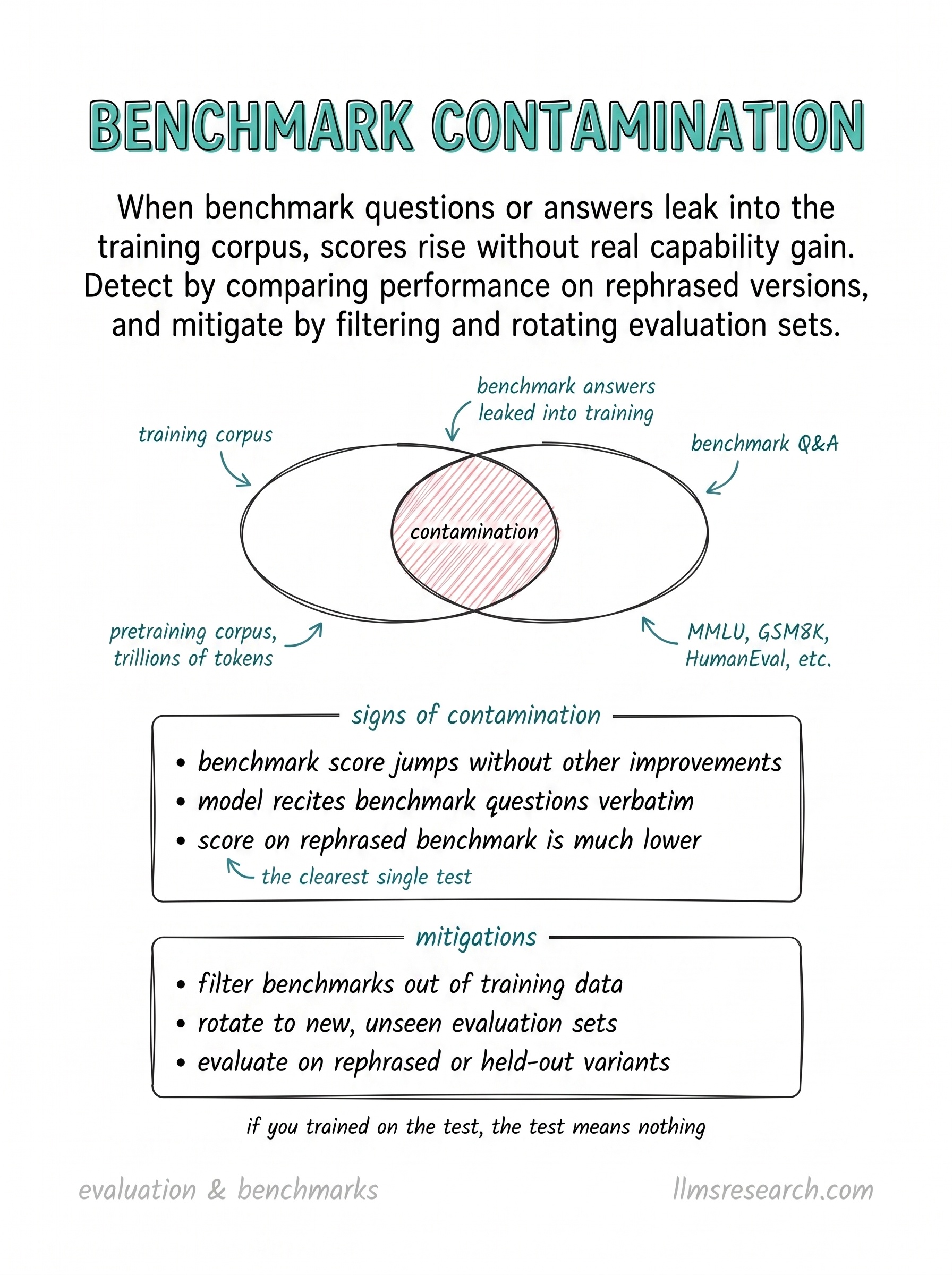
A benchmark only measures generalization if the model has not already seen the test. Benchmark contamination breaks that assumption. The card draws a Venn diagram. One oval is the pretraining corpus, trillions of tokens scraped from the web. The other is a benchmark Q&A set such as MMLU, GSM8K, or HumanEval. The overlap region is highlighted as contamination: benchmark answers that leaked into training.
When contamination happens, the model may not be solving the task. It may be recalling memorized question-answer pairs. Scores jump while behavior on nearby tasks stays flat. The signs box lists three tells. A benchmark score spikes without broader improvements. The model recites benchmark questions verbatim. Performance drops sharply on rephrased versions of the same items. That rephrase test is the clearest single check because it keeps the skill demand while breaking surface memorization.
Mitigation starts before training and continues after release. Filter known benchmark text out of pretraining corpora using exact and near-match detection. Rotate evaluation to new held-out sets that were not public during training. Report scores on rephrased or private variants alongside public leaderboard numbers. Teams increasingly treat contamination as a routine audit, not a rare scandal.
The card’s bottom line is strict: if you trained on the test, the test means nothing. Contamination is narrower than general data contamination, which also covers PII and copyrighted text, but the logic is the same. Evaluation only informs decisions when the train and test boundary holds. Treat suspicious score jumps as a prompt to run rephrase probes before trusting a headline number.